In Chinese Cuisine Masterclass, Willy Mark explains why ‘Chinese cuisine’ is as broad a description as ‘Western civilisation’
- Venerable Chinese cuisine food promoter covers four regional cuisines, with recipes from north to south, east to west
- Cantonese, Chiu Chow, Beijing, Sichuan and Shanghainese food cultures are all represented

William (as I know him) Mark Yiu-tong is venerated in the Hong Kong restaurant world. He’s now more than 80 years old, but for decades he was an active supporter and promoter of Chinese cuisine in Hong Kong, the mainland and abroad.
In the introduction to Chinese Cuisine Masterclass (1984), Mark writes that although Chinese food is found throughout the world, it’s often underappreciated or misunderstood. “‘Food and love of beauty are in our natures.’ Such a Chinese proverb might be found in a fortune cookie for there are truly hundreds of Chinese proverbs about food. In a real Chinese restaurant, of course, you would never find a fortune cookie. That abomination of modern marketing techniques is a commercial triumph of the overseas Chinese, just like chop-suey[...] has [nothing] to do with the reality of ancient Chinese cuisine.
“Chinese cuisine can be a daunting phrase. It is as comprehensive and overwhelming as any label that is attached to a massive portion of mankind’s cultural history. ‘Chinese cuisine’ is as broad a description as ‘Western civilisation’. No one volume could claim to teach a student the whole of Western civilisation in a couple of hundred illustrated pages, and this book cannot hope to cover the whole of Chinese cuisine. We can give only a sample, some hints and enough recipes to allow the reader to make a culinary voyage of discovery.”
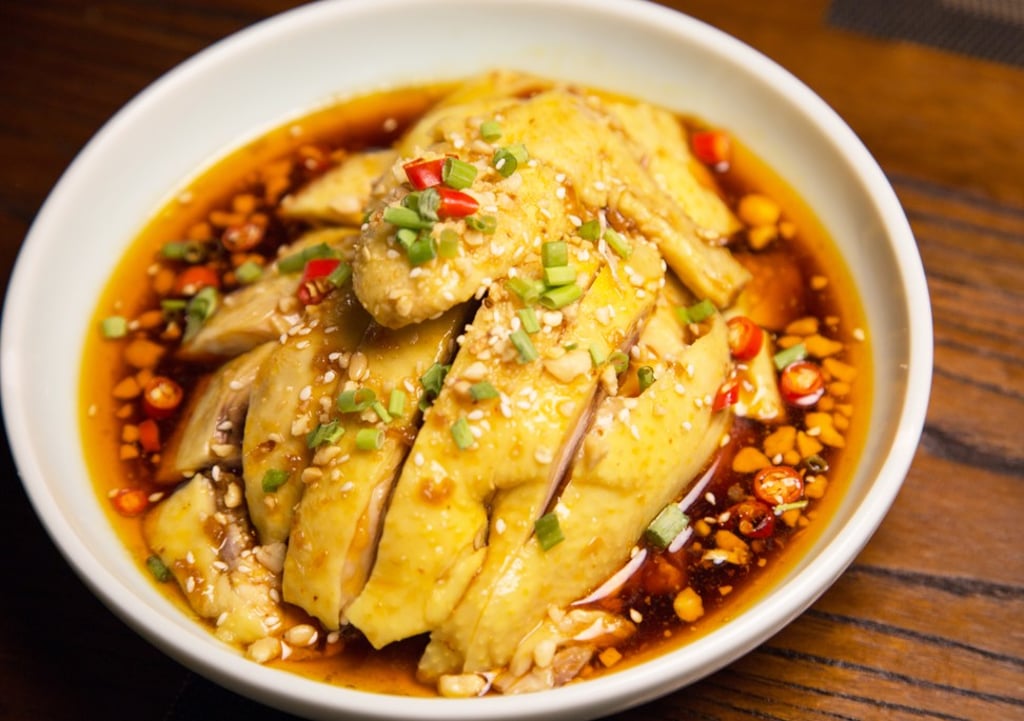
From the southern school (by far the most extensive chapter), Mark gives recipes for dishes of pan-fried egg dumpling with minced pork and shrimp; deep-fried shrimp balls with sweet-and-sour sauce; abalone, chicken and duck wrapped in lettuce leaves; shrimp, ham and melon rolls; crab with fermented beans and peppers; roast goose; fried crispy pigeon; and braised e-fu noodles with shredded pork and mushrooms.