-
Advertisement
PostMag
Life.Culture.Discovery.
History
MagazinesPostMag

Why China’s record in honouring historical agreements smacks of cherry-picking

How could China dismiss the 1984 Joint Declaration as meaningless, yet days later cite an 1890 treaty signed with Britain in support of a territorial claim in the Himalayas? It’s all about convenience

Reading Time:8 minutes
Why you can trust SCMP
British prime minister Margaret Thatcher (seated left) and Chinese premier Zhao Ziyang (seated right) sign the Sino-British Joint Declaration, on Hong Kong in Beijing, in December 1984. Picture: Xinhua
Peter Neville-Hadley

“History is the best text­book” is a mantra of the Xi Jinping era, often on the Chinese president’s lips and frequently repeated by state media. So it was surprising when Foreign Ministry spokesman Lu Kang recently suggested that history might be ignored, or had an expiry date.
Speaking at a press conference on June 30, Lu described the Sino-British Joint Declaration of 1984, which set out the policies for governance of Hong Kong for 50 years from 1997, as “a historical document [that] no longer has any realistic meaning”, adding: “It also does not have any binding power on how the Chinese central government administers Hong Kong.”
Yet just four days later, another Foreign Ministry spokesman, Geng Shuang, insisted that a far older Sino-British agreement was as binding as ever. In China’s current territorial dispute with Bhutan over the Doklam region, the Convention between Great Britain and China Relating to Sikkim and Tibet of 1890 was to continue to define the border between those two.
Advertisement

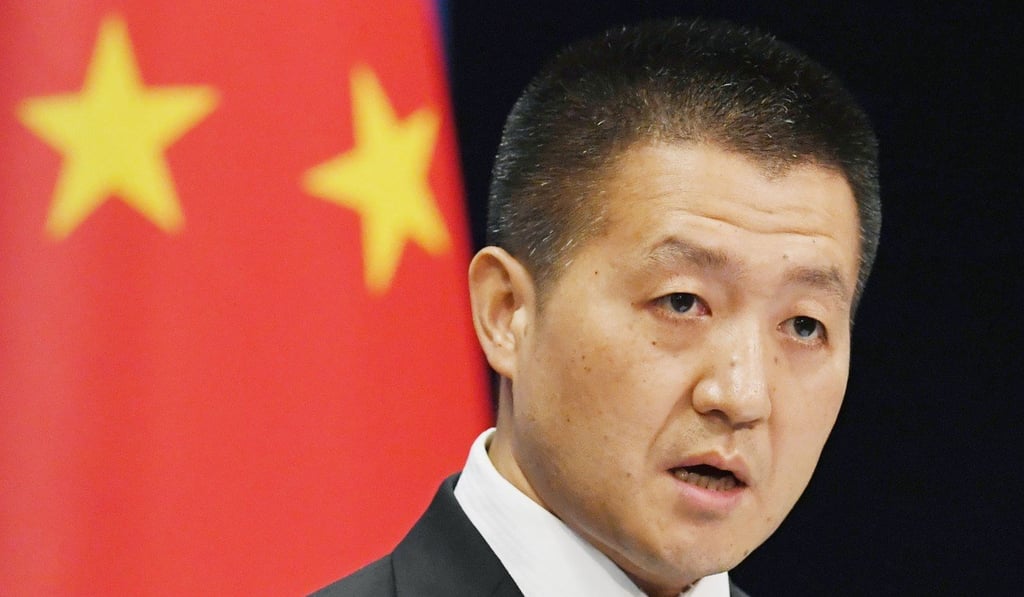
Chinese Foreign Ministry spokesman Lu Kang. Picture: Kyodo
On July 8, Xu Hong, director general of the foreign ministry’s treaty and law department, did concede, in clarifying Lu’s remarks, that the Sino-British Joint Declaration was still legally binding, without managing to dispel the impression that history can sometimes be less a matter of textbooks and more a matter of convenience, as the history of Chinese international treaties itself seems to demonstrate.
Advertisement

China’s first international treaty with a foreign power was 1689’s Treaty of Nerchinsk. This set out the Qing empire’s border with an expanding Russian empire, allowed for a Russian settlement in Beijing with the aim of training interpreters, and agreed on certain formal trading relations that handed Russia a near-monopoly in the trans­port of Chinese rhubarb root, then highly valued in Europe as a panacea.

Advertisement
Select Voice
Choose your listening speed
Get through articles 2x faster
1.25x
250 WPM
Slow
Average
Fast
1.25x