Sustainable tourism key to Malaysian marine park’s ambitious plans
Alternative livelihoods for fishermen essential to survival of threatened turtles, dugongs and whale sharks off Sabah

The boat docks at a rickety pier and our guide leaps over the side to begin up a steep path cutting through tropical jungle. It is approaching midday and, shielded from the cooling sea breeze, the air is becoming thick and heavy. Ahead, our escort of M16-wielding soldiers (a formality, I’ve been told) clambers up the slippery slope while trying to maintain discipline.
A crevice marks the entrance to the cave, which has special importance for the locals, Muslims who also hold pagan beliefs. Our guide sternly warns us not to disturb anything within – and he has good reason.
Nearly two years ago to the day, two Spanish tourists were taken to this cave at the end of a tour of the island. On their return to the mainland, a wave overturned their speedboat, flooding the engine. They drifted for 10 days. Starving and parched, they survived on the flying fish that landed in their boat and from the condensation droplets formed in the early dawn.
Eventually found in a state close to death, the tourists admitted to having stolen a rock adorned with crystal from the cave. Villagers believe they were punished accordingly.
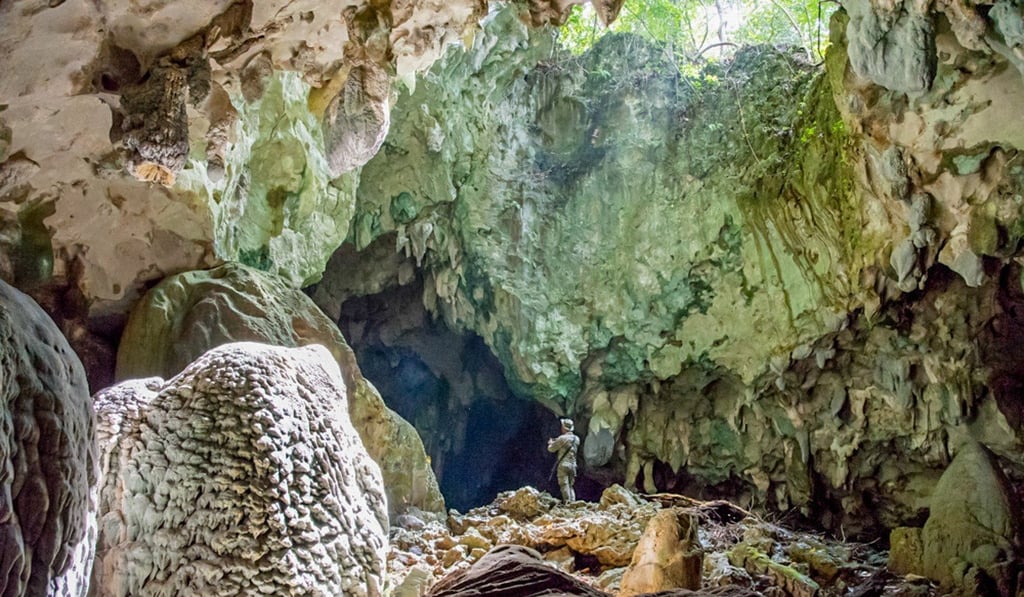
We are being shown the sights of Balambangan, one of a small cluster of islands off the northern coast of Sabah, in Malaysian Borneo. We slip into the darkness and soon a spectacular cavern is revealed, illuminated by sunlight that penetrates through a collapsed section of roof. A low screech grows to a din as thousands of black bodies – a colony of wrinkle-lipped bats – take flight at our approach.
The cave appears familiar, but it takes some weaving through the shimmering stalactites and stalagmites before the reason dawns: it is almost identical to Thailand’s celebrated (and popular with visitors) Phraya Nakhon Cave – but here, we are completely alone.