Home of Hong Kong heritage: the ‘pink house’ on The Peak is steeped in history, but faces an uncertain future
Having changed hands last year, what lies next for the house at 5 Pollock’s Path, which was home to the Brown family for more than 50 years and is overflowing with history, is not clear

In The Honourable Schoolboy, by John le Carré, published in 1977 and still one of the best novels set in Hong Kong, Old Craw needs somewhere discreet to spend a night. Old Craw is an Australian journalist working for British intelligence. David Cornwell – Le Carré’s real name – based him on Richard Hughes, Australian journalist, possible spy, stalwart of the Foreign Correspondents’ Club and author of another Hong Kong classic, Borrowed Place, Borrowed Time – Hong Kong and its Many Faces, published in 1968.
Murkiness is afoot in the colony so Old Craw does not head home. He had friends, an American lawyer and his wife, who owned one of Hong Kong’s 200-odd private houses, an elderly rambling place on Pollock’s Path, high up on The Peak, and they had given him a key. A consular car was parked in the driveway but Craw’s friends were known for their addiction to the diplomatic whirl.
That house and its owners were also based on real-life subjects. Cornwell had stayed in it, sleeping on a Chinese day bed in the study. It belonged to Charles and Rosamond Brown. Charles, who died in 2012, was American but an architect, not a lawyer. Rosamond is British and an artist, and until last month, 5 Pollock’s Path had been her Hong Kong home for more than 50 years.
It was true about the social whirl. The parties, however, were not obliged to be diplomatic. (That was left to the French consul general, who moved into 8 Pollock’s Path in 1981.) A governor could, occasionally, be seen at the Browns’ gatherings but the flavour of the crowd was usually creative – artists, architects, journalists – and seasoned with lively lawyers.
Hughes came, of course, although he never actually spent the night. At evening’s end, with the help of other merrymakers, he was often manoeuvred back up the 56 steps that led to the road. Departing guests passed a structure where sedan-chair carriers (“coolies” was the non-politically correct term) had rested from the exertions of carrying their human burdens up and down The Peak. The Browns created their driveway from one of those old paths that ran through their garden.
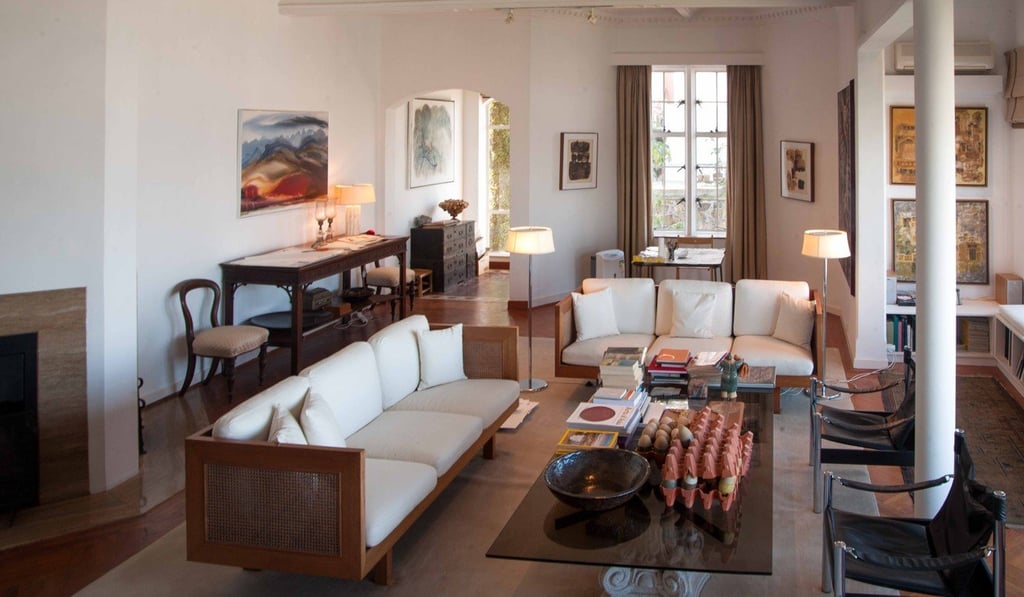
In 1966, when they had first seen it, that garden had been waist-high in weeds. They had thought the house was a ruin: not a light shone at night and the windows stood open to The Peak’s particular climate. They had been in Hong Kong a couple of years already and were living in a place on Plantation Road owned by a Shanghainese man called Jimmy Lee, who liked to wear spats when he dined at the newly built Mandarin Hotel and drove around town in a Rolls-Royce that was too big for his garage. It was this garage the Browns were renting.