California’s succulent smugglers: plant poachers seed Asia’s desire for dudleya
The current craze for hardy succulents, which started in South Korea and spread to China, has resulted in organised gangs stripping the US state of a plant crucial to its fragile coastal ecosystem

Last December, Patrick Freeling, a game warden with the California Department of Fish and Wildlife (CDFW), was in his office in Mendocino County when his phone rang. No one back then, not the anonymous caller and certainly not Freeling, could have imagined the events that phone call would set in motion: not the arrests, the court cases, the undercover agents pressed into service prowling California’s coastline. In less than six months, international poaching rings stretching to South Korea and China would be exposed – operations that, prior to that phone call, no one knew existed.
The woman on the phone had been annoyed. Earlier that day, while visiting the post office, she had found herself stuck in line behind a man sending 60 packages to China. As curious as she was peeved by the inconvenience, she asked what he was shipping so much of. He raised a finger to his lips with a conspiratorial “Shhhhh!” and said it was something “very valuable”. When she asked where he got the items, the man pointed towards the sea.
Being from Mendocino, the woman knew she should be on the lookout for poachers. Illegal divers, pilfering abalone for sale in Asia, had become a scourge up and down the coast. And she knew exactly what to do. She called the CDFW.
Had somebody else picked up the phone, the story would likely have ended there, but she got through to Freeling, a dogged investigator and passionate conservationist. Although poachers were not in the habit of sending shellfish in unrefrigerated boxes through the post, Freeling contacted United States Customs and Border Protection, who seized and X-rayed the boxes. What they discovered confounded everyone.
The boxes were packed with dudleya, plucky little succulent plants common to Northern California’s coastal cliffs. Each had been carefully wrapped for replanting. dudleya poaching was not unheard of in 2017. A tractor-trailer had been discovered in Baja California, Mexico, filled with 4,746 plants. But those were dudleya of an especially rare variety, found only on one small island.
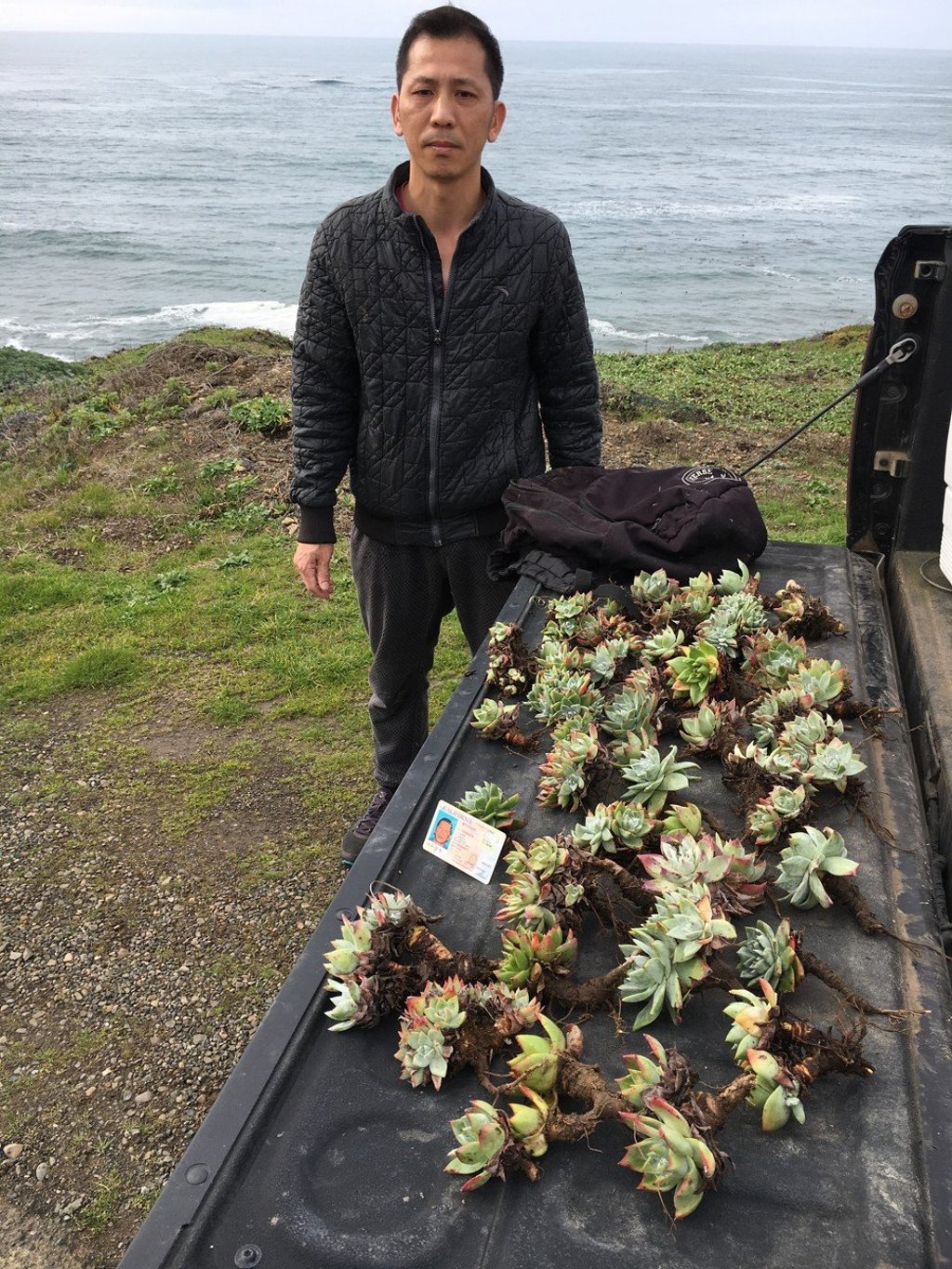
No bigger than a baseball, the dudleya in Mendocino were relatively common, not just in nature but in nurseries, where they grow easily. Who would need 60 boxes of dudleya? What were they for?