China’s Green Great Wall is on the front line of its fight against desertification, but is it sustainable?
•In an excerpt from his book, The World In a Grain: The Story of Sand and How it Transformed Civilisation, Vince Beiser questions whether the ‘greening’ of China’s deserts is environmentally viable
•Evidence suggests some tree-planting initiatives more interested in quick profit than the environment

From the top of a certain windblown hill in Duolun county, in China’s Inner Mongolia province, the view could be described as either profoundly inspiring or deeply strange. For miles around, the terrain is dun-coloured, dry, sandy desert stubbled with yellow grass. But the cluster of hillsides closest to the one I found myself standing on in the spring of 2016 were emblazoned with enormous, carefully configured swatches of green trees.
They were planted to form geometric shapes: a square, a hollow-centred circle, a set of overlapping triangles. The flatland below them was striped with ruler-straight bands of young pine trees, all the same height, standing in formation like soldiers ready for battle.
Zuo Hongfei, the cheery deputy director of the local “greening office” of China’s State Forestry Administration (SFA), eagerly pointed to an 80-foot-long display showing how barren this part of Duolun county was just 15 years ago, before a massive greening campaign installed millions of trees across the land. Photos and satellite images show it was largely desert, dotted here and there with spindly trees and shrubs. “See?” said Zuo, pointing out a picture of an old man and a young girl in front of a low dwelling half swamped by dunes. “The houses were almost buried by sand!” [...]
The sand lands that cover about 18 per cent of China have expanded rapidly. By 2006, they were devouring usable land at a rate of almost 1,000 square miles per year [...] up from 600 square miles per year in the 1950s.
That’s a problem not only for the people living in those areas, but also for the many millions more who live close enough to deserts to be affected by the movements of sand. Migrating dunes threaten farm fields and even whole villages. Stretches of roads and railways are constantly shut down by blown sand. Sandstorms regularly blow tens of thousands of tonnes of sand and dust into Beijing and other cities, snarling traffic and creating a vicious health hazard. The World Bank has estimated that desertification costs the Chinese economy some US$31 billion per year.
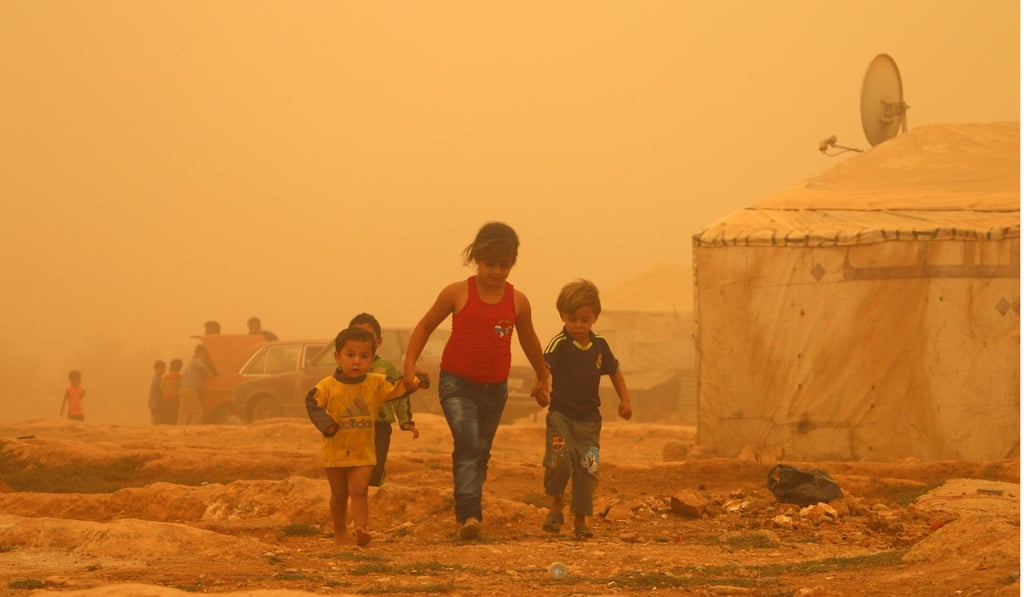
This is an issue that goes far beyond China. According to the United Nations, desertification directly affects 250 million people worldwide, including in parts of the United States. Sand is slowly burying the once-flourishing Malian town of Araouane, on the edge of the Sahara desert. In 2015, a massive sandstorm blanketed Lebanon and Syria, killing 12 people and sending hundreds to hospitals with respiratory problems. And particles from dust storms in China have clouded the air as far away as Colorado.