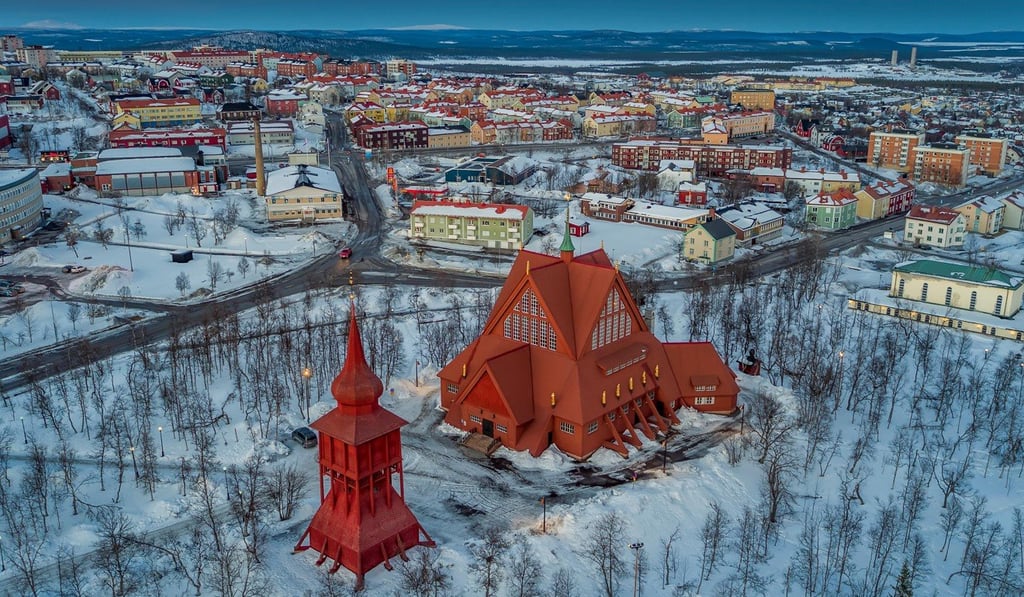
Kiruna, Sweden: the mining town that is moving east at a cost of more than US$1 billion
- Located in Swedish Lapland, the country’s northernmost – and youngest – city is shifting its centre 3km, as the iron ore industry undermines the ground it was originally built on

Even the 2pm setting sun, suffusing frigid Lapland below and ruddy clouds above with coppery good cheer, can’t outshine it. From thousands of feet up it flashes like a lighthouse and dominates the land. Lower, and the airport approach seems routed to show off its rotund magnificence. It’s so big a deal that the King of Sweden, Carl XVI Gustaf, has come all the way to the Arctic to open it.
Kiruna may have that sinking feeling – as what sounds like a disaster movie unfolds beneath its feet – but its shimmering new City Hall is a chest-beating expression of civic pride. It’s not going anywhere, it proclaims, least of all down.
That’s because it’s been parked a safe distance from all the subterranean action going on in other districts. Kiruna exists because of its iron ore mine; but now (more disaster-horror movie overtones) the mine is eating its own creation.
Kiruna, 145km north of the Arctic Circle, has a problem. Gravity inconveniently has it that, if you cut out enough buried material, whatever was above it will eventually fall down. Sweden’s northernmost city sits atop a magnetite iron ore seam slicing below it at an angle of about 60 degrees. What state-owned mining company Luossavaara-Kiirunavaara Aktiebolag (mercifully referred to as LKAB) likes euphemistically to call a “deformation area” has appeared where two-thirds of the city lake, drained a few years ago, used to sit; fissures are showing and the worry is that as they meander farther from the mine the city will collapse into any number of sinkholes.
Closing the pit isn’t an option: “the world’s biggest and most modern underground iron ore mine”, according to a company spokesman, it is also Kiruna’s largest employer, directly providing work for 1,800 of the city’s 18,000 residents. And its ore, 26 million tonnes of which is produced annually, is the world’s purest.