Los Angeles and Hong Kong offer opposing urban models, but architects in both cities face the same issues
At the ‘Island_Peninsula’ exhibition in LA, Hong Kong architects presented creative designs for high-density living, addressing affordability, spatial limitations and how to foster a sense of community – problems increasingly seen on the other side of the Pacific Ocean

Hemmed in by abrupt mountain inclines and the deep waters of its legendary harbour, Hong Kong’s skyline is notorious for stacking people and public services on top of one another, the most vertical city in the world, rising ever higher to make contact with the clouds. Thousands of kilometres across the Pacific Ocean, in California, Los Angeles occupies the opposite end of the urban spectrum, with its limitless sprawl of single-family homes beneath an endless sky.
These metropolises seem antithetical. But an upcoming exhibition organised by the Hong Kong Institute of Architects draws some intriguing parallels between the two and showcases how creative design can solve similar problems faced by these opposite urbanities.
“Through working on this exhibition, I came to the conclusion that Hong Kong and Los Angeles have a lot of similarities,” says Mehran Ayati, international curator of the “Island_Peninsula” exhibition and founder of MehranStudio, an LA-based architecture practice. “In addition to being ports that operate as economic and cultural gateways for their respective regions, both cities face uncertain futures.”
Presenting potential solutions to these uncertainties, the exhibition’s first iteration in LA last year comprised 16 exhibits by architects living and working in Hong Kong. Organised around four characteristics central to building design in Hong Kong – glamour, efficiency, orderliness and constant change – each installation responded to the specified themes through conceptual models, such as a miniature bamboo theatre that illustrates the beauty of Hong Kong’s traditional scaffolding techniques, and replicas of high-density housing models that show how architects have responded to spatial limitations.
That LA played host to such a Hong Kong-specific showcase was testament to the ways that architecture can transcend place; the Southern California city is densifying and might one day have to reckon with issues already familiar in Hong Kong.
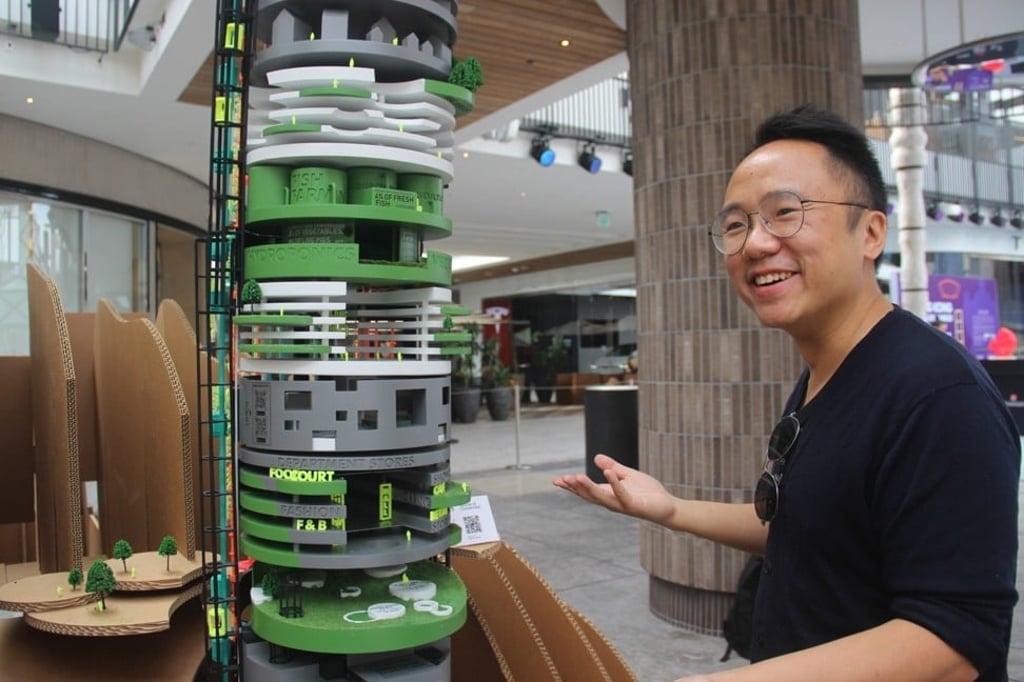
For Eric Ho Lick-fai, whose “Island of Condensed” was one of the most radical exhibits at the LA exhibition, Hong Kong’s housing market encourages boundary-pushing designs.