China has positioned itself as a leader in the fight against climate change, but is it really prepared for the role?
Following the United States’ withdrawal from the Paris Agreement, China, the world’s second-largest economy, was expected to take the environmental lead
As the deadlock at the recent COP25 conference shows, Beijing has other plans
Infernos have burned through the Amazon and much of Australia. Island nations from Vanuatu to the Virgin Islands are inhaling as deeply as possible before disappearing under a rising sea.Climate breakdown is proving to be every bit as dramatic as Al Gore was when he stood on a crane beside his stage-sized chart in order to keep up with the rising temperature line flying off the graph, in An Inconvenient Truth (2006).
Neither that documentary film nor the former United States vice-president’s 2017 sequel got everything right but some of Gore’s grimmest warnings have come to pass in the intervening 14 years. The US, the world’s largest economy, and the fossil-fuel industry have an obvious interest in seeing business continue as usual but the tension between those demanding drastic measures to mitigate climate collapse and those fighting to protect the status quo is, in some ways, working to the advantage of the second-largest economy.
China remains – by far – the biggest emitter of carbon dioxide, with total emissions in 2018 standing at about 14 gigatonnes, according to United Nations statistics. That’s more than twice those of the US, although China’s per-capita emissions roughly match those of Japan and the European Union.
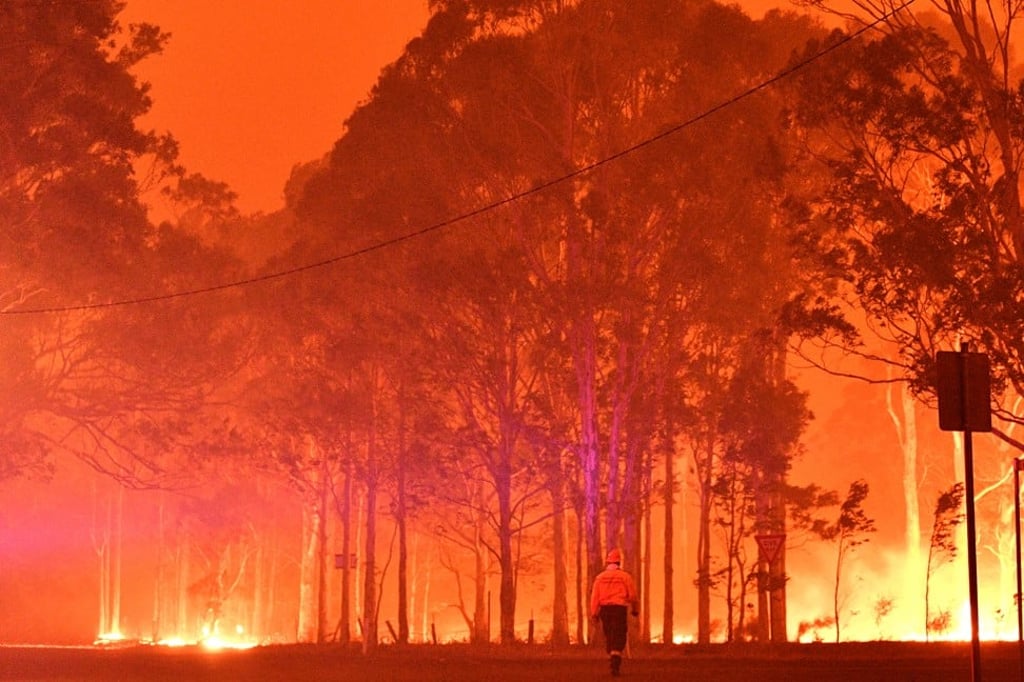
A firefighter surveys a bush fire around the town of Nowra, in the Australian state of New South Wales, on December 31, 2019. Photo: AFP
Advertisement
While many countries have been phasing out the use of coal, China increased its capacity for the emission-intense fossil fuel by 42.9 gigawatts in the 18 months to June 2019. This rendered the 8.1GW reduction made by the rest of the world in the same period almost irrelevant. Furthermore, under the geopolitical Belt and Road Initiative, China plans to finance a quarter of all new coal projects in the rest of the world, including plants in South Africa, Pakistan and Bangladesh.
And so in December, at the UN’s most recent round of climate talks, COP25 – hastily rearranged in the Spanish capital, after the Chilean government deemed the original venue, protest-wracked Santiago, too risky a proposition – the Beijing delegation rolled into the Feria de Madrid conference complex with conflicting priorities. China had to at least appear to be embracing measures to tackle climate change but any new plans that could work against the interests of the politically influential domestic coal industry had to be stalled.