For centuries, war and opium have been entwined in Asia – sometimes assisted by the US
In an excerpt from the book Killer High, author Peter Andreas lays out how the opium poppy has been funding political parties and conflict for generations, often with the CIA’s tacit approval

By the early 1930s, China was estimated to be the source of seven eighths of the world’s narcotics supply, which reached international markets via Hong Kong, Macau and Shanghai. British journalist H.G.W. Woodhead described the situation in a detailed investigation: “In general it may be stated that throughout China today with the exception of isolated instances, no effort is or can be made by the National Government to control the sale or smoking of opium. It can be purchased without difficulty, in practically every town and village of any size throughout the country. And the traffic is controlled by the military and big opium rings.”
The government also illicitly exported narcotics to the United States and elsewhere to generate foreign exchange to pay for military supplies, including major aircraft purchases. Chiang Kai-shek and the Kuomintang used opium suppression as a tool to attack rivals, especially targeting areas of communist activity. In June 1934, Chiang announced the Six Year Opium Suppression Plan, with the stated aim of total eradication of the drug within six years. The new military-enforced prohibition policy included the execution of thousands of drug offenders.
The Six-Year Plan was a means to ensure that the government would exercise complete control over the opium economy while simultaneously depriving regional political rivals in the southwest of opium funds. The Japanese occupation of Shanghai, in August 1937, diminished but did not end Kuomintang influence over the opium trade, and its alliance with the criminal underworld remained as strong as ever.
Having used opium to help finance their revolution, after taking power on October 1, 1949, Mao Zedong’s triumphant communists quickly moved to eradicate it. On February 24, 1950, the new government issued its General Order for Opium Suppression, which begins: It has been more than a century since opium was forcibly imported into China by the imperialists. Due to the reactionary rule and the decadent lifestyle of the feudal bureaucrats, compradors and warlords, not only was opium not suppressed, but we were forced to cultivate it; especially due to the Japanese systematically carrying out a plot to poison China during their aggression, countless people’s lives and property have been lost. Now that the people have been liberated, the following methods of opium and other narcotic suppression are specifically stipulated to protect people’s health, to cure addiction, and to accelerate production.
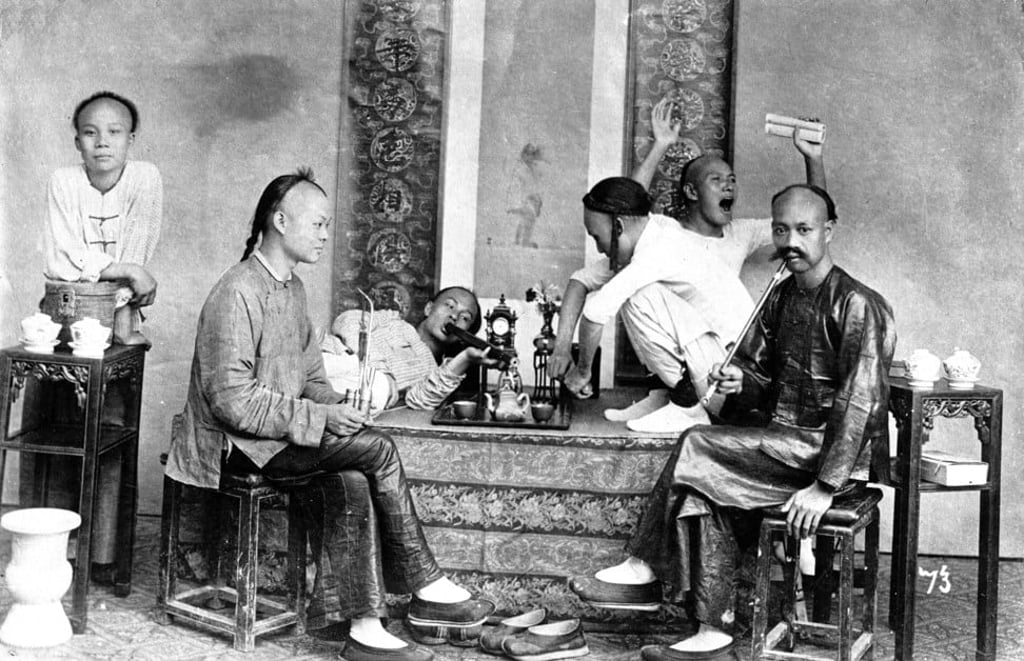
Chinese anti-drug rhetoric was wrapped up in the larger revolutionary cause – to be against opium was to be against foreign imperialism and capitalist decadence. The post-revolution movement targeting “capitalist vices” included rounding up and executing thousands of drug dealers and forcing addicts to choose between treatment or imprisonment. In 1952 alone, the crackdown generated 82,000 arrests, 35,000 prison sentences and 880 public executions. The Central Committee told local authorities that “it is easier to get people’s sympathy by killing drug offenders than killing counter-revolutionaries. So at least 2 per cent of those arrested should be killed”.
By 1953, China’s post-revolution exit from the opium trade prompted a fundamental reconfiguration of the political economy of narcotics in the region. Major traffickers, including the Shanghai underworld leadership, fled the country, with many of them relocating to Hong Kong – master chemists who would turn the colony into the world’s leading high-grade heroin laboratory.