Indigenous and Asian slaves were the lifeblood of Western Australia’s early pearl industry
The pearl fishing industry in Broome, Western Australia, boomed on the backs and blood of slaves plucked from Indigenous communities and, later, Asia, with many risking, and losing, their lives to enrich their white masters

“Aalingoon came into the bay and lives beneath the sea,” wrote late Indigenous pearl shell carver Aubrey Tigan Galiwa, quoted in Lustre, a 2018 book about the Australian pearling industry.
“He comes out every full moon, when it’s a big tide. As he floats on his back, as he drifts, the scales fall off his back, and turn into goowarn [pearl shells] as they drift down to the seabed below. The tides come in and chuck them everywhere, on the reefs, all around the islands. This way he always gives us more shells. This is a power. This is part of our ceremony.”
In the state of Western Australia, pearls are not just beautiful commodities formed by Pinctada oysters. For Indigenous Australians, they are a gift from the rainbow serpent who controls water and rain, deposited across King Sound inlet just east of Broome, an area about five times larger than Hong Kong Island.
For more than 20 millennia, Indigenous people in this region have harvested Pinctada pearl shells, the oldest evidence of their trade being a fragment of a 22,000-year-old shell discovered in the state some 200km from the coastline.
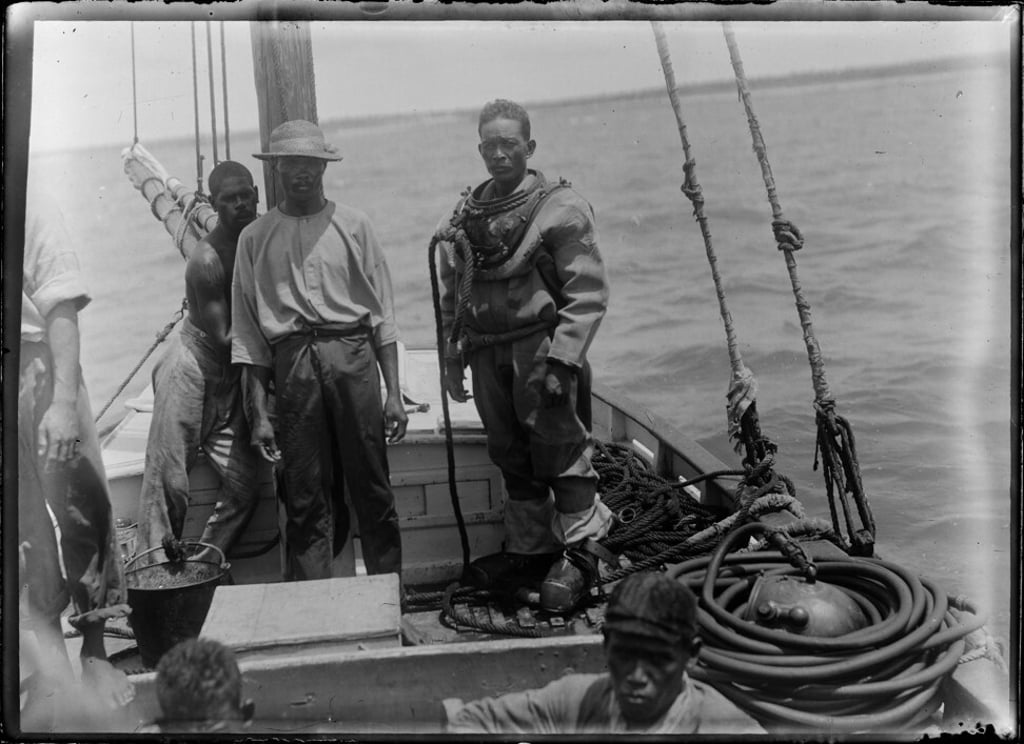
The first pearls to arrive in the Western world were sold widely in the Roman Empire. At that time, these gemstones had already been used in China as luxurious gifts for at least 2,000 years. When Europeans and white Australians learned of Broome’s pearl riches in the mid-1800s, the town became inundated by money-hungry explorers, who used and abused pearl divers. Poorly cared for and paid a pittance, these workers were exploited for decades.
When in 1871 a Western Australian law was introduced to offer some protection to Indigenous workers, pearling bosses chose to look for new divers from China, Japan, Malaysia and the Philippines. By 1910, Western Australia was the world’s biggest pearl producer and, amid the scramble for wealth, pearling bosses flouted state laws, subjecting Indigenous and Asian divers to atrocious working conditions.