
- China’s rise to the top of global chess rankings is no happy accident but the result of its decades-old Four Steps plan, dedication, and help from neighbours
There are 32 seconds left on the clock for Russia’s Ian Nepomniachtchi, and he is scrambling to secure the victory he was denied in his last attempt at the International Chess Federation (Fide) world championship, in 2021.
His opponent, China’s Ding Liren, has an advantage in time and in pieces on the board, and one move could mean the end for Nepomniachtchi, who has dominated most of this year’s final, on April 30, in Astana, Kazakhstan.
As the fourth and final 10-minute tiebreaker begins, most of those watching think it will result in a draw, which will then lead to a series of one-minute bullet games. But moving his rook to G6 to threaten Nepomniachtchi’s queen, Ding pushes for a risky win.
Black pawn to A2 is Nepomniachtchi’s answer as he sits up straight and takes a breath. He looks to the side, stretches out his arm and scatters the neatly lined up pieces he has taken over the course of the match. A black knight rolls and falls to the floor. He knows he is beaten.
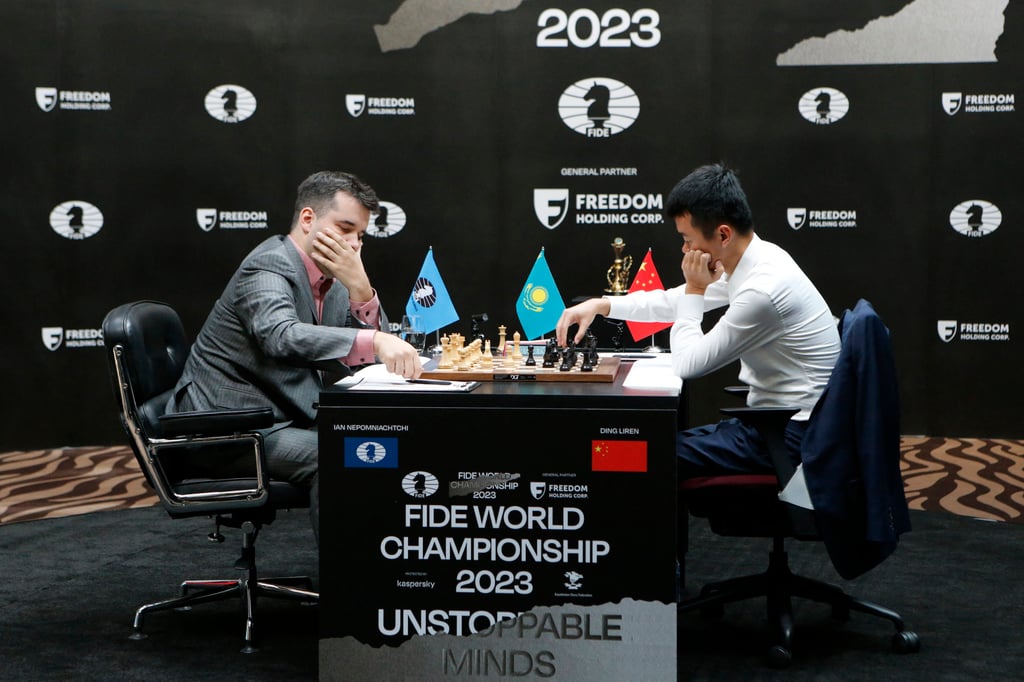
Ding makes a final move with his bishop, and – checkmate – Nepomniachtchi wastes no time extending his hand to give Ding a congratulatory shake.
Ding, dumbfounded at the results, sits with his head in his hand for almost a minute as his counterpart leaves the hall. Finally – after the decades it took to get here – Ding stands and walks out the same way, his first moments as the new men’s chess world champion, and the first one to represent China.

Ding became China’s 30th grandmaster in 2009, at 16 years old. That same year, he decided to try for a professional career in chess.
He was named the Chinese Chess Champion in 2009, 2011 and 2012, beating all other players in the annual individual national championships, and has represented his homeland in the Olympiad from 2012 to 2018. He led the Chinese team to victory in the Asian Team Chess Championship in 2014 in Tabriz, Iran.
“The best part of me is persistence,” says 30-year-old Ding at a May 18 press conference at the Chinese Chess Academy in Beijing.
The importance of Ding’s success and of China’s Four Steps strategy in elevating the country in the world’s chess rankings cannot be underestimated. “The significance goes beyond chess itself,” says Zhu Guoping, dean of the Chinese Chess Academy. “This will make the world look at Chinese chess, and Chinese people, differently.”
Chen Zude, who served as the first president of the Chinese Chess Association (CCA) from 1992, defined these Four Steps, which were to win the women’s individual world championship, then the women’s team world championship, followed by the men’s team world championship and the men’s individual world championship.

China’s Xie Jun won the women’s individual championship in 1991, holding the title until 1996, and regaining the crown from 1999 to 2001. Xie was integral in securing the gold medal for the Chinese women’s team in the 1998 Chess Olympiad in Elista, Kalmykia, Russia.
In 2007, when Fide officially created a separate world team championship for women, China took the gold in Yekaterinburg, Russia, and has won three times since in the biennial competition.
China’s men first tasted victory in the Fide World Team Championship in 2015, led by Ding, winning again in 2017 and 2022, and then came Ding’s big win in Kazakhstan this year.
China’s Ju Wenjun recently defended her individual world title against Lei Tingjie, also of China, and the nation has secured its position as the game’s dominant power, currently holding the men’s individual championship and the women’s individual championship. The men’s and women’s team championships will be contested this September in Poland.
All good progress, especially since Ding wasn’t even supposed to have a title shot this year. He was called up only because the 10-year reigning champion, Magnus Carlsen of Norway, in a surprise move decided to step aside, allowing third-ranked Ding to take his seat across from second-ranked Nepomniachtchi in Astana.

Nonetheless, the new world champion’s win is a direct result of the CCA’s working towards this goal since before Ding was born. Wenzhou, Ding’s hometown, has become known as China’s “chess city” thanks to a thriving chess community and several prolific players having been born there.
“Last month Chess.com’s web and mobile apps had over 3 million monthly active users from India, but less than 75,000 reported from China,” says Chess.com business analyst Nate Baker.
China’s entry into the world chess community helped the country open up to the rest of the worldQuah Seng Sun, a member of the Malaysian Chess Federation in the late 1970s
Both Baker and Leon Watson, head of public relations at Chess.com, expect there to be a surge in Chinese users following Ding’s win.
“If he has even a fraction of the influence in China that Magnus Carlsen had in Norway,” says Watson, “then the game will be Chinese very soon.”
Ding was introduced to chess at the age of four. In 2017, at 25 years old, he became the first Chinese player to qualify for the Candidates Tournament, which decides who will compete for the world championship title, leading to a winning streak of more than 100 unbeaten matches in classical play (classical allowing at least 65 minutes per player, versus the various but invariably faster rounds of rapid and blitz).
It was the longest such streak in high-level chess until then world champion Carlsen beat the record in 2019.
Being raised in a growing chess culture, Ding was encouraged to play, learn and compete freely. But chess was almost non-existent in the closed-off country until 1974, when then-Fide deputy president Florencio Campomanes led an effort to champion the game there.

It was the first meeting of the Asian chess presidents, and they conceived a new idea to entrench the game in the region.
“The concept behind the Big Dragon Project was simple: to select an Asian country as a trailblazer in order to bridge the gap in chess technique and knowledge between Asia and the Soviet Union, Europe and North America,” says Quah Seng Sun, a committee member of the Malaysian Chess Federation in the late 1970s.
“While India could have been chosen, the country sided with the Philippines, Indonesia and Singapore to give China, with its larger population and potential, the opportunity.”
And so, a year after the Penang meeting in 1974, Fide voted to accept the CCA as a member.

“China’s entry into the world chess community not only helped the country open up to the rest of the world, but also invited the Malaysian Chess Federation to visit China in April 1978,” says Quah.
Around the same time, Campomanes led a Philippine team to visit four cities in China to compete with locals in mini-tournaments, which set a precedent, and the CCA soon began promoting chess programmes in schools.
Campomanes had done this sort of thing before, in Russia, and, during his 13 years as Fide president, from 1982 to 1995, more than 50 countries joined.
His reputation as an organiser was further cemented with events such as the Asian Team Chess Championship, which has featured different formats throughout the years, but participating countries always compete for gold, silver and bronze in the open and women’s categories. (Ding first appeared in the tournament in 2012, ranking fourth in the winning China team. By the next tournament, he led the national side to back-to-back victories.)
But as much as Ding has become the face of China’s chess ascendancy, long before the Four Steps philosophy that led to his achievements, there was Qi Jingxuan.

Back in the 1970s, Qi’s biggest obstacle to securing the rank of grandmaster – the top-tier title given by Fide, which is bestowed for life – was Eugene Torre, Asia’s first grandmaster and poster child for the Philippine chess scene.
Torre became eligible for the title in 1974, at the age of 22, after winning silver at the 21st Chess Olympiad in Nice, France. Organised by Fide, the biennial tournament featured national teams from all over the world.
Seven of the top 10 players that year were Soviets and Torre’s breakthrough led to a generation of Filipino and other Asian chess players identifying with a new hero. He led the national team until 1986.
“It was a dream come true not only for me but for the whole country,” says Torre.
“There was a big celebration in the Philippines. And with the expertise of the late Florencio Campomanes as Fide president, chess became very popular not only in the Philippines but in the whole of Asia.”

In 1977, Campomanes invited the fledgling Chinese teams to visit four cities in the Philippines for more matches, after which the Chinese ambassador said, “We are your students now. But sometimes the students beat the teachers.”
In 1979, Torre led the Philippines to another victory in the Asian Team Chess Championship, while China held on to their second-place position.
In 1981, China took a run at the throne but came up short with the silver medal, the defeat biting all the harder as it happened in Hangzhou.
Then in 1983, Qi led China to victory in the fifth Asian Team Chess Championship, in New Delhi.

“I felt that ultimately China would capture the title and dominate this event but I was hoping not this time,” says Torre. “However, I have to mention that the Philippines was undermanned in this championship because our two alternates failed to join us in New Delhi.”
After 1986, the Chinese team won the Asian Team Chess Championship each year until 1991, when Qi-trained Xie achieved the first of the Four Steps. By the end of the decade, step two had been completed, when the Chinese women’s team of Xie, Zhu Chen, Wang Pin and Wang Lei won the 1998 Olympiad.
The Chinese women maintained their command of the sport until well after the completion of step three, in 2014, by the Chinese men’s team, which featured Ding, Yu Yangyi and Wei Yi, known as the “post-’90s” masters.
With Ding’s championship win, the Four Steps are complete, ending almost 90 years of European and American dominance.
Ding has taken down some of the biggest names in the world over the past several years, even beating Carlsen at premier chess events such as the 2019 Sinquefield Cup in St Louis and at the 2022 Chessable Masters, held online because of the pandemic. Each one furthered Ding’s career with sizeable cash prizes and a boost to his reputation.
I will gradually adapt to my current title. I did have doubts about chess before, but at least for the next two or three years, I will persist.Ding Liren
On the road to the world championship in April, he also beat top Japanese grandmaster Hikaru Nakamura at the Candidates Tournament 2022 in Madrid to finish second and overcame Nepomniachtchi in several matches at the previous Candidates Tournament.
But that year, Ding finished fifth overall while Nepomniachtchi won the tournament to gain this shot at Carlsen, which ended in his defeat by Ding.
“I will gradually adapt to my current title,” Ding says at the Beijing conference in May. “I did have doubts about chess before, but at least for the next two or three years, I will persist.”
He says his friends helped him through the emotional struggles around the time of the championship and that he now “feels more comfortable”.
Unlike American legend Bobby Fischer, and now Carlsen, Ding says he will defend his title when it comes up for grabs in 2025, and even if he loses, he says he will compete in the Candidates Tournament in 2026.

“Chinese chess players are less inclined to openly express their ambitions,” says Ding. “Being outspoken and domineering is something they would do when they were younger, but it would be seen as immature behaviour.
“I dug deeper into my inner self before this game, hoping to bring out more of my potential and show a greater desire for glory.”

