Then & NowCritical political commentary is flourishing in Hong Kong, but it is not without risk
The two instances when China opened itself up to criticism were swiftly followed by a crackdown on critics who stepped forward, something Hong Kong needs to be wary of

No names are necessary; the general public, who followed various journalists and their work over time, can readily discern this sudden shift. Equally, the resounding public silence from usually oh-so-reliable pro-Beijing cheerleaders has been starkly obvious in recent months. Without clear direction, they have little to say.
Historical analogies – and a fearful warning – exist between Hong Kong’s recent explosion of brutally frank, mostly fair, constructively critical public commentary and a similar outpouring that the Communist Party encouraged in late 1956. This campaign was partially initiated in response to growing unrest among China’s intellectuals and the urban bourgeoisie. These groups had initially supported the Communist assumption of power in 1949 – whatever their reservations – as they reasoned that nothing that followed could have been much worse than the rampant corruption, administrative inefficiency and overall societal decline that characterised the collapse of the Nationalist government in 1947-48.
“Let a hundred flowers blossom, let a hundred schools of thought contend!” proclaimed Mao Zedong poetically, as the campaign kicked off. Open discussion of the party’s shortcomings and honest public exploration of possible improvements could only lead to the general betterment for society, and political regeneration for the regime, after the initial challenges of establishing overall power had been achieved. Or so the public were led to believe.
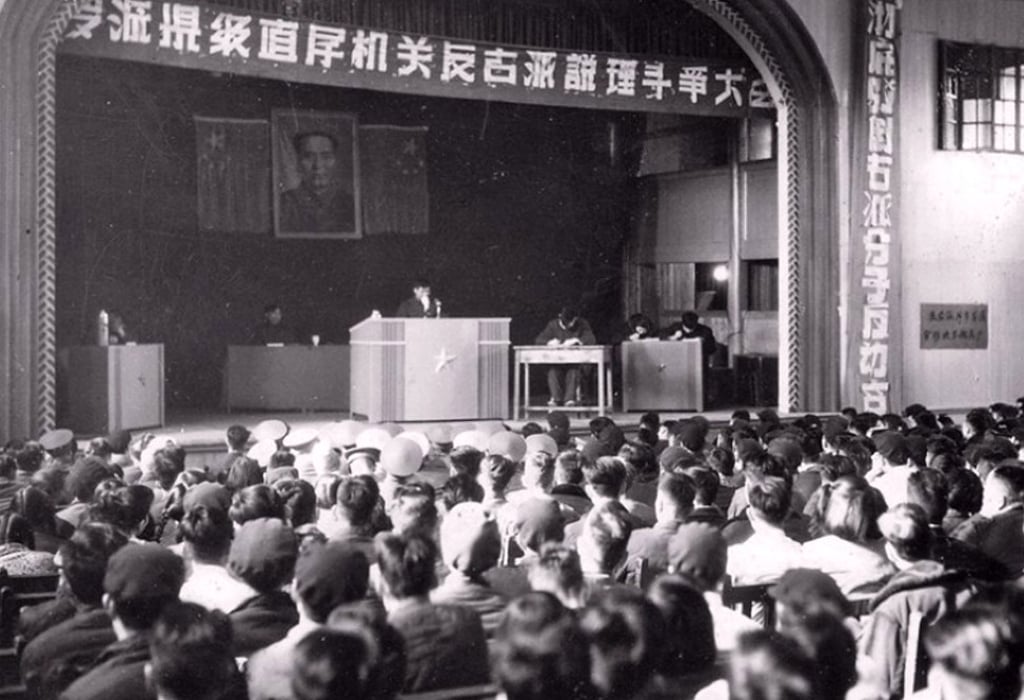
By the summer of 1957, the “Hundred Flowers Campaign” was getting out of hand, as wide-ranging criticism accelerated all over China. Party leaders became alarmed when they could no longer control the narrative, especially when the emerging story was not one that suited their purposes. And so they backtracked, cracking down hard on those they had previously encouraged to speak up.