-
Advertisement
PostMag
Life.Culture.Discovery.
Lessons from China's history
MagazinesPostMag
Wee Kek Koon

Reflections | Political graffiti was as common to ancient China as it is to Hong Kong

  • Subversive messages and slogans, whether carved in rock or sprayed onto buildings, carry the same spirit of defiance
  • During the Qin dynasty, a purportedly prophetic meteor was discovered, although the engravings were decidedly earthly

Reading Time:2 minutes
Why you can trust SCMP
‘Liberate Hong Kong; revolution of our times’ spray painted at the Hong Kong University of Science and Technology, in Clear Water Bay, Hong Kong. Photo: Felix Wong
Weeks of anxiety and occasional panic over the spread of Covid-19 in Hong Kong have relegated last year’s anti-government protests to the back of our minds. While sporadic protests continue, the intensity of the violence has been toned down. Face masks no longer protect against tear gas but a coronavirus that, in three months, has infected tens of thousands of people, most of them in mainland China.
Perhaps to remind us the “yellow” camp is not a spent force, its call to arms “Liberate Hong Kong; revolution of our times” was spray-painted on the wall outside Gun Club Hill Barracks, a People’s Liberation Army base in Jordan, last month. Graffiti featuring this and other political slogans have become ubiquitous in Hong Kongin the last eight months. The defacing of public surfaces has been an act of dissidence since time immemorial, a defiant smudge on the facade of normalcy.

More than 22 centuries ago, another case of political graffiti demonstrated the people’s defiance against authority. The Qin dynasty’s first emperor, Shi Huang, unified China in 221BC and reigned for 10 years, using severe laws and tyranny to terrorise the people into obedience. But resentment was never far beneath the surface.

Advertisement

Then in 211BC, a meteor was observed streaking towards Dongjun, the eastern commandery, which covered present-day northeast Henan and west Shandong. The meteorite that was retrieved had seven characters inscribed on its surface: “After the first emperor dies, his territory will be divided.” The portentous find was reported back to the emperor, who sent his high-ranking censor-in-chief to investigate.
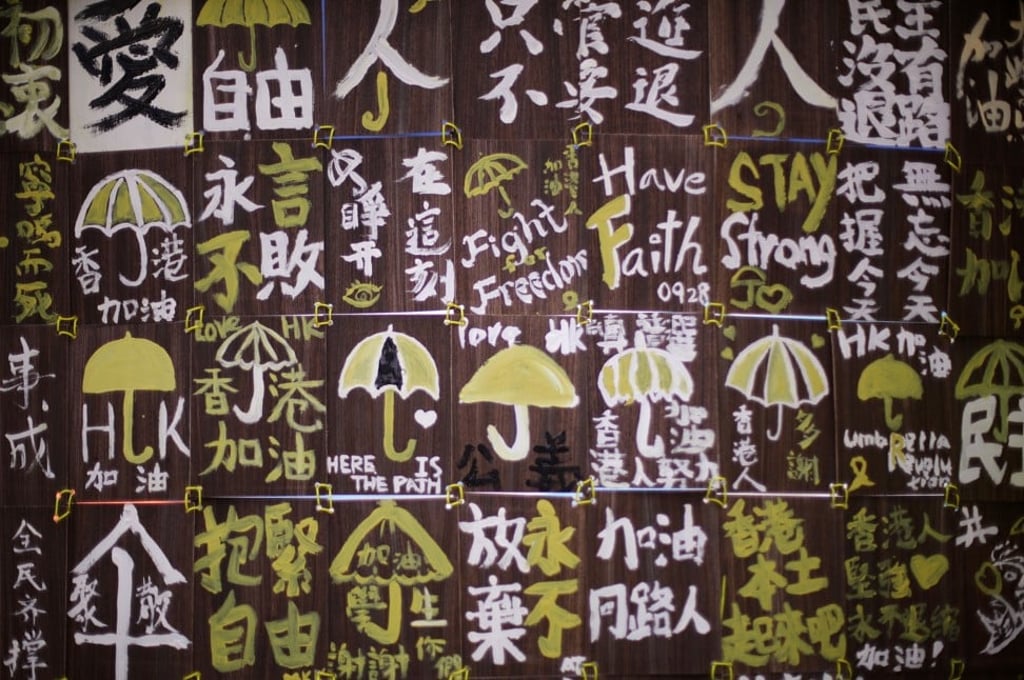
Graffiti on a wall in Admiralty, Hong Kong, in support of Occupy Central, in 2014. Photo: SCMP
Advertisement

The emperor refused to believe the inscription was a message from the heavens and was convinced the subversive graffiti was very much of this earth. Under his orders, the censor-in-chief interrogated residents in the vicinity but no one would admit to carving the characters.

Advertisement
Select Voice
Choose your listening speed
Get through articles 2x faster
1.25x
250 WPM
Slow
Average
Fast
1.25x