
Then & NowWhy ‘blood and bandages’ became Hong Kong’s favoured architectural style
Several well-known examples of this brick and render style survive, including the Fringe Club and Foreign Correspondents’ Club buildings, and the recently renovated Central Police Station

Hong Kong’s building materials are an often-overlooked aspect of the city’s evolution. In the colony’s early years, other than locally quarried stone, all materials had to be imported, includingtimber, glass, plaster, concrete and pipes, and sanitary fittings. Some local industries developed – notably concrete, pipes, tiles and sanitary fittings – but other items continued to be imported.
“Canton bricks” have been produced in the kilns around Foshan, in Guangdong, for several centuries; the Nan Fung kilns at Shek Wan are a nationally known visitor destination. Its potteries exported narrow-gauge, bright orange-red bricks around the region.
A well-preserved local example of Canton brickwork is the former Government Pathological Institute (now the Museum of Medical Sciences), built in Mid-Levels in 1906. Other bricks came from further up the China coast, sometimes transported to Hong Kong as ballast with other cargoes. The University of Hong Kong’s Main Building, constructed in 1910-12, is built of rose-coloured Amoy bricks from Fujian.
Local bricks were made from fine clay, known as Canton mud and also popular with gardeners as a nitrogen-rich soil improver and growing medium for water-grown edible tubers including lilies, lotus and water chestnuts. Canton mud is produced from the fine silt in pond water, which is ingested by fish and ducks, processed by gills, intestinal tracts and duck gizzards, and excreted. In the process the soil particles become progressively finer. This material was used to produce bricks with the evocative, and accurate, name “duck poo green”.
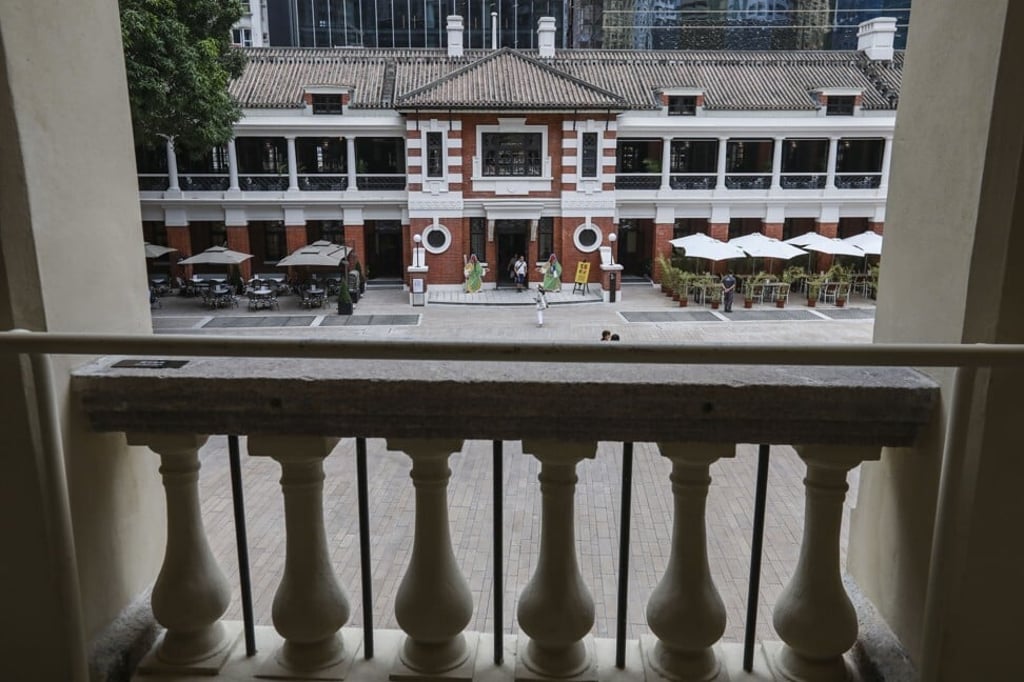
Both local and imported bricks were used in an architectural style known as “blood and bandages”, developed in the years straddling World War I and remaining commonplace into the 1920s. The colour scheme – slashes of red brick and cream or white plaster, whitewashed stone or Portland cement bands – made this a particularly vivid style. It was also economical, allowing the use of cheap and unattractive broken bricks in the sections rendered in concrete.