ReflectionsChinese art rebels, the Lingnan School bucked centuries of inherited wisdom with its bold use of colour
- The Lingnan School developed a progressive style in the early 20th century, rejecting the long tradition of austere black-and-white works
- Among its most famous artists were Zhao Shao’ang, a master of the flower-and-bird genre, and Guan Shanyue, whose landscapes are stunning in their splendour

Among the various types of traditional Chinese paintings, I am partial to monochromatic works that are impressionistic or even abstract. While many prefer the vivacious colours and meticulous detail of paintings commissioned by the imperial courts and similar works (and there is nothing wrong with that – to each their own), I prefer the interplay between infinite shades of black ink and paper that creates multiple textures and illusions of light and shadow.
The affinity for black-and-white ink painting was strong among the literati in China’s late imperial period, during the Ming and Qing dynasties (1368-1912). Colours were for formal court portraits and gewgaws. By the early 20th century, however, when China was in the throes of foreign invasions and revolution, a new school of Chinese painting emerged, the Lingnan School, which bucked centuries of inherited wisdom.
The word “Lingnan”, which means “south of the mountains”, is a geographical appellation that refers to a region in China that is located to the south of five sprawling mountain ranges. Consisting of a larger area in the past, Lingnan in the present day is generally taken to mean the region covering Guangdong, Guangxi, Hong Kong and Macau.
The Lingnan School was so named because its founders, artists Gao Jianfu, Gao Qifeng and Chen Shuren, all hailed from the province of Guangdong, which was also where they developed a bold and progressive style of painting in the early 20th century. However, the founders never referred to themselves as the Lingnan School. In fact, they were not very impressed with the name because they found the geographical reference limiting and thought that it might take the focus off their art. They were concerned that they would be construed as just another group of regional artists. Despite their misgivings, the name stuck.
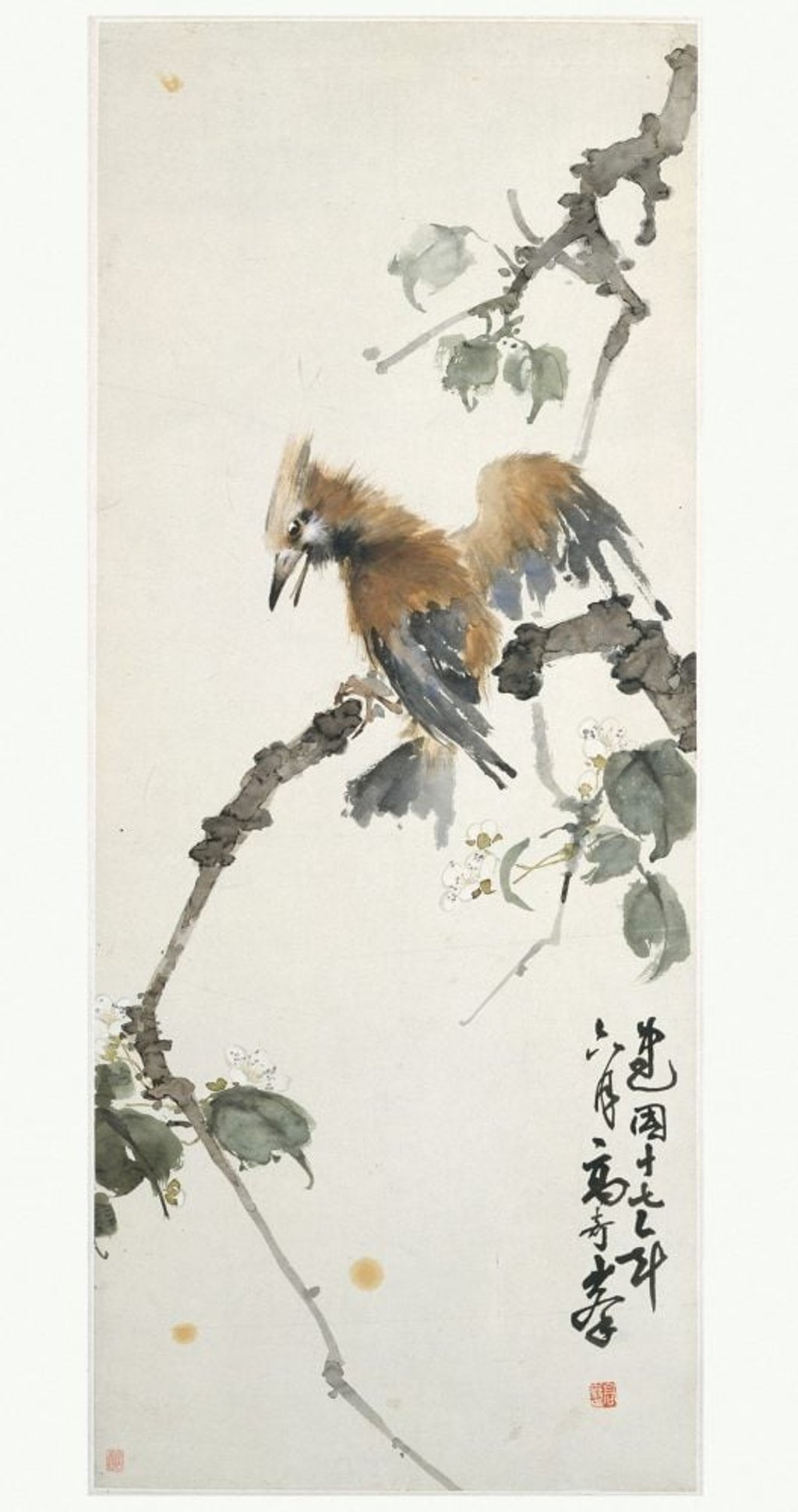
The Lingnan School was very much a product of that particular period in China’s history, where millennia of Chinese tradition and modern ideas that originated in the West collided with a resounding crash. Its founders and proponents advocated the incorporation of Western styles into Chinese paintings to create artworks that were still Chinese in essence, but infused with modernity and dynamism.