Advertisement
PostMag
Life.Culture.Discovery.
Old Hong Kong
MagazinesPostMag
Jason Wordie

Then & NowWhen Nationalist flags bedecked a Hong Kong town for Double Tenth holiday in live-and-let-live era that seems long gone

  • Commemoration of the Wuchang uprising in 1911 that led to the Republic of China’s formation was a lively affair in parts of Hong Kong under ‘Pax Britannica’
  • In Kam Tin in the New Territories Nationalist flags lined the road, fireworks flashed all night and the drinking went on until dawn

3-MIN READ3-MIN
2
A Taiwan flag flies in Hong Kong on the Double Tenth holiday in 2011 at the Red House in Castle Peak, Tuen Mun, marking the centenary of the Wuchang uprising that led to the Republic of China. The holiday was formerly celebrated in other places in the territory, including Rennie’s Mill and Kam Tin. Photo: SCMP/K.Y. Cheng

In recent weeks, certain senior Hong Kong officials – who must be held to higher standards than the general public – have erroneously referred to October 10 as Taiwan National Day. Since Taiwan is an integral part of China, the island – whether self-ruled (as at present) or otherwise – cannot, by definition, have its own National Day.

Let us be clear – Double Tenth commemorates the start of the Wuchang uprising in 1911, which led to the establishment of the Republic of China the following year. Taiwan’s separatists have their own flag – not the Nationalist one; given the chance, these groups would choose a different date altogether.

After the People’s Republic was proclaimed, on October 1, 1949, China found itself with two national days, each celebrated by political parties that declared themselves the country’s rightful rulers – whatever geopolitical realities might otherwise suggest. Hong Kong straddled the Chinese civil war’s opposing sides, and – as ever – arbitraged their differences to the colony’s advantage. Festering animosities occasionally spilled over into violence; in 1956, political tensions led to riots across northern Kowloon, with numerous fatalities. As the years passed, an uneasy truce descended.
Advertisement

Pax Britannica enabled this; as marine scientist F.D. Ommanney astutely noted in Eastern Windows (1960) when regarding these National Day commemorations, “yet to whichever of these two flags the Chinese in Hong Kong profess allegiance they are all at heart thankful for the presence of the third one, much less often seen than the others, which hangs listlessly from its staff outside the police-station”.
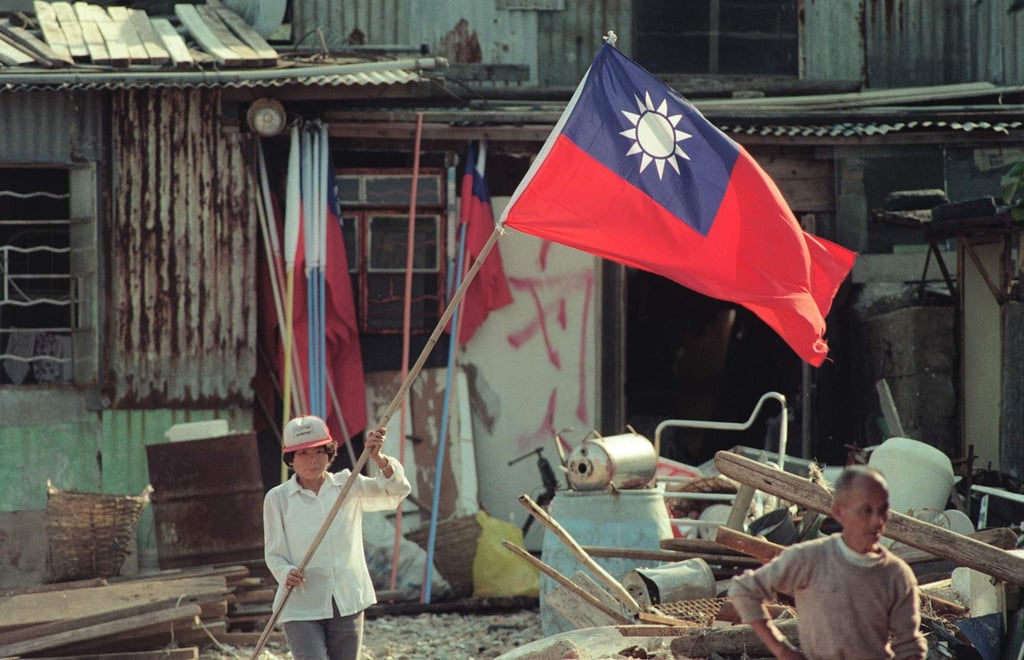
A Rennie’s Mill resident prepares for the Double Tenth celebrations in 1993. Photo: SCMP
During the final decades of British rule, various places continued to openly display the Nationalist flag on Double Tenth and loudly celebrate the Chinese Republic’s establishment. Rennie’s Mill, on the shores and slopes of Junk Bay, was the most well-known example; almost as fervent, though less publicised, was Kam Tin in the northwestern New Territories.
Advertisement
Advertisement
Select Voice
Select Speed
1.00x