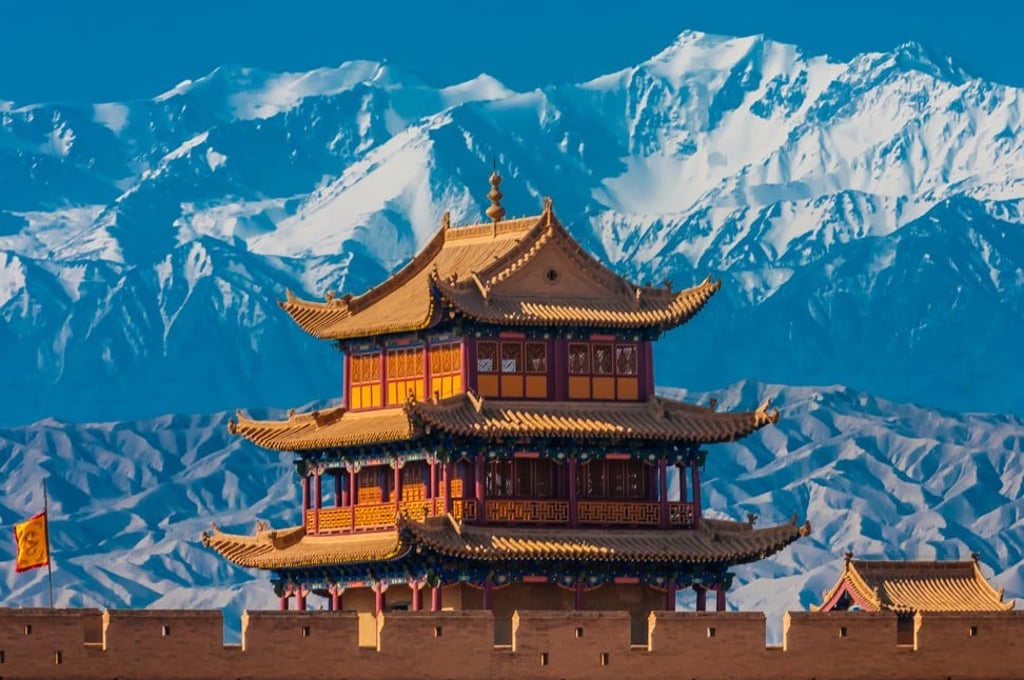
Sister cities in the West a bulwark for China against worsening US ties
- Orlando and Guilin, Philadelphia and Tianjin, St Louis and Nanjing – 201 places in US alone have sister-city, or twin-town, agreements with places in China
- Sister-city relationships have their roots in mutual understanding, but offer economic spin-offs too

As United States-China relations continue to deteriorate, fuelled by suspicion of the latter’s “Belt and Road Initiative”, the Huawei woes and ongoing trade war, there is some light at the end of the tunnel. According to the Chinese People’s Association for Friendship with Foreign Countries, no fewer than 201 city partnerships exist between the two great powers.
Sister-city relationships, or town twinning, as it’s known in Europe, arose as a form of fence mending after the horrors of the second world war. The English city of Coventry, for example, reached out to Stalingrad (now known as Volgograd), in the Soviet Union, and later Dresden, in East Germany, in a symbolic gesture aimed at reuniting three cities devastated by heavy bombing. Exchange visits were organised, cultural activities promoted and reconstruction work jointly undertaken.
Bonds formed out of shared adversity have evolved, and economic considerations increasingly take precedence over the lofty ideals of fostering friendship, cooperation and understanding. Nevertheless, some towns and cities still pair up for reasons that don’t have the air of a get-rich-quick scheme. The tiny Scottish village of Dull and the American town of Boring have a “declaration of pairing” that now includes an association with the Australian county of Bland, creating what has been dubbed a “trinity of tedium”.
At the other end of the spectrum are Unesco alliances. Cusco, gateway to Peru’s ancient Inca citadel of Machu Picchu, is twinned with Xi’an, starting point of the Silk Road and home to the Terracotta Army. Archaeological marvel Petra, in Jordan, has entered into a sister city agreement with the World Heritage Site of Jiayuguan, situated at the less touristy western end of the Great Wall.
Christened the Venice of the East by Marco Polo, Suzhou is celebrated for its canals, bridges and Unesco-listed classical Chinese gardens. Today the city suffers from severe pollution and overcrowding – an unimaginable scenario in 1980, when a twinning protocol aimed at promoting tourism was signed with Venice. These days, the inhabitants of both cities welcome initiatives that discourage swarms of sightseers.