
Destinations known | Thailand might have found the solution to Japan’s overtourism problem – replica theme park draws crowds
- Hinoki Land near Chiang Mai offers tourists a taste of the Land of the Rising Sun without having to leave Southeast Asia
- Attraction’s inclusion on proposed list of top cultural attractions has incited jingoistic ire in local residents

Its golden tiers and elegantly curved eaves reflected in the tranquil water encircling it, Kinkaku-ji is one of Japan’s most iconic structures. It is also one of the country’s most crowded tourist attractions. In 2017, Travel + Leisure magazine estimated that the Zen Buddhist temple received around 6 million people annually, which means that, on an average day, you and more than 16,000 others could be jostling for the same “perfectly composed” picture. Not that any of these images will reveal the reality of the situation, mind.
The same is true of the Fushimi Inari shrine, and its tunnel of red torii gates, and Arashiyama bamboo forest, in Kyoto, and Senso-ji in Tokyo, none of which are ever as quiet as Instagram posts imply. However, there could be a solution to the saturation of sightseers at top Japanese attractions, and an example lies thousands of kilometres to the southwest, in northern Thailand.
Hinoki Land is a recently opened theme park just over two hours drive from Chiang Mai, featuring replicas of some of the most famous hotspots in the Land of the Rising Sun. Guests enter through an imitation Kaminarimon, Senso-ji’s imposing entryway, many posing for a picture beneath a large red lantern that reads “lucky gate” rather than “thunder gate”. There’s a scaled-up version of Kyoto’s Kinkaku-ji, which, some have argued, is better than the original, because the balcony is accessible to visitors, and a torii tunnel leads, well, nowhere, but it does provide a prime photo opportunity.
Tourists can even wander the park grounds wrapped in a rented yukata, just like they can in Kyoto. And in Hinoki Land, the costume costs just 350 baht (US$11); those hiring an outfit in the former Japanese imperial capital’s Gion district can pay up to 16,200 yen (US$147) for the pleasure.
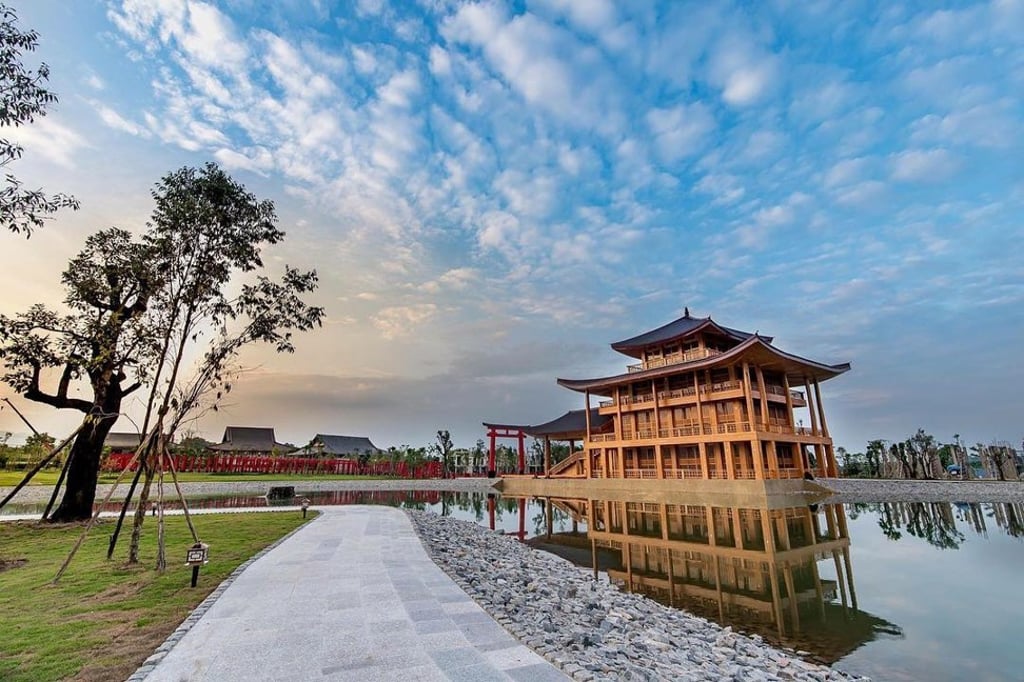
The theme park is the brainchild of Anirut Juengsutprasoet, a businessman who made his fortune importing hinoki cypress. Speaking to English-language business journal the Nikkei Asian Review last month, Anirut said: “Many Thai people cannot afford to travel to Japan, even if they want to. I wanted to create a place where everyone can experience the Japanese culture and traditions.”