The d’Arenberg Cube: Australian vineyard grows five-storey Rubik’s puzzle
- A$16 million McLaren Vale landmark contains a wine-tasting room, restaurant and Alternative Realities Museum
- Five-year fight to build the giant Rubik’s Cube pays off with 400 per cent increase in cellar-door sales for d’Arenberg Wines
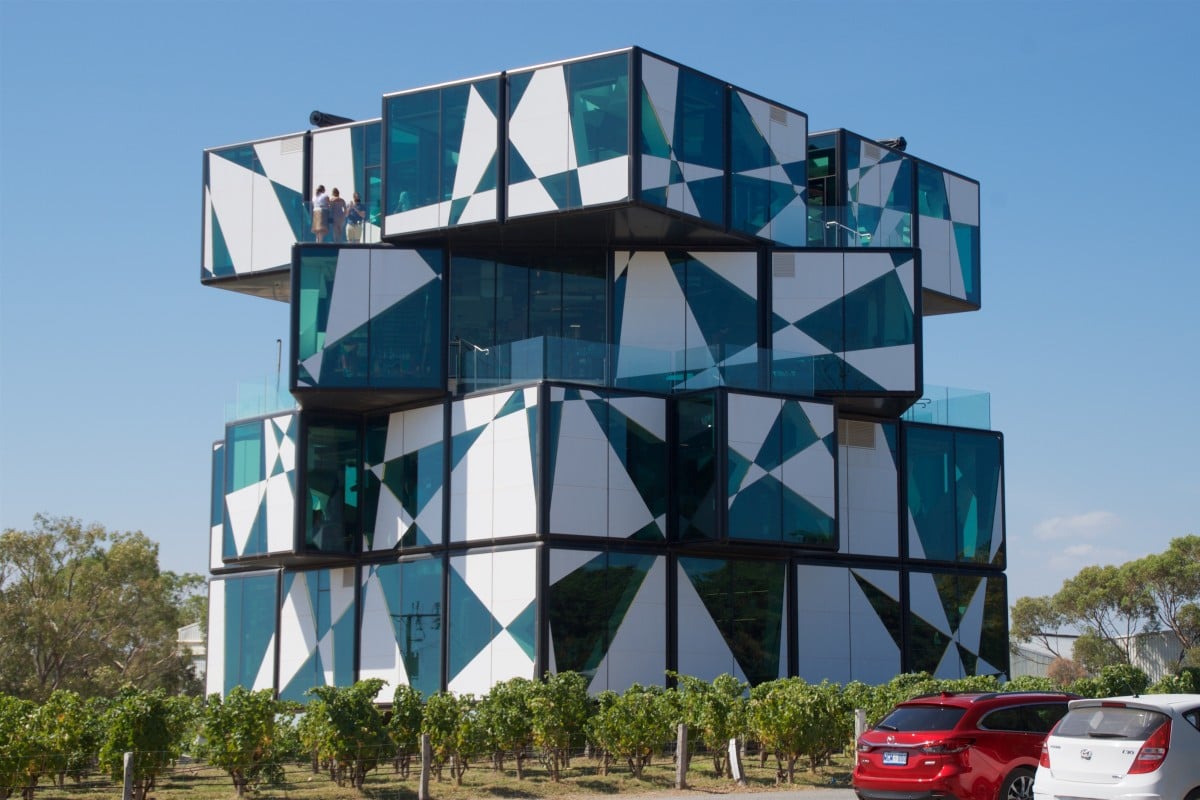
So what’s a giant Rubik’s cube doing in the middle of South Australia? Attracting attention, mainly. The d’Arenberg Cube, in McLaren Vale, a 45-minute drive south of Adelaide, is the brainchild of loud-shirt-wearing fourth-generation winemaker Chester Osborn, of d’Arenberg wines. It took him about nine years to get the five-storey oddity – which houses a tasting room and a restaurant – built, despite the 2008 financial crisis and opposition from his father and the rest of his family. He also had to fight most of his business managers.
Intergenerational conflict and high finance? I sense a soap opera in the making – a Down Under Dynasty, but with wine instead of oil. The opposition is drinking its words. The Cube features in travel advertising (and it’s got the d’Arenberg name into Post Magazine’s travel pages, hasn’t it?); tourism authorities take scale models of it to trade shows around the world; and no self-respecting selfie-taker visits Adelaide without a side trip to The Cube, creating a massive social media presence for the vineyard and its more than 80 wines. Cellar-door business has grown by more than 400 per cent.
Fair enough. But what about those wines? McLaren Vale is home to some of Australia’s oldest vines, and d’Arenberg has been in operation since 1912. The wines were successful long before Cube construction started, in 2015, with 70 per cent of production going to export. In fact, the existing tasting room was already overrun. Osborn originally planned new buildings in the low-rise, old colonial style of the originals, but woke up one day thinking, “I need something iconic that really draws people and that’s an outstanding piece of artwork.”
Is The Cube outstanding artwork? That might be going a bit far, perhaps, but it certainly stands out. Osborn’s thinking was that wine is a puzzle to work out, and his vineyard’s names for its wines are also a puzzle. So he asked himself what was the world’s most iconic puzzle, and then, after struggles with architects, engineers and government paperwork, he had his answer – a Rubik’s Cube – built in glass and steel at a cost of about A$16 million (HK$88 million). Rather a lot for a tasting room.
Wouldn’t it have been cheaper just to simplify the names of the wines? Like The Old Bloke and the Three Young Blondes, The Dead Arm or Stephanie the Gnome with Rose Tinted Glasses, you mean? Perhaps. Even Osborn sometimes gets that last one wrong. But each name has a story behind it, many illustrated by installations around the site or inside the Cube.