Legado Alcázar: experience Spanish culture and heritage at historic hotel in the heart of Seville
- The property is home to the only hotel rooms in the city overlooking the Real Alcázar palace gardens
- 12th-century Moorish archaeological elements discovered during renovations now encased in glass

What’s so special about it? Once part of Seville’s spectacular Real Alcázar palace, built in the 14th century for King Peter of Castile, this hotel has perhaps the most desirable address in the Andalusian capital’s Santa Cruz quarter.
Legado Alcázar’s 17th-century framework was recently subject to a sensitive update to transform the former mansion into a hotel. Over the course of the renovations, archaeological elements dating to the Moorish Almohad empire (1121-1269) were uncovered. These have been not only carefully conserved, along with centuries-old ceramics and tiles, but also celebrated in the redesign. Make sure to spend a penny in the downstairs toilet.
You’re telling us to go to the toilet? Trust us. From there, you can reach out and touch royalty, or rather, an original wall of the Alcázar.
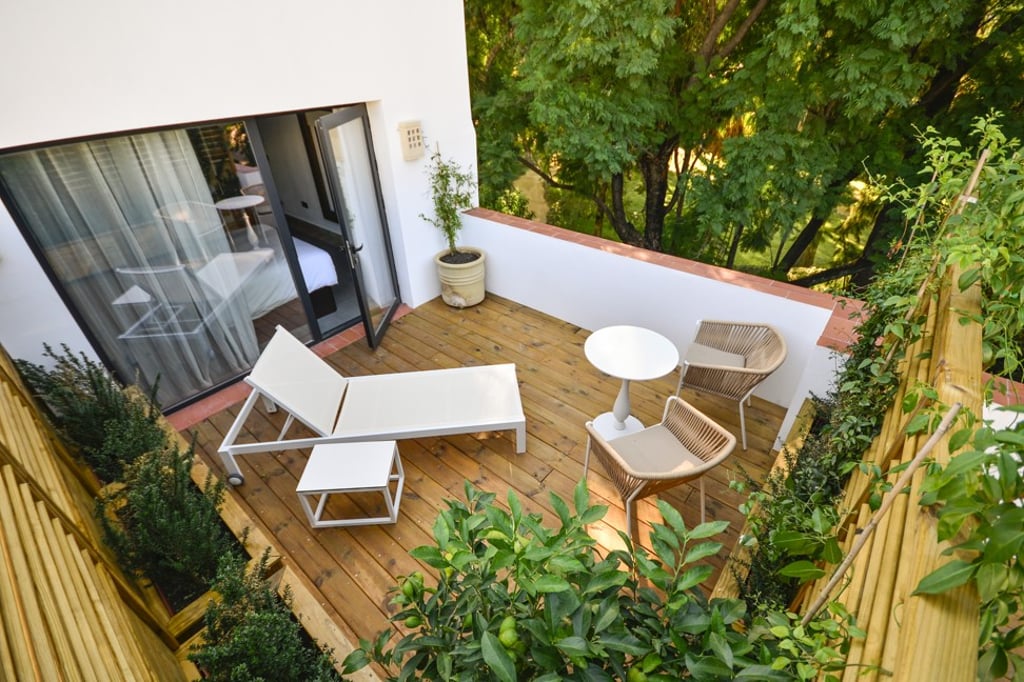
What are the lodgings like? The hotel has 18 rooms and no two are the same. In some, those ancient architectural features have been encased in glass floors or walls. Others have balconies overlooking the palace’s perfectly pruned gardens (below) – the only hotel rooms in the city with such an enviable view. Superior rooms have a spa bath or hot tub. All are united by a neutral interior aesthetic that allows the historical elements to shine.
Is there anything to eat? A satisfying breakfast of fruit and cooked or cold options is served in the courtyard (below left) and a compact, cafe-style space behind reception. Complimentary coffee and cake can be found in the latter in the afternoon, and in the evening, the space becomes a bijou bar serving local wines and other drinks.
What about dinner? Tradition dictates that you don’t even think about dinner until after 9pm and, when you do, make it tapas. This quintessentially Spanish style of dining is said to have begun at a humble farmers’ bar in Seville (although there are other origin stories), where bartenders would serve drinks with a saucer of ham or cheese on top, to keep the flies out, the patrons happy and the establishment full. That “tapa” translates as “lid” gives this tale legs.