Korean DMZ Peace Trail hike offers a soldier’s-eye view of world’s most heavily fortified border
- Three new walking routes offer a rare opportunity to witness the military might that has helped maintain an uneasy peace
- Signs along the path alert hikers to the possibility of mines, while military minders ensure no one ventures off course

The deer raises its head and, still chewing and flicking its short tail, holds my gaze. Apparently unconcerned about the 20 walkers invading its habitat – even those in Day-Glo green vests – the animal takes another mouthful before sauntering off into the brush. The young buck might not be so nonchalant if it could understand the signs that hang at short intervals along the fence. Each an inverted red triangle, they bear a single word: Mine.
The inaptly named demilitarised zone (DMZ) remains the world’s most heavily fortified border – razor wire, sandbagged bunkers and, yes, minefields – although the minimal chances of detente breaking out between the two Koreas has encouraged Seoul in recent months to open a number of hiking routes through areas of the front line that had been off-limits to all but the military.
The second DMZ Peace Trail opened in June, in Cheorwon, halfway across the peninsula, and a third stretch is scheduled to open to the public in the town of Paju, about 30km northwest of Seoul, in September. The first trail, and the one I’m taking, opened in April, along a coastal section of the border in eastern Gangwon province, some 90km from the capital and where the 257km ribbon of land that has separated the feuding Koreas since the 1950-53 war ended in a stalemate reaches the sea.
This route is neither long – a mere 15km – nor particularly taxing, but the government plans to link the three routes to create a single, 500km coast-to-coast trail by 2022. It’s an ambitious plan and one that relies heavily on improving cross-border relations.
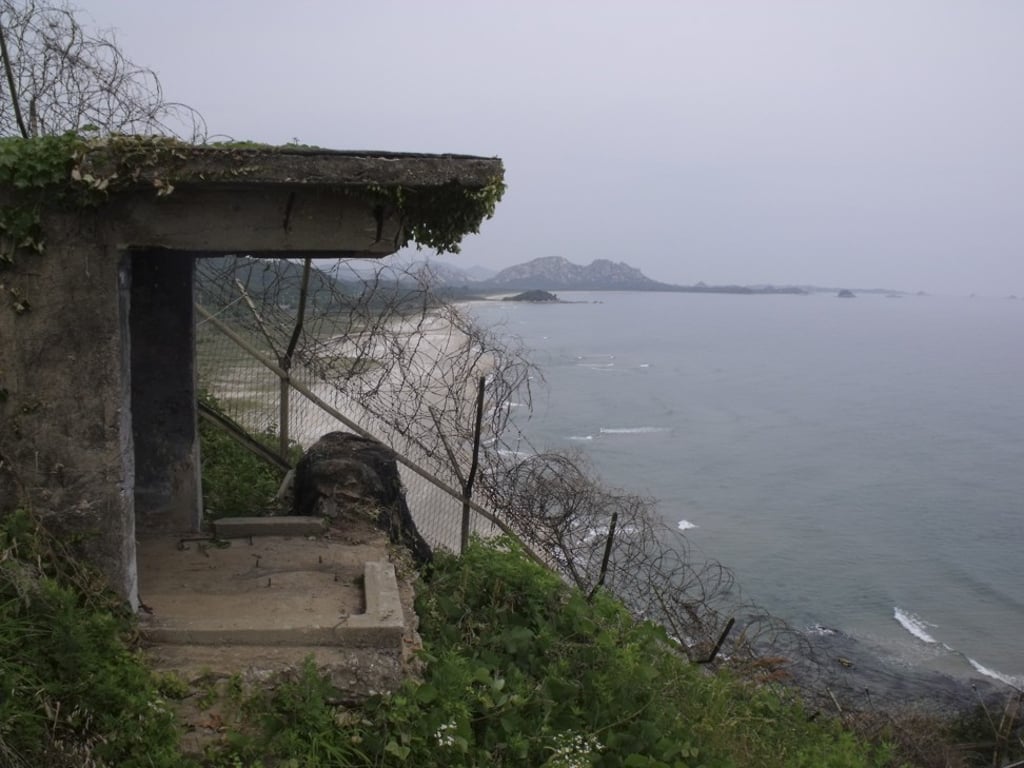
Approaching the starting point for the hike, it is clear that despite the dialled-down rhetoric, the South Korean military is still very much on the alert. We pass through a checkpoint with black-and-yellow striped roadblocks ready to be swung into position and soldiers holding semi-automatic weapons across their chests. Between smallholdings on which grow cabbage, for kimchi, military facilities are concealed behind high fences and camouflaged vehicles are conspicuous.