The return of South Africa’s sea turtles is a conservation success story
- KwaZulu-Natal’s Sea Turtle programme has seen leatherbacks and loggerheads nesting in greater numbers
- Dunes and beaches of South Africa’s first natural Unesco World Heritage site are an underrated destination

During the eerie calm that settles just after midnight we spot her. A large, dark shape, flecked white by moonlight, lugs itself from the waves, leaving a wake of two-metre-wide tractor-like tracks. She is fully lit fleetingly by the routine swirl of KwaZulu-Natal’s Sodwana Bay lighthouse: a leatherback turtle, the second-largest reptile species in the world.
To find her, it took two hours of scouting the nocturnal shoreline with guide Pete Jacobs, of Ufudu Turtle Tours, in a safari-style 4x4. As we drove along the hard sand left by the high tide, the open sides of the vehicle whipped the ocean breeze into mini gales, the beach below heaving with scuttling ghost crabs. Following a coffee break, Jacobs steered the vehicle south, towards the beaches of Mseni, and that’s where we saw her.
Of the seven species of sea turtle found worldwide, five – the leatherback, loggerhead, green, hawksbill and Olive Ridley – swim through South Africa’s seas. Only the leatherback and loggerhead leave the Indian Ocean here, though; the former being rarer.
Turtles predate the dinosaurs and have crossed the oceans for 100 million years. Watching one lay her eggs is a timeless wonder. By the light of a red torch (white light could chase the turtle back into the sea, with the risk she might lose her eggs), Jacobs gathers us around our quarry as she prepares a nest site.
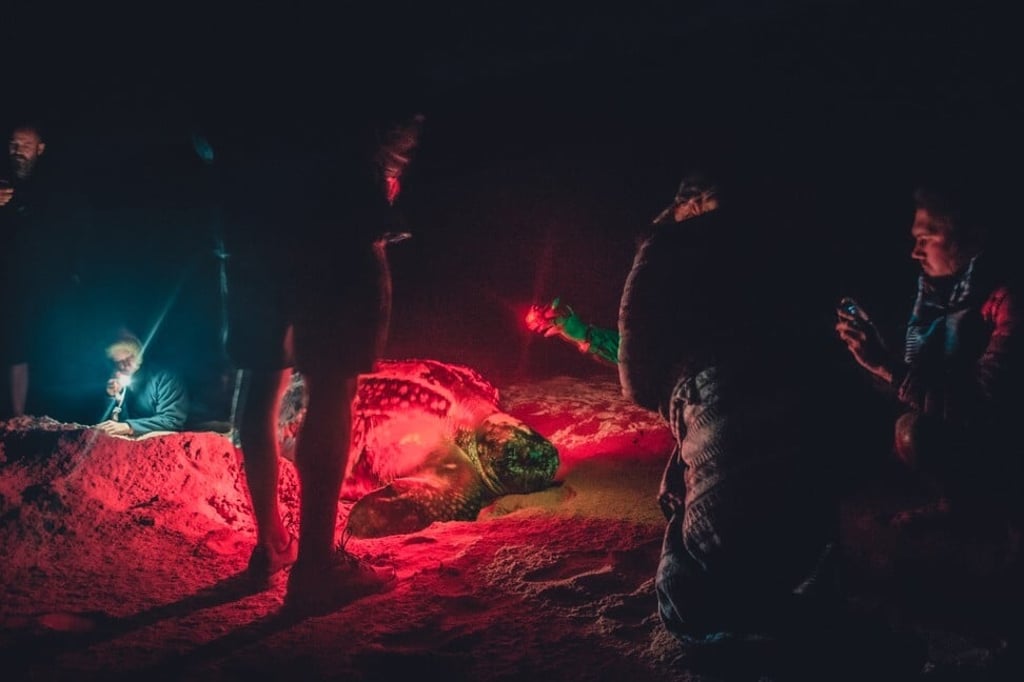
The turtle swivels in a circle, flattening the sand – quite a feat for a creature her size, more than two metres across and nearly as long. Once satisfied, she starts digging with her back flippers. Her precision and tenderness are striking. Scoop by sandy scoop, she lifts the white gold substrate and flicks it away, taking about 15 minutes to clean out a hollow nest.