Why Taiwan’s sea salt fields are 2020’s next unlikely travel trend

A producer of quality sea salt for more than 1,000 years, the Kinmen Islands’ Xiyuan Salt Field has emerged as an unlikely tourist hotspot, while Michelin-starred restaurants like Taipei’s Taïrroir and Logy covet heritage salts from Zhounan, Chiayi
Thanks to the blessings of good shorelines, abundant sunshine and smooth and flat fields, Taiwan is among several regions in Asia that boast a long tradition of sea salt making.
Historical records suggest that Taiwanese sea salt history dates as far back as the year 914, on the Kinmen Islands – just 6km off the Fujian coastline – long before China’s Song dynasty (960–1279) was established.
“The strong northeast monsoon, dry weather in autumn and winter, plus long summer daytimes facilitated fast seawater evaporation, making Kinmen one of Fujian’s eight major salt fields in ancient times,” according to author and historian Huang Cheng-liang.
The Kinmen salt flats were the mainstay of the main island’s economy before it became a Taiwanese beachhead. Over the course of a millennium, the industry experienced peaks and troughs before closing in 1995, only to reopen in 2008. The Xiyuan Salt Field, the last one left, has now been redesigned for cultural and tourism purposes.
Salt flats have dotted Taiwan’s western coast since the late 17th century, but uncompetitive pricing when compared with mass production led to all salt fields being shut down when Taiwan joined the World Trade Organisation in 2002.
Nowadays, Taiwan’s highly affordable but regular-tasting table salt is chiefly produced in the large-scale and highly mechanised plants of the Taiwan Salt Industrial Corporation (Taiyen), a former monopoly, which uses electrical power to extract it from the seawaters of northern Taiwan. Taiyen currently supplies more than 70 per cent of the home table salt market.
Nevertheless, the salt fields of Jingzaijiao in Tainan, and Zhounan in Chiayi in southeastern Taiwan, created in 1818 and 1824 respectively, were restored in the 2000s in a bid to preserve the island’s centuries-old salt-making heritage.
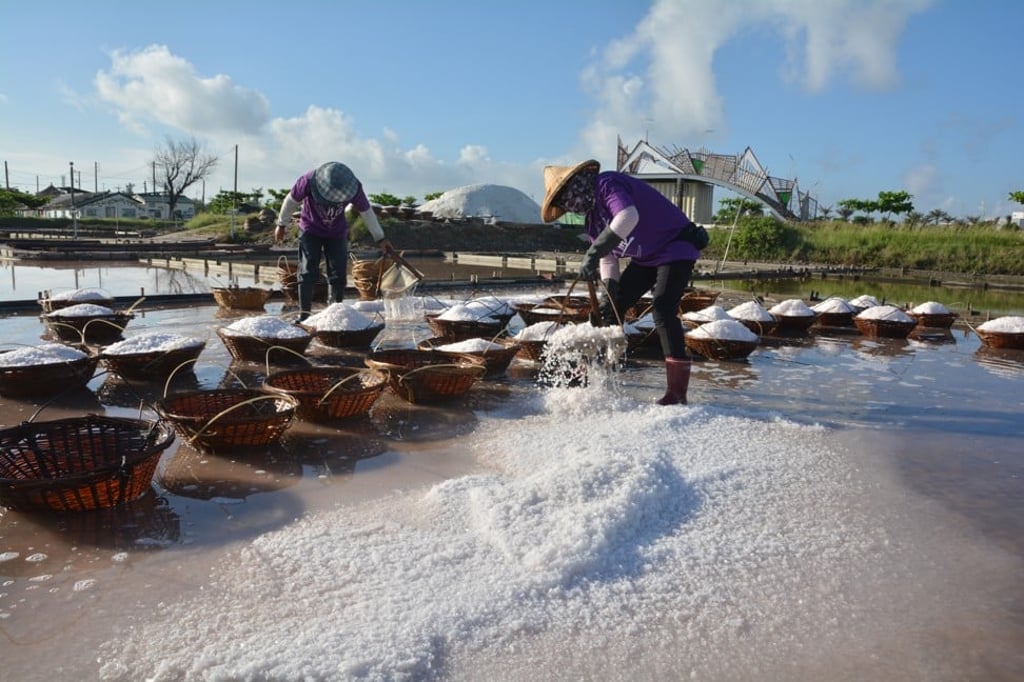
Since ancient times, these salt flats have utilised water from the Taiwan Strait and are paved with glazed tiles that help reflect solar radiation to absorb the heat and expedite crystallisation. The tiles also help to prevent seawater contamination from dirt at the bottom of the evaporation ponds. Harvesting salt takes a week in summer but three to four weeks in winter.
“Sea salt making is essentially the work of Mother Nature determined by the forces of seawater, soil, wind and sunshine, apart from labour,” says Tsai Jiung-chiau, a newspaper journalist turned salt maker who heads the Budaizui Cultural Association that manages the Zhounan Salt Field.