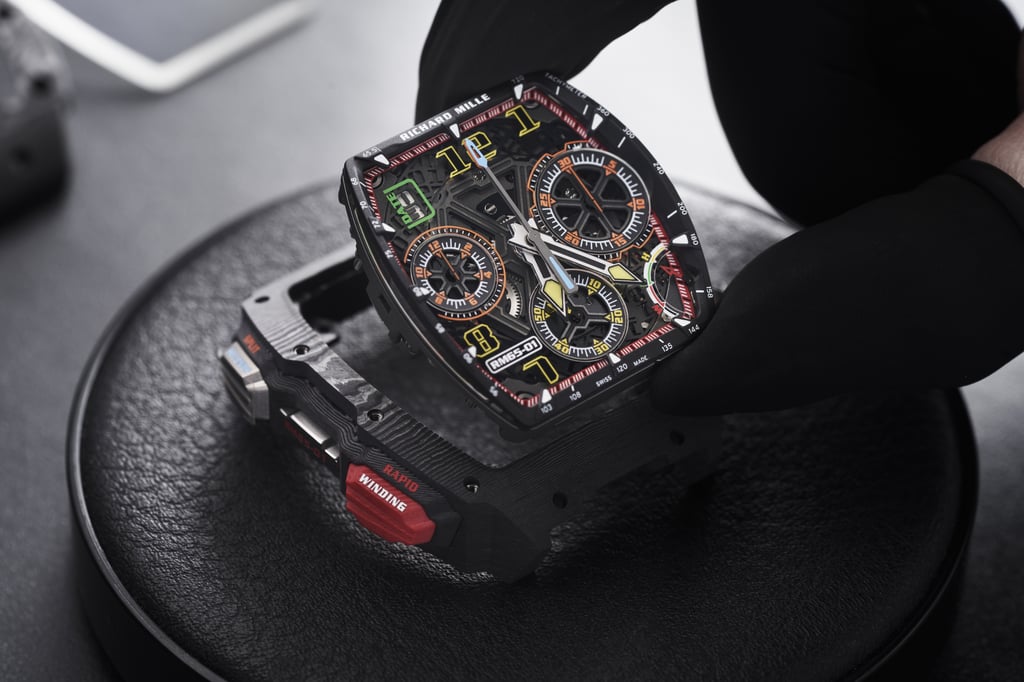
STYLE Edit: Introducing Richard Mille’s superfast new RM65-01 Automatic Split Seconds Chronograph

- A balance wheel oscillating at 5MHz is a key part of this masterpiece of precision watchmaking, aided by movement experts Vaucher Manufacture Fleurier
Technical complexity and unerring precision has always been right at the heart of Richard Mille’s watchmaking, and its latest RM 65-01 Automatic Split Seconds Chronograph is certainly no exception to that. Rather, the watch is a prime example of the brand’s watchmaking prowess, and it might just be Richard Mille’s most complex timepiece ever.
As the name suggests, the RM 65-01 houses a highly precise split-seconds chronograph complication, which is able to make stopwatch calculations that are accurate to 1/10th of a second – no mean feat for a mechanical watch. This precision is made possible thanks to the high oscillation rate of its balance wheel, which beats at a rapid 5Hz – significantly faster than most other watches, which usually oscillate at a rate between 2.5 and 4Hz.

Even more impressively, the complication is integrated into the movement itself, whereas many other chronograph watches are usually modular. The integrated movement was developed in partnership with movement expert Vaucher Manufacture Fleurier and has a superior column wheel and vertical clutch architecture, which allows for greater accuracy, precision and reliability in timekeeping.
A fast-rotating barrel ensures that the movement always receives the ideal torque for energy transmission throughout the duration of its 60-hour power reserve, and the newly designed oscillating rotor allows the rotor’s inertia to change for improved winding efficiency depending on the activity level of the wearer – so even if you’re desk-bound all day, you can rest assured your watch will keep running.
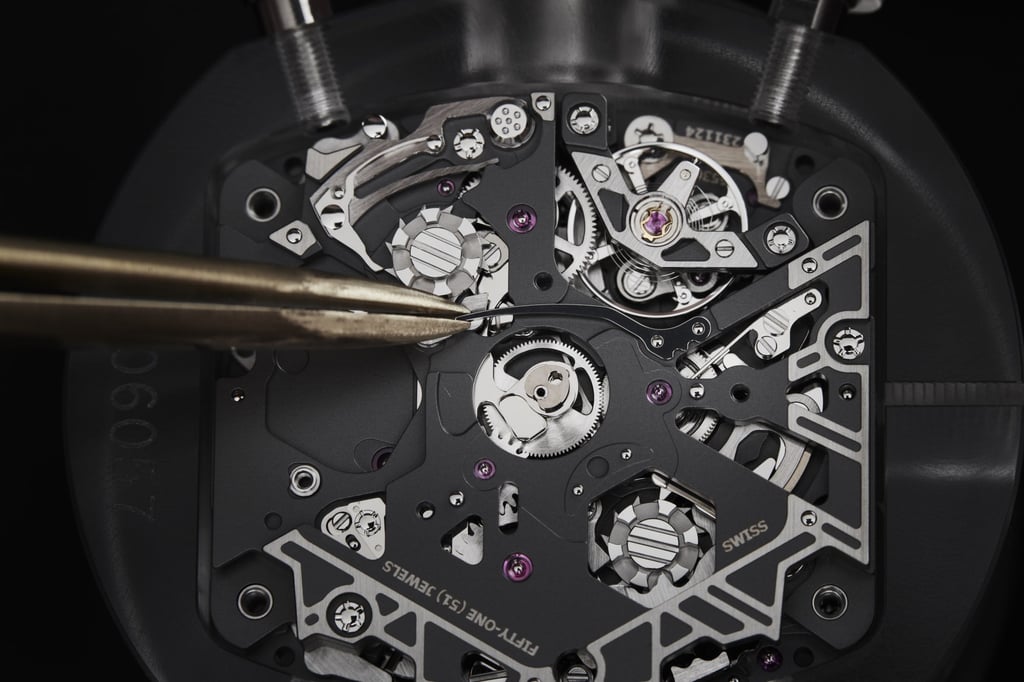
If you ever need to wind the watch quickly – say, after it has spent a few weeks in a safe – Richard Mille has invented a patented rapid-winding mechanism that allows the wearer to fully wind the watch by pressing on a pusher at 8 o’clock. After 125 quick pushes, the barrel is fully wound and ready to go – much more quickly than winding the crown. The development of such a rapid-winding mechanism was no easy task, thanks to the high levels of energy transfer involved.