Style Edit: Inside the impressive Richard Mille RM UP-01 Ferrari – the French watchmaker and Italian car manufacturer collaborated on the thinnest watch in the world, but just how does it work?

- The ultra-thin RM UP-01 Ferrari is the first timepiece resulting from Richard Mille and Ferrari’s partnership, boasting a scant 1.75mm thickness with its movement only 1.18mm thick
- Years of design work and hours of testing went into the limited-edition watch, which is entirely shock resistant with its baseplate and skeletonised bridges in grade 5 titanium
Not all racing cars are created equal. Those that excel in their field often stand out in more ways than one, their success intrinsically tied to their technical prowess and sleek aerodynamics.
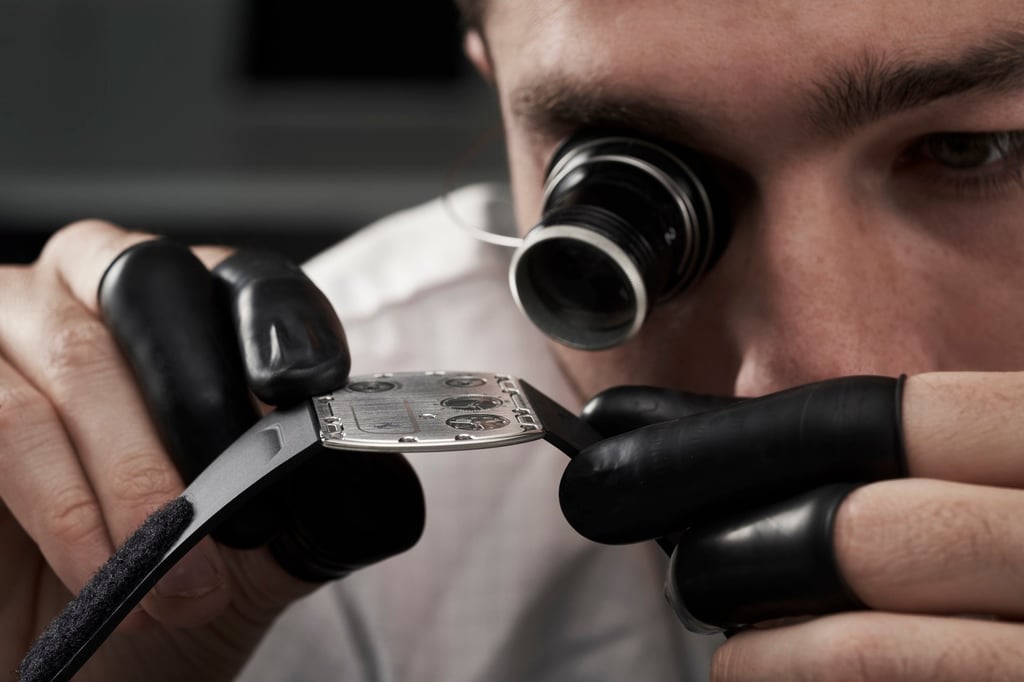
Making this ultra-thin timepiece a reality was no simple task. It required Richard Mille to push its convention-defying approach to design one step further.
“Shaving off those last millimetres of depth was an extremely demanding and lengthy process,” explains Julien Boillat, technical director for cases at Richard Mille. “For such a project, it was necessary to set aside all the knowledge we had amassed over years of practice, and every conceivable standard of watchmaking.”
Both Richard Mille and Ferrari are fighting for poll position in their respective fields. It was their shared pursuit of precision and perfection that led to the development of the RM UP-01, a timepiece created using traditional watchmaking architecture with the movement assembled inside the case – keeping it entirely shock resistant – rather than a design that uses the caseback as a baseplate. Keeping to this traditional form was no easy feat given its ultra-thinness.
It was necessary to set aside all the knowledge we had amassed over years of practice, and every conceivable standard of watchmaking
But the watch’s dimensions aren’t the only impressive design element for the RM UP-01. It maintains the same high-end specs as the brand’s other timepieces including the ability to withstand accelerations of over 5,000g, far beyond the force that can be endured by humans. In 2003, Indycar driver Kenny Brack experienced 214g – the highest G-force that a human has ever survived. By comparison, the US Army’s Sprint anti-ballistic missile accelerated at around 100g on its way to a top speed of Mach 24 (24 times the speed of sound).
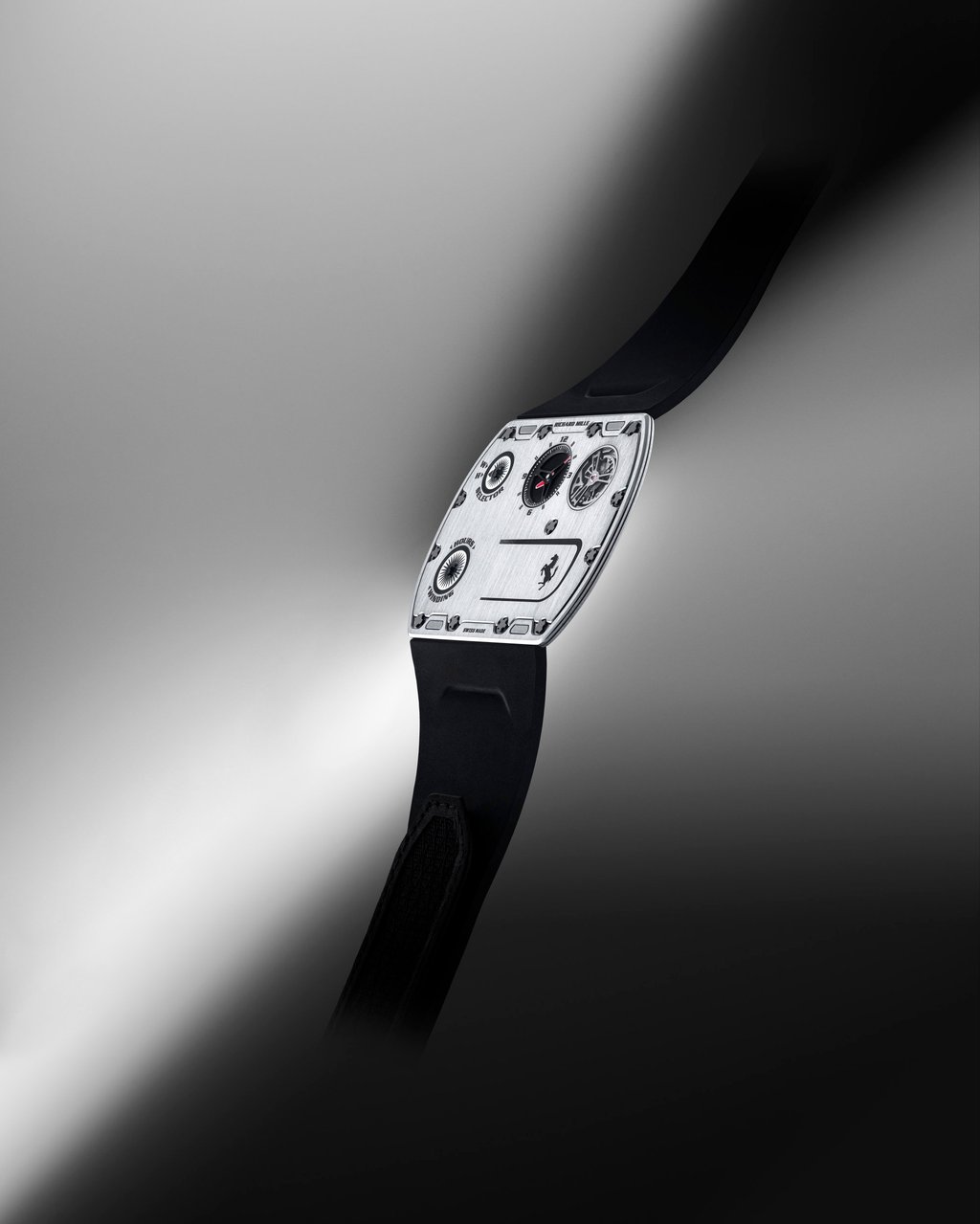
To maintain the dimensions, fine hairsprings are fitted into the barrels, the small plate of the balance and guard pin were removed, and the two sapphire crystals – one over the time indicators and one over the regulator – were reduced to just two-tenths of a millimetre in diameter. The winding mechanism was also adapted and the winding stem was removed to accommodate the new, thinner timepiece architecture. They have been replaced with two crowns – one to select a function and the other to utilise it – that have been integrated into movement wheels in the case.
Just 150 of these record-breaking timepieces has been produced, rendering it a collector’s item in the making and the perfect demonstration of Ferrari and Richard Mille’s shared commitment to excellence.