The future of business-class includes personalisation, tech and privacy

It’s not just lie-flat seats. It’s customisation with literally millions of ways to make your experience unique to you.
While the vast majority of fliers are feeling the squeeze with tighter and tighter economy seats (we’re looking at you, American Airlines) and downright frightening customer-service disasters (United), we might well be witnessing the dawn of a new golden age of travel in the business-class section.
Now a standard fixture on most planes—both the jumbo jets that regularly traverse oceans as well as the single-aisle planes that make domestic short hops—business class first debuted a mere 40 years ago. British Airways created a “Club Class” between first and coach back in 1978, while Qantas coined the actual term “business class” a year later.
The New First Class
So where is business class heading now? First off, it’s replacing first class on many airplanes and routes—it’s simply a less-expensive, less-expansive version of first class that still features lie-flat beds, multicourse menus created by celebrity chefs, and amenity kits stocked with spa products. It makes sense for airlines: There are more seats and more fliers who can purchase these seats, thus more money to be made.

Second, the seats in business class are getting innovative updates—both technological and ergonomic—that should impact the flight experience in large and small ways. And since airlines typically fly just a handful of aircraft types, you’ll see similar-looking seat styles across brands. There will be uniformity in the improvements. It’s shockingly expensive (think millions of dollars and several years) to develop a new business-class product, so once risk-averse airlines find a style that works, they stick to it.
The focus now is on refining the use of space and new technology within each seat to maximise passenger comfort.
A High-Tech Revolution
One glimpse into what this future will look like already exists. Though it won’t debut on commercial flights until 2019 at the earliest, the Waterfront seat was unveiled at the 2016 Consumer Electronics Show and is the result of a collaboration among seat manufacturer B/E Aerospace, design firms Teague and Formation Design Group, and technology giant Panasonic.
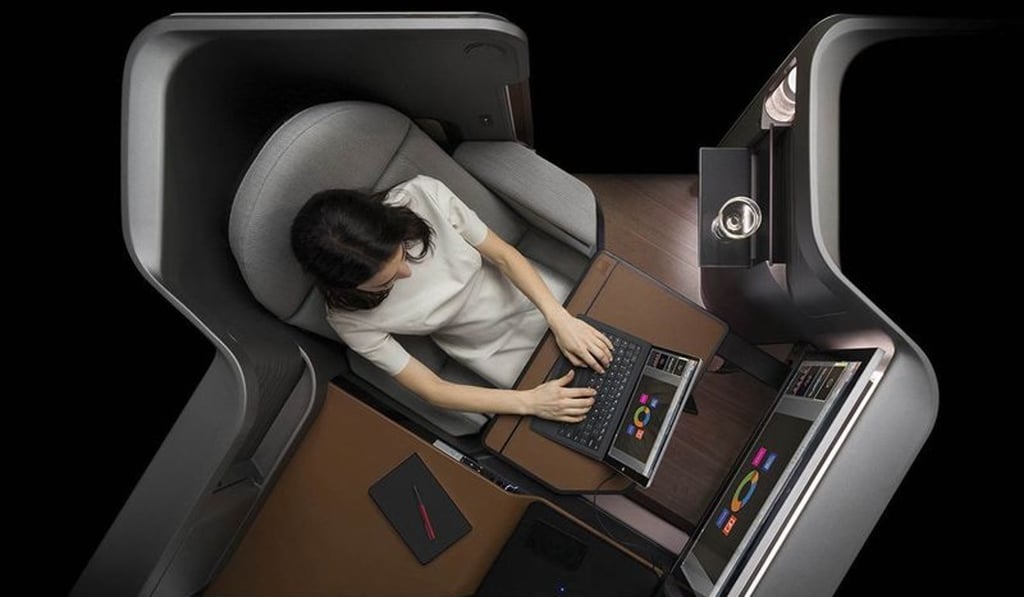
The physical seat is based on existing models from B/E, but Waterfront’s technology sets this iteration apart. The showpiece is a 24-inch, 4K ultrahigh-definition entertainment system, to which passengers will connect via an app on their smartphones or with a provided in-seat tablet.
Using their phones, passengers will be able to control everything: seat positioning (it reclines to a fully flat 79 inches), ambient lighting (there are more than 16 million possible settings), climate control of the seat’s various sectors, ordering meals and drinks, and creating entertainment playlists. Passengers can illuminate a Do Not Disturb sign or set a wake-up call for the crew to rouse them based on when they want to rest.
The system will remember their preferences from flight to flight within an airline network, and their settings will automatically be available. The entire point of the seat and all its technological bells and whistles is to allow passengers to tailor the entire flight experience to their individual inclinations.