Citi brings game-changing digital solutions to wealth management and institutional banking
Cross-sector collaboration among key players in the fintech ecosystem is transforming the client experience

Technology has long played a role in banking, but the speed and breadth of innovations are transforming the sector at an unprecedented rate. Fintech – or financial technology – is enabling banks to better serve clients.
“We engage with fintechs in many different ways and have been partnering with various companies to deliver a better client experience,” says Aveline San, CEO and head of banking, Citi Hong Kong and Macau. “Fintechs help advance technology, offering better products and solutions to our clients.”
As part of its strategy to catalyse innovation in the sector, Citi invests in fintech start-ups under its Citi Ventures arm, utilising the bank’s global network of investors, tech buyers and business advisers to help them build to scale.
Citi Ventures has built a portfolio of 115 start-ups across seven focus areas, including distributed ledger technology and digital assets, future of commerce, and artificial intelligence (AI) and data. “With offices around the world, we can scan the different technologies and introduce them to our stakeholders. A lot of our banking clients prosper in that ecosystem by learning more about these technology companies,” San says.

“We are part of the ecosystem and want to support fintechs,” she adds. “We take them on board as clients, helping them with financing and services to further their growth. We also collaborate with industry associations, regulators and the government, bringing stakeholders together to facilitate the healthy development of the fintech ecosystem. We can help narrow the gap between demand and supply in product design so that the best solutions are built by the fintechs who understand the banking sector’s needs. The more of these collaborations we foster, the more the industry prospers.”
San points to Citi’s Wealth 360, a management tool on the bank’s mobile app as an example of how cross-sector collaboration can transform the consumer experience. Through the Interbank Account Data Sharing (IADS) pilot programme introduced by the Hong Kong Monetary Authority earlier this year, Wealth 360 offers interbank information on cash flow, spending patterns and even a calculation of carbon footprint based on credit card usage.
San says this digital wealth management feature demonstrates the potential of open banking. “We are the first bank to offer retail clients the ability to look at financial information across banks by leveraging the IADS framework. Clients can access monthly cash flow reports and track their spending habits. There are a lot of solutions we can provide by partnering with fintechs, but we need the whole banking system to come together to yield the full benefit for our customers.”
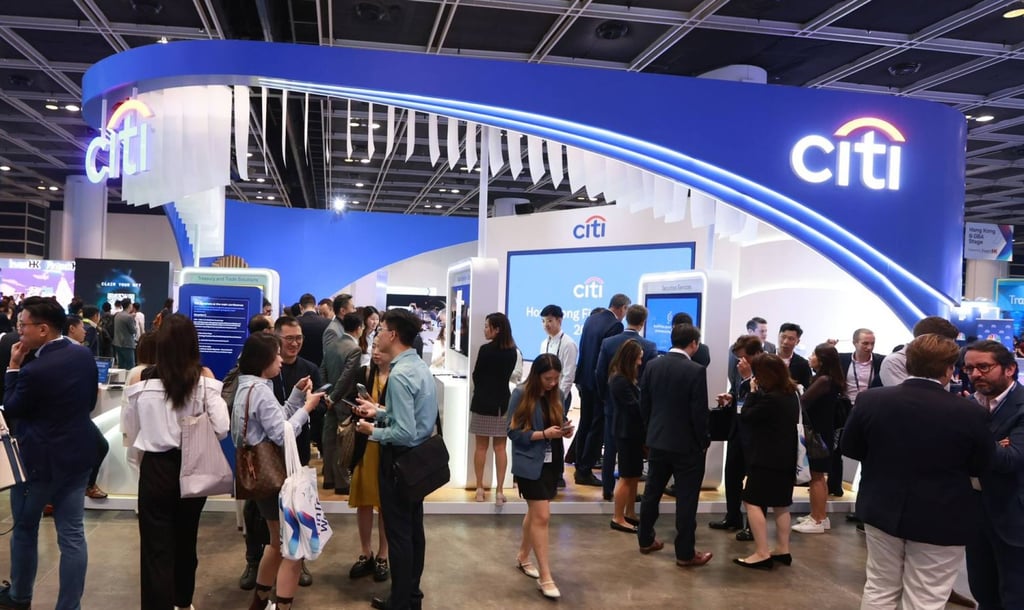
Citi has also made significant investments in building out its digital banking platforms for its 19,000 institutional clients, which include 85 per cent of Fortune 500 companies. The bank, which processes close to US$5 trillion for clients daily across borders, currencies and asset classes, invested more than US$12 billion in technology last year as part of its ongoing strategy to deliver solutions that anticipate clients’ needs across the full spectrum of treasury, trade and securities and fund services. The bank’s solutions are designed to address cost, speed and transparency with real-time processing, and near-instant capabilities and settlement cycles, including advancements such as transaction settlement on the next business day following the trade.
One such solution is Citi Token Services, a next-generation transaction banking service piloted last year for cash management and trade finance. The service utilises blockchain and smart contract technologies, enabling institutional clients to make programmable payments using tokenised deposits and process multimillion-dollar transfers between Citi branches on a 24/7 basis.
“The continued progress of Citi Token Services is a key component of the bank’s pursuit of real-time, always-on services for our institutional clients,” San says. “Using blockchain and smart contract technologies, we have created a patented programmable payment and liquidity platform, which will reduce costs and streamline processes.”

The bank has also introduced Citi Real-Time Funding, expanding its real-time treasury suite of solutions for its corporate clients and enabling institutional clients to move funds between cross-border accounts automatically based on predefined rules.
The adoption rate of digital services has been highly successful. Around 90 per cent of Citi’s consumer banking customers in Hong Kong are active users of its digital platform, while nearly 100 per cent of Citi’s top corporate clients are using the CitiDirect digital transaction portal. San credits the success of CitiDirect – the platform now boasts more than 350,000 active users – to the consumerisation of the institutional experience, which provides clients with global transaction capabilities using an intuitive and user-centric interface.
AI will profoundly change the future of finance, San notes. While interest in AI is now much higher, the technology has been around for more than 70 years; Citi has long employed AI and machine learning to enhance efficiency and the customer experience, for example. Looking ahead, advances in generative AI have the potential to revolutionise financial services because the sector is information-rich – and banks need to be prepared, San says.
“We need to upskill our people to ensure they are equipped with the technical skills, but also the durable human skills that cannot be replaced by a machine,” San says. “Our research suggests that communication, empathy and interpersonal skills that help with analytical and critical thinking are most important in the banking industry. At Citi, we take a proactive approach to skills-building.”