J.P. Morgan Private Bank report reveals how wealthy families can adapt in a complex world
New Global Family Office Report highlights governance, succession planning, investment management and cybersecurity as key areas of concern

In the face of ongoing global uncertainties and an increasingly complex and changing economic and investment landscape, exceptionally affluent families are keener than ever to achieve long-term success and financial returns. Many are taking strategic, sophisticated approaches to achieve their goals, according to J.P. Morgan Private Bank’s “2024 Global Family Office Report”.
The report, which surveyed 190 single-family offices globally, reveals the challenges that ultra-high-net-worth (UHNW) families face in an increasingly complex global landscape, including issues around family governance, preparing the next generation of family leaders, and concerns around cybersecurity.
While many families have employed the right financial acumen to meet these challenges, overall progress is uneven. Nearly three-quarters of the UHNW families surveyed have taken measures towards developing an effective governance model – by establishing an investment committee and board of directors, for example – although 27 per cent have not.
Every family is different and each has its particular multigenerational and multicultural needs. The more complex the relationships and the broader the family assets, the greater the need for a formal structure to manage the decision-making process, says Paul Knox, managing director and senior wealth advisor at J.P. Morgan Private Bank, Asia. “The whole basis of family governance is that you understand and address the different interests of the people involved in the family business or directly involved in managing the family wealth.”

The private bank’s extensive knowledge in tailoring governance structures is key to engaging with UHNW clients and working to meet their unique goals. “A lot of learning comes from other families that we’ve worked with that have done this successfully,” Knox says. “But the biggest challenge is to help families understand and identify the issues around governance. Some families may meet regularly, and while there is real bonding and camaraderie, they may not necessarily tackle the important issues. A more routine and formal gathering may allow family members to contribute differently.”
In addition to governance, the report also examines the costs associated with running a dedicated family office. With mean staffing levels of 11 people, average annual operating costs amount to US$3.2 million. Knox points out that costs are often underestimated and that clients should think of a family office as a business requiring a budget and resources.
Next generation
An estimated US$31 trillion globally will be transferred to younger generations in the next decade by individuals with a net worth of at least US$5 million, according to Altrata’s “Family Wealth Transfer 2024” report, placing succession planning at the forefront of UHNW families’ concerns. Meanwhile, almost 70 per cent of respondents cite succession planning as a family office goal, according to J.P. Morgan Private Bank’s report. Yet like governance issues, many families have yet to implement processes to ensure smooth and successful succession management.
The successful transfer of generational wealth is about more than money; it is about cultural capital, the family’s role, values and vision. For family offices outside the United States, the report finds that working in the family’s operating business is the most common approach to preparing younger family members while engaging them in philanthropy is the most commonly cited way for US-based family offices.
“There are many examples we can point to where families are looking to employ the next generation in the family office to learn the roles that they consider important,” Knox says. “But it also depends on the skill set of the family members and whether they are the appropriate people to be making those decisions.” Preparing those in line to inherit wealth and take over the family responsibilities, he adds, requires different generations of family members – who may have conflicting interests – working together to answer difficult questions.
“What keeps the family together?” Knox asks. “It’s either because there’s a business or a structure. But the key point is that it will work if the family can forge a natural affinity.”
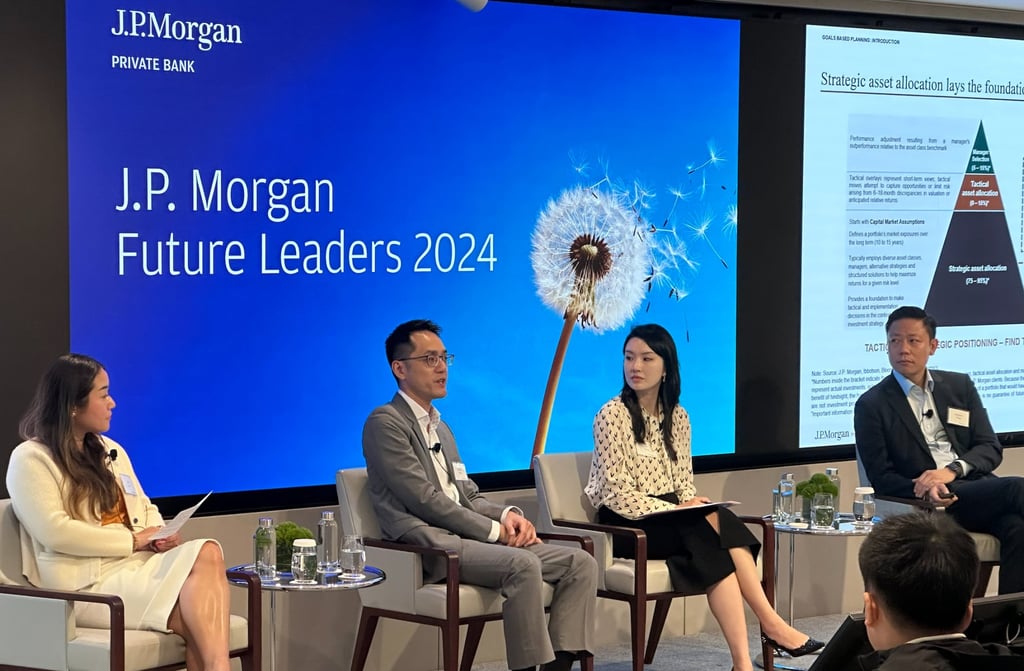
Through programmes such as the Future Leaders initiative, J.P. Morgan Private Bank helps empower the next generation of UHNW families with the knowledge needed to take up future financial and leadership responsibilities. “It’s about making sure that the next generation understands the particular skill set they will need to be custodians of the family’s wealth, if that is what the family and its successors want,” Knox says.
Alternative investments and cybersecurity
While the family office offers a wide scope of services, its primary goal is to preserve, grow and strategically manage the family’s wealth for the long term. According to the report, alternative assets account for 45 per cent of the average portfolio, including private equity, real estate, venture capital and hedge funds. For some clients in Asia, allocation to alternatives could reach up to 50 per cent for some portfolios, according to the bank.
For investors seeking diversification, alternative investments can mitigate portfolio volatility. Clients with sufficient wealth and a medium- or longer-term investment horizon may allocate some of their capital to alternative investments using strategies that serve different purposes.
J.P. Morgan Private Bank suggests a “barbell approach” for family offices, which aims to balance their portfolios with stable, semi-liquid structures and higher-return investments. This strategy combines various suitable alternative investment solutions that can enhance returns while reducing portfolio volatility.
Cybersecurity is another key area highlighted in the report. Forty per cent of family offices consider the tools and methodologies adopted to tackle the problem insufficient, while more than one in five still have no strategies in place to combat the threat. In an increasingly sophisticated cybersecurity landscape, almost a quarter of respondents said they have been exposed to a cybersecurity breach or financial fraud. “Many clients haven’t fully considered cybersecurity within their family offices,” Knox says. “As a bank, it’s something that we are constantly monitoring to protect ourselves and our clients, so there’s a lot of valuable insights we can share on this issue.”
Dedicated wealth management
With the growing complexity of global markets, more endowments, foundations and families are engaging trusted resources like J.P. Morgan Private Bank’s Outsourced Chief Investment Office (OCIO) to help manage their wealth. Clients gain access to experienced advisers and sophisticated tools which can function as their dedicated investment team, or serve as an extension of their internal investment resources. “One of the biggest challenges for family offices is hiring the right talent because trust is only built up over time, so many clients seek out our well-established OCIO capabilities to support their investment needs,” Knox says.
With more than 200 years of wealth management expertise, J.P. Morgan Private Bank has a deep understanding of the priorities of UHNW families and the best practices for setting up family offices. Its global team of dedicated wealth advisory experts offer personalised resources and guidance in investment management, wealth planning and cybersecurity. Additionally, they offer programmes such as Future Leaders for younger generations.
“Our role is to understand a family’s specific needs and, if necessary, challenge some of their assumptions about what they’re trying to accomplish. By doing so, we can help guide their decision on the best way forward to meet their goals,” Knox adds.