UOB Gateway to Asean Conference sheds light on abundant opportunities in the region
Bank brings annual event to Vietnam for its third edition, attended by senior executives, government officials and regional business leaders

The recent global economic recovery has been steady but challenging. Despite this, the near-term outlook for the Asean region remains positive – and one bright spot is Vietnam, with projected growth of nearly 6 per cent this year driven by a recovering export sector, robust foreign direct investment (FDI) and policy support, according to the International Monetary Fund.
As the commercial hub of one of the fastest-growing economies in Southeast Asia, Ho Chi Minh City took centre stage for the third annual UOB Gateway to Asean Conference in September. Hosted by UOB, one of Asia’s top banks, the event was held for the first time in Vietnam and brought together the bank’s top executives, government officials and business leaders to share insights and exchange ideas.
In his keynote speech, Phan Van Mai, chairman of the Ho Chi Minh City People’s Committee, said that the city’s already well-developed infrastructure, which encompasses roads, rail, air and sea links, will undergo further upgrades by 2030.
By that time, Asean is expected to have a combined population of 700 million. That demographic power, driven by educated and digitally savvy youth and a growing middle class, will make it the fourth-largest economy in the world.
Phan emphasised that with a burgeoning workforce of young, high-quality individuals, plus plans to upgrade technology at existing processing and industrial facilities while also investing in new ones, Ho Chi Minh City is well positioned to become an innovation hub for a range of advanced industries, including information technology, biotech, automation, new energies, semiconductors and electronic components.
The Gateway to Asean Conference reaffirms UOB’s long-term commitment to Vietnam. In 1993, it became the first Singaporean bank to establish a presence in the country – with only three employees. The number has since grown to more than 1,400 employees, spread across five branches in Ho Chi Minh City and Hanoi.
“For more than 30 years, the UOB Group has remained steadfast in serving our clients in Vietnam through market cycles and across diversified business franchises,” said deputy chairman and CEO Wee Ee Cheong. He added that in the past two years, the bank has helped more than 170 companies expand into Vietnam, with pledged investments valued at about S$2.4 billion (US$1.84 billion).
In 2011, UOB established the one-stop Foreign Direct Investment Advisory, which now has 10 dedicated centres across major Asian cities to help businesses navigate the diverse regional landscape.
“Our entire region, including Vietnam, is also attracting record levels of FDI inflows,” Cheong said. “Last year, global FDI fell 2 per cent, whereas Asean’s grew 1 per cent to reach a record of US$226 billion. With a combined GDP of US$3.6 trillion, the region’s economy is growing faster than most developed nations. We expect growth to reach around 5 per cent this year.”
More than 4,500 companies have utilised UOB’s FDI advisory services to expand overseas in the past 10 years, and S$42 billion in investments have been pledged by companies that the bank has served over the past four years. “As an Asean-focused bank,” Cheong pointed out, “UOB is well positioned to support business growth in our key markets across the region.”
Not surprisingly, two closely linked topics, sustainability and innovation, were on the agenda at the conference.
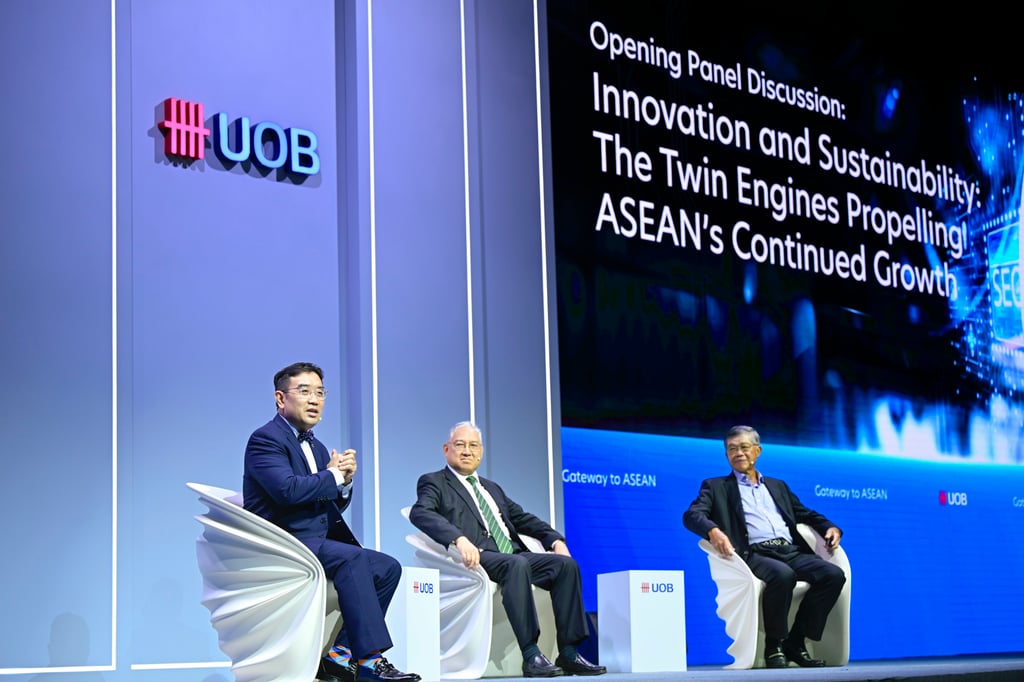
“One of the big fallacies about the global supply chain is the emphasis people put on things like labour costs or transportation costs per container,” said William Fung, a conference panellist who is group deputy chairman of global consumer goods supply chain giant Fung Group.
“The reality is that if you produce the wrong merchandise, your biggest cost is your markdown – or, worse still, unsold obsolete merchandise.”
Keeping manufacturing lean and the inventory low, he added, is also crucial, as it is good for the environment and the bottom line.
“You don’t produce more than you need or can consume, otherwise it goes into the landfills or is dumped in the ocean. We use a lot of technology … making sure that our customers can gauge demand as accurately as possible. Part and parcel of that approach is to have in place an optimal replenishment strategy for retailers selling our seasonal products.”
Another panellist, Goh Peng Ooi, founder and executive chairman of leading enterprise tech solution provider Silverlake Axis, shared his view that innovation may seem disruptive at first, but it is ultimately about making positive changes.
“We worry about technology replacing jobs … we used to work seven days a week, until midnight. Since we mechanised, we reduced the working week to six days. After automating, it’s down to five,” he said. “Soon we’ll have the technology in place to shorten it to three or four days.”
Goh cited two of his favourite books by Jim Collins – an American author and expert on corporate growth – to illustrate why some companies have become generational names and others have even been able to thrive during difficult times.

“Built to Last is about sustainability, and Great by Choice is about the challenge of making great choices,” he noted. “Because change is the only constant, when you build, you fight against change. You end up with the curve of diminishing returns. And that’s the reason why you have to reinvent, rebuild, rewire and remodel, and you have to go through that process and commit to the process.”
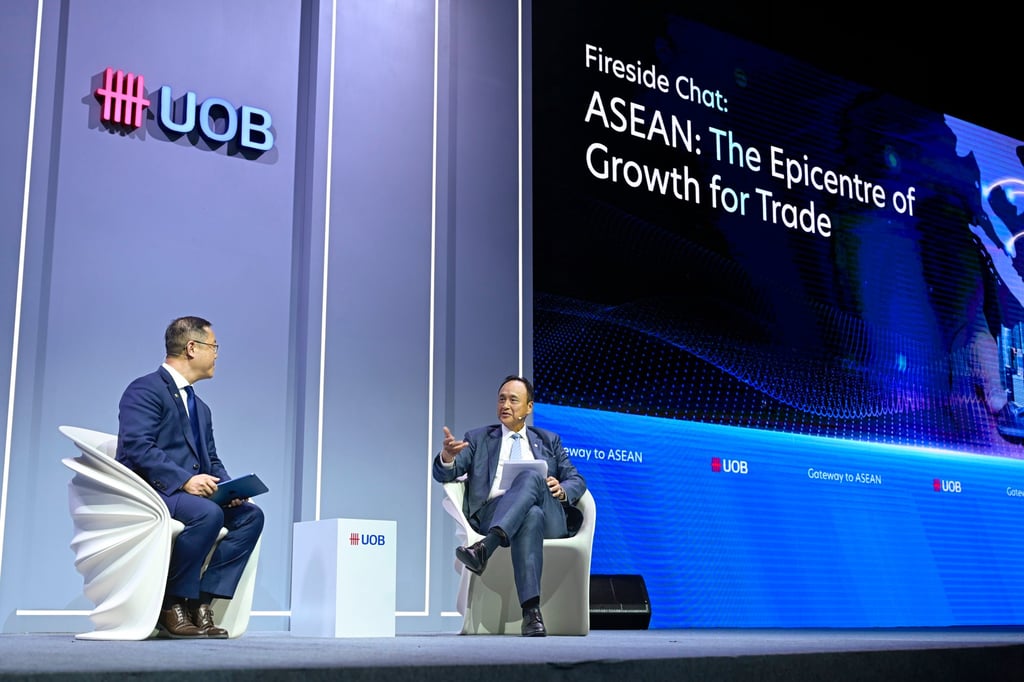
Frederick Chin, UOB’s head of group wholesale banking and markets, explained how the bank has similarly embraced innovation to meet the needs of an evolving business landscape. He shared these insights during a fireside chat titled “Asean: the Epicentre of Growth for Trade”, which was moderated by Kevin Huang, chief operating officer of the South China Morning Post.
“We don’t just bank individual companies, we bank the whole ecosystem along the supply chain, from buyers to sellers,” Chin said. “That enables us to connect, provide efficiency and deliver the best service. That’s the reason why we invested in a trusted and integrated digital platform to enable businesses to connect from point to point, from procurement to sales.
“We believe in the Asean moment now. We are here for the long term and look forward to partnering with all businesses as they build their future and make their mark in Asean.”
As UOB approaches its 90th anniversary next year, its extensive network in the region ideally positions it to help businesses connect within Asean and Greater China, and also with the rest of the world. Recognising and overcoming the challenges of such a diverse cultural bloc as Asean, with all of its distinct regulations, is where UOB has a unique advantage in serving clients across the region.
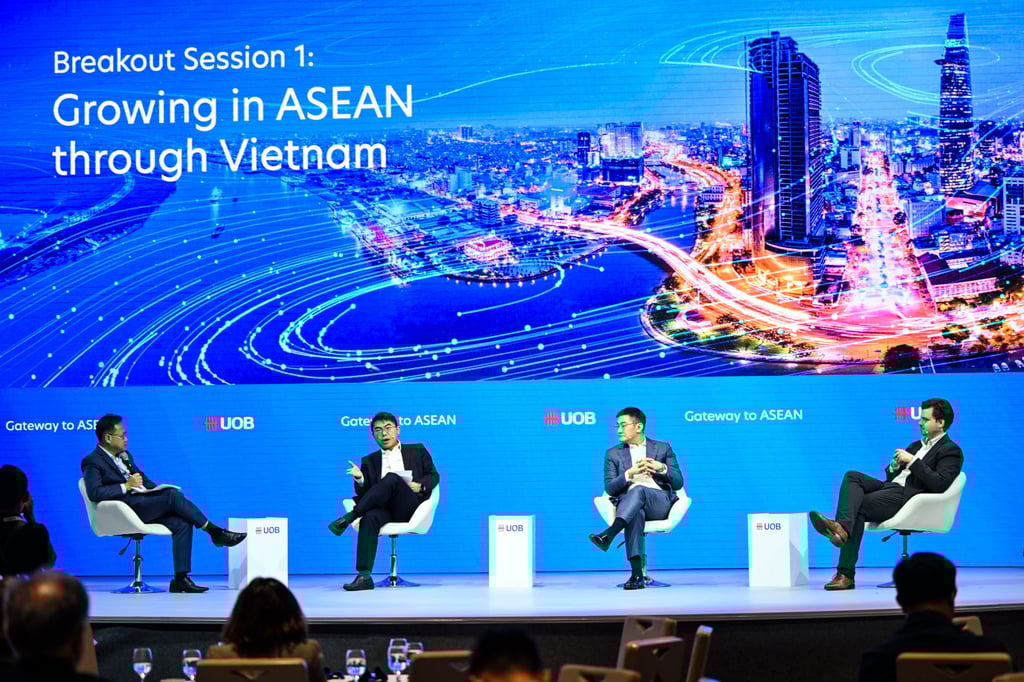
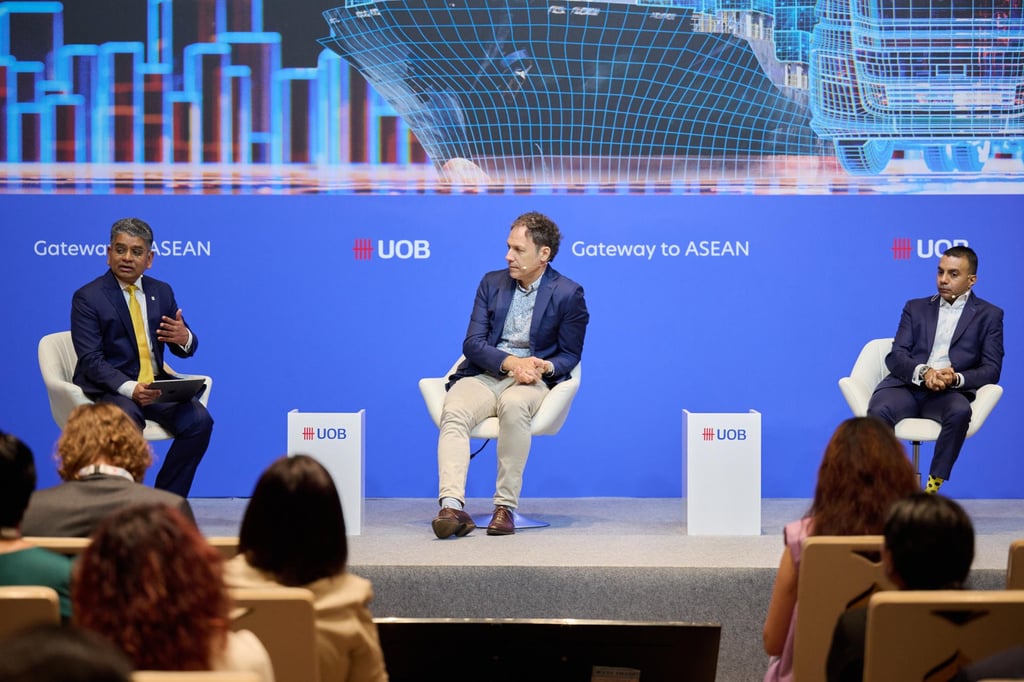
The final part of the conference featured three breakout panel sessions, titled “Growing in Asean through Vietnam”, “Innovating with Sustainability” and “Managing Supply Chains Showcase”, during which representatives from notable brands and leading businesses discussed how they are powering global supply chains while leveraging Asean’s economic rise.
The business leaders heaped praise on Vietnam for ticking all their boxes. They remarked on how the country stands out as the ideal location to serve the Asean region, having built strong commercial networks in just a few years with its wider neighbours and also having developed an ability to quickly complete paperwork and permissions for businesses to set up base there and get up and running.
In addition, they said innovation and sustainability should be seen as key pillars at the core of any business to help it thrive and become future-proofed. They further noted that putting those elements at the heart of any business will pay off in the long run. The panellists also pointed to the importance of diversifying and building relationships throughout supply chains and forming strong partnerships within the supply system, as those are key to business sustainability.