Hong Kong’s flourishing global financial centre a draw for investors
New Capital Investment Entrant Scheme underpins opportunities for global investors, with enhancements taking effect this month

Hong Kong’s position as a leading international wealth hub looks set to continue, with a robust financial infrastructure, mature commercial and business ecosystem, significant potential business opportunities and connectivity to Asia-Pacific all playing into its favour.
The city’s appeal as a global financial hub extends to its business ecosystem. Hong Kong is home to more of the world’s top 500 family enterprises than anywhere else in Asia, in addition to many global companies, multinational banks and financial institutions. Hong Kong is also driving entrepreneurship with the aim of transforming into a regional hub for innovation and technology, leading to more investment opportunities.
This ecosystem, along with a range of incentives to attract international investment and talent, is expected to strengthen economic growth and boost the city’s position as a global wealth centre.
Fast-track residency
Last year, the Hong Kong government launched the New Capital Investment Entrant Scheme (New CIES), an investment-migration initiative aimed at bringing new talent to Hong Kong and attracting investment to the city. The initiative covers a wide range of investment assets, including equities, debt securities, certificates of deposits, subordinated debt, eligible collective investment schemes, limited partnership funds and properties in Hong Kong. In addition, applicants are required to invest in a CIES Investment Portfolio, which will contribute to the long-term development of Hong Kong’s economy and society.
The initiative aims to grant wealthy individuals and their families fast-track residency in Hong Kong. According to InvestHK, the government body charged with bringing foreign direct investment into the city, more than 910 applications have been made for the scheme, potentially bringing an estimated HK$27 billion (US$3.5 billion) into Hong Kong’s economy.
What’s more, transformative enhancements of the net asset requirement designed to boost the New CIES take effect this month. Those high-net-worth individuals wishing to join it need only prove the ownership of assets or equity – which may include the respective portion of the assets jointly owned with family members which are absolutely beneficially entitled to the applicant – of HK$30 million or more in the preceding six months prior to the application for net asset assessment – as a reduction from the current requirement of two years.
In addition, permissible investments made through a wholly owned private company in the form of a family-owned investment holding vehicle (FIHV) or family-owned special purpose entity (FSPE) can be counted towards the investment requirements under the scheme, fostering synergy between the scheme and the establishment of family offices in Hong Kong.

“We have a stable and transparent regulatory environment that attracts international investors and high-net-worth individuals,” says Patrick Yip, vice-chair of Deloitte China. “These people are seeking secure and efficient wealth management solutions – and we have them.”
Favourable taxes
Hong Kong’s tax environment is characterised by low rates and simplicity: there is no sales tax or VAT; no investment withholding tax, capital gains tax or estate tax; and no tax on dividends or interest from savings. This straightforward system means individuals and businesses are only taxed on income sourced from within Hong Kong, making it particularly appealing for global high-net-worth individuals and investors.
In addition, there is a maximum salaries tax rate of just 17 per cent and corporate profits tax rates of 8.25 per cent on the first HK$2 million of profits and 16.5 per cent thereafter. These factors help Hong Kong stand out as a tax-friendly jurisdiction, contributing to its reputation as a global financial hub that attracts international investors seeking efficient ways to increase their wealth.
“In the complex world of global taxation, simplicity is hard to find. Unless, of course, you’re in Hong Kong,” says Yip. “In other places in the world, estate duty can go up to 40 per cent; in Hong Kong, we have zero. We have a simple tax regime that only taxes individuals on salaries and profits – at a maximum tax rate that is quite low by world standards.”
While most countries tax individuals based on their worldwide income and their place of residence, Hong Kong’s status as a Special Administrative Region of China allows individuals to take advantage of the “one country, two systems” principle, ensuring Hong Kong retains its independent immigration, monetary, fiscal and taxation systems, according to InvestHK.
The body says that as the only common law jurisdiction within China, Hong Kong benefits from a distinct legal framework that supports its competitive economy. In addition, it notes the city operates as a free port with an independent customs territory, imposing no restrictions on foreign ownership or the movement of capital, talent, goods or information.
Open market
Hong Kong aligns its regulatory framework with major international markets, facilitating the free flow of information and capital. It is ranked as the world’s freest economy among 165 jurisdictions, improving its position by one place since 2023, according to the Fraser Institute’s “Economic Freedom of the World 2024” report.
The city also excels in other key areas, securing the top rank for “Freedom to Trade Internationally” and “Regulation” while achieving third place in “Sound Money”, according to the report. This recognition underscores Hong Kong’s effective utilisation of its free-market advantages, which contribute to a transparent, open and equitable business environment.
One company that has benefited from Hong Kong’s favourable business environment is Crown Worldwide Group. The global logistics company established its Asian and global headquarters in Hong Kong in the 1970s.
“Establishing a business here was a very easy process, so we were able to be profitable from our first year,” says James Thompson, chairman and founder of the group. “As we expanded our business to other countries, we found that almost all of them had hidden issues or difficulties in establishing or running a business.”
Beyond finance
In addition to its deep talent pool, Hong Kong is home to five universities ranked among the world’s top 100 institutions, including the University of Hong Kong. This academic excellence further contributes to the city’s appeal as a hub for talent and investment, reinforcing its status as a prime destination for wealth management and financial services. Hong Kong also has world-class healthcare facilities and is considered one of the safest cities to live in, according to the World Population Review.

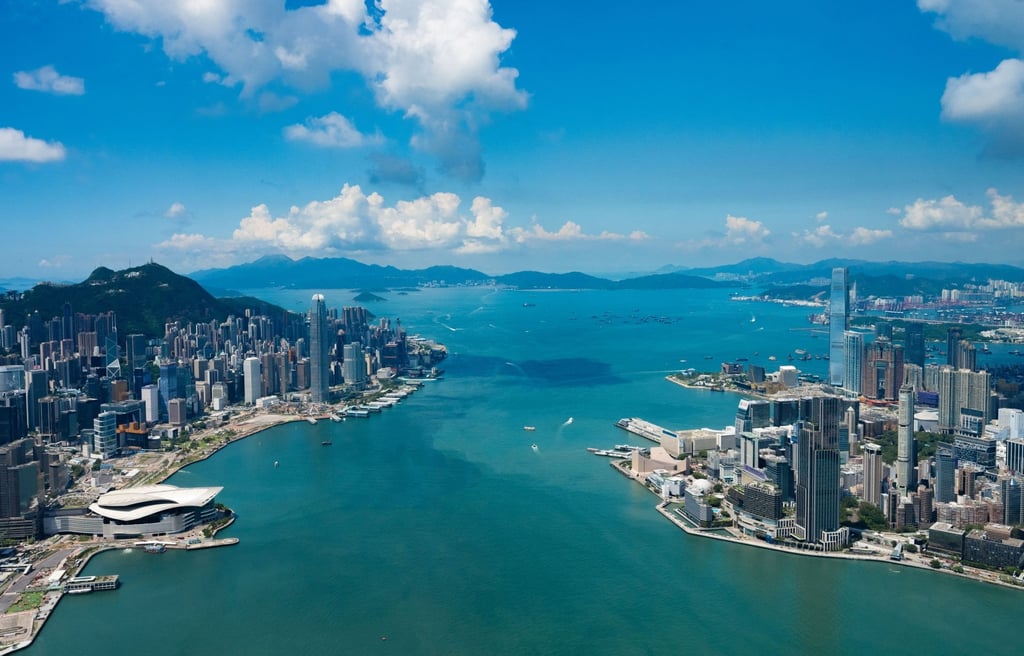
Hong Kong’s appeal as an international city goes well beyond its financial credentials. In addition to a striking harbourfront skyline set against a backdrop of mountains – with beaches and country parks just a short distance from the city – it is also a mecca for food lovers, with venues ranging from local dai pai dong (outdoor eateries) to Michelin-starred restaurants.
It also has a flourishing arts scene and hosts world-class events, including Art Basel, LIV Golf and the Hong Kong Sevens rugby tournament.
Thompson says the city also offers excellent schools, as well as a vast array of recreational activities and places to meet friends. “In my view, there is very little that is lacking,” he adds.