5 start-ups face EQT Impact Challenge 2025 public vote for a chance at grand finale
Expert panel of judges selects top contenders from more than 200 early-stage science and tech ventures

Hong Kong’s vibrant tech start-up scene has brought forward a stand-out group of contenders for the top prize in this year’s EQT Impact Challenge. The contest aims to find the leading pre-seed or early stage company to receive a grant and technical assistance from EQT, a global investment organisation with a strong track record in scaling innovative ventures.
More than 200 entrants initially competed for the chance to impress with their breakthrough concepts, business plans, financial models and ambitions to scale for long-term growth. From that initial pool, 10 were shortlisted for this year’s Jury Deliberation and Finalists Showcase, where they had the opportunity to pitch their business ideas to a panel of experienced judges.
The judges picked just five entrants to create video pitches that will be shared online so that the public can vote for the start-ups that will progress to the grand finale.
The pitching sessions were fast-paced and demanding, designed to mirror the real-world pressures start-ups face when presenting to prospective investors.
In addition, the winning start-up gets access to funding, strategic guidance and introductions to a network of industry experts, respected consultants and potential investors.
The second- and third-place finishers will each receive €50,000 from Central Cove Group, the private investment office of Jean Eric Salata, a jury member and chairman of EQT Asia. Salata, recognising the strength of this year’s entries and eager to champion Hong Kong’s emerging talent, opted to support the initiative directly.
The five hopefuls stood out because of the boldness and originality of their ideas, the thoroughness of their plans and their potential to have a far-reaching impact. Together they showcase not only innovation, but also some of the most pressing healthcare and environmental issues of today.
Alcarbo Technologies uses algae to capture and convert carbon dioxide into valuable by-products. Allegrow Biotech specialises in molecular engineering for immunotherapy, while Editact Therapeutics is working on gene therapy to tackle familial Alzheimer’s disease.
They are joined by Green Vigor, which uses water tanks to generate electricity, and Syngular Technology, whose goal is to use 3D imaging to improve the accuracy of complex surgical procedures.
Expert judges highlight stand-out ideas
EQT is one of the world’s largest investment firms and organiser of the event, with a mission to back transformative companies through strategic investment and operational support. The company has nearly three decades of investment experience in Hong Kong, lending deep market insight to its support for early-stage innovation.
Salata was joined on the jury by Anjum Rangwala, vice-president on the investment team of EQT Foundation, which is the philanthropic arm of EQT and oversees the EQT Impact Challenge.
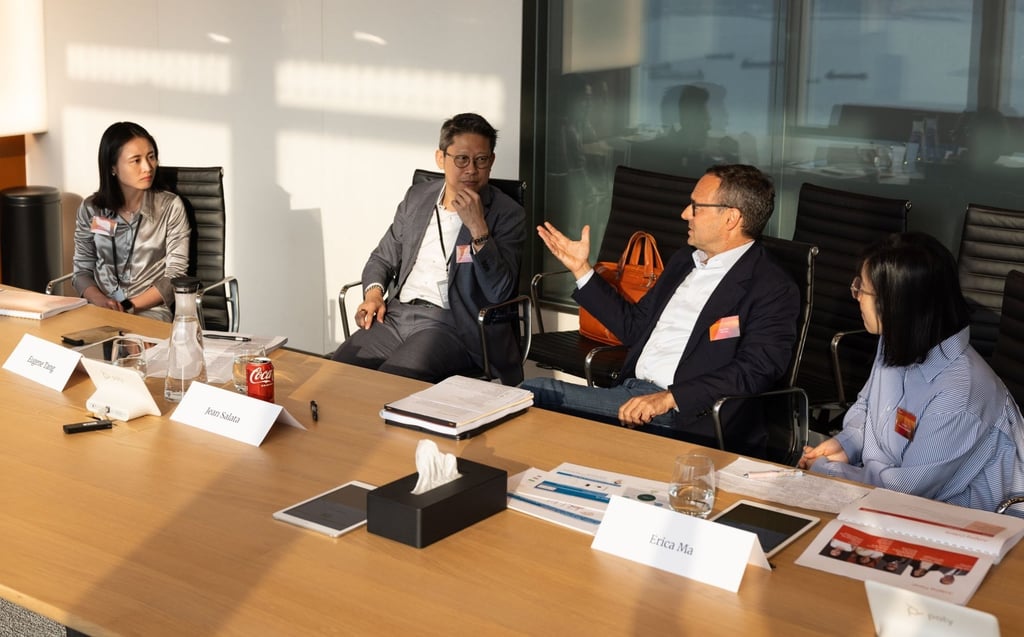
Other jury members were Eugene Tang, managing editor, business and projects, at the South China Morning Post, which is the co-organiser of this year’s competition; Joyce Li, portfolio management and fund strategy lead at 01Fintech Group; and Erica Ma, managing partner of Cocoon Ignite Ventures. Each judge brought unique expertise to the panel, offering insights based on diverse professional backgrounds.
Salata was impressed by Alcarbo’s presentation. “It is a very elegant solution that you could apply and scale to have a real impact,” he said. “I like how the founder talked about building [a carbon capturing site close to Yuen Long] in San Tin, leveraging the border between Hong Kong and Shenzhen. It’s a great way to represent the solution.”
For Li, it was clear that Allegrow’s innovative approach to cell therapy had the potential to revolutionise the field. “I thought their focus on reducing cell therapy costs and improving quality was impressive,” she said. “The fact that they’re targeting an unmet need and using biomaterials to recreate the in-body environment stood out to me.”
Ma felt that the potential cost accessibility of Allegrow’s solution meant it could really have an impact on a large part of the population.
Rangwala praised Editact’s focus on gene editing for familial diseases, something that could change many patients’ lives. “They’re starting with one indication [familial Alzheimer’s disease], but the technology can expand to 370 other inherited diseases,” she said. “The access and scalability piece is strong.”
Scalability was also a plus for Green Vigor’s water system, with Tang also highlighting its energy conservation benefits. “It’s a very localised solution, but it’s scalable enough to be implemented in every building,” he said. “I think the [system’s] modularity is a strong point, and the impact is significant.”
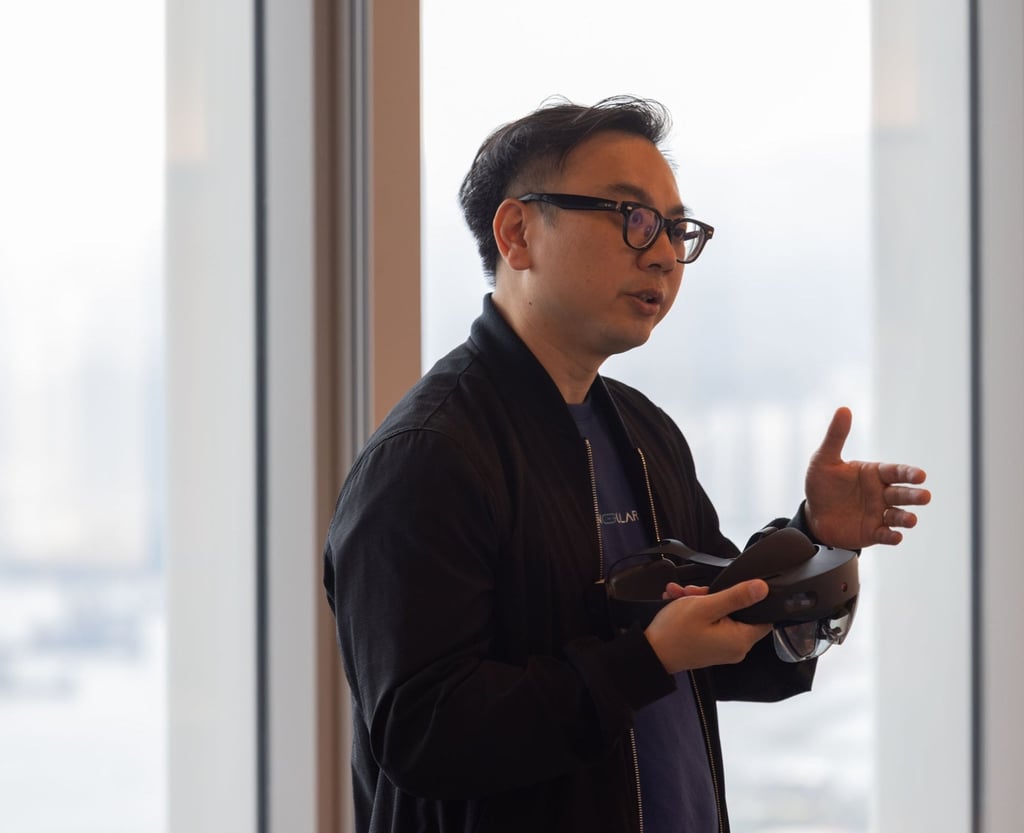
Syngular’s place in the top five was confirmed because of the way it was leveraging the latest developments in technology to improve life-saving surgeries.
“I gave them a high score, mainly because I felt like they are ready to showcase in Hong Kong,” Ma said. “They talk about how they’re going to be in the Prince of Wales orthopaedic hospital, and I think that’s a really strong indication of their readiness.”
Rigorous evaluation process
The aim of the EQT Impact Challenge, a pitch competition that has held previous editions in Japan, South Korea and Singapore, is to identify and then support innovators and entrepreneurs.
To get to the final round, the competing start-ups had to first pass a demanding assessment of their commercial and scientific viability. Each of the 10 science and technology-based start-ups selected for this year’s Finalists Showcase submitted a pitch deck outlining the strengths of their team, their funding targets, expected revenue streams and the science behind their innovations.
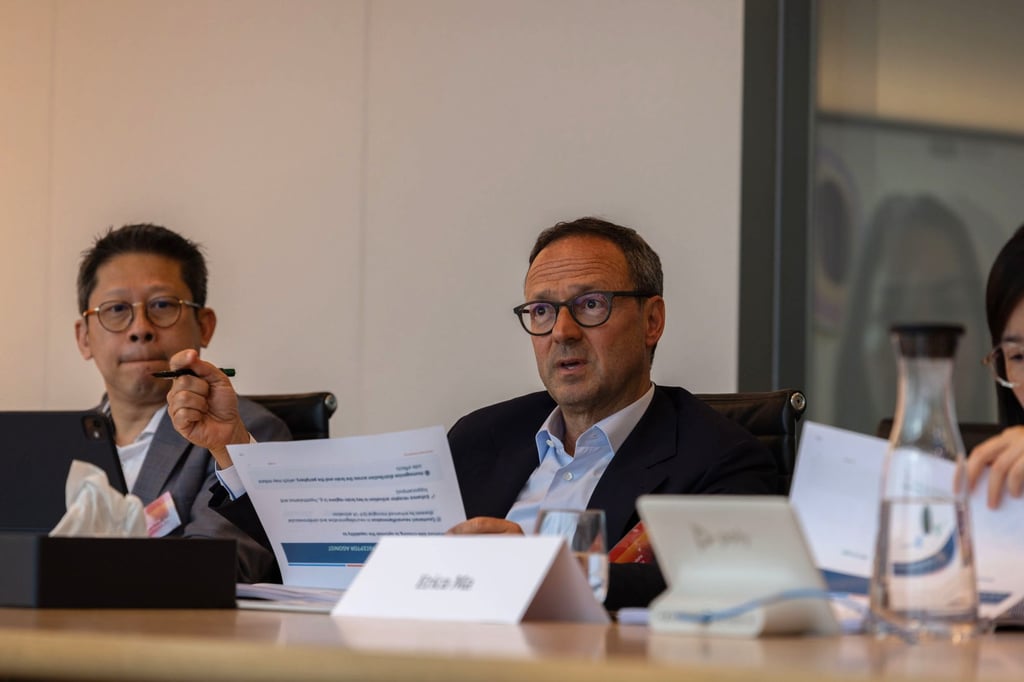
One speaker from each company had three minutes to present their case, followed by a five-minute question and answer session that allowed the jury to scrutinise the submission.
The panel drew on expertise across different sectors and a wealth of experience in what companies need to succeed, bringing diverse perspectives and a sharp appreciation of what might or might not work.
Their focus was on the obstacles a company might encounter, the strategies it would use to fend off rivals in the same field, as well as corporate structure, commercial viability, and long-term investment trends.
They also tested the candidates with questions on the technical aspects essential for getting a company off the ground and ensuring it thrives. They wanted to know the precise involvement of advisers mentioned in some of the presentations, whether letters of intent had actually been signed, in which jurisdictions patents had already been approved, and what the immediate next steps would be if additional funding was secured.

They also wanted to hear about risk mitigation, putting an effective sales team in place, adding more staff to support expansion, as well as companies’ strategies to incorporate artificial intelligence.
There was a geographic focus, too, as the judges also took note of how well the various contenders had taken advantage of what Hong Kong can offer to support go-ahead innovators and entrepreneurs.
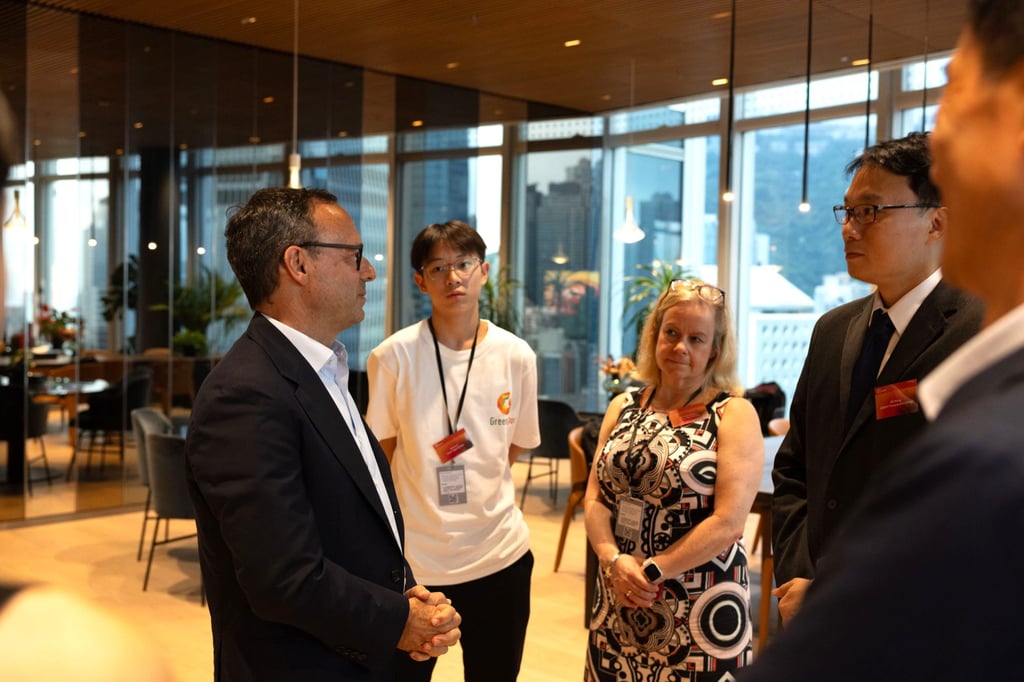
That includes not only advice from the academic community and experienced mentors, but also laboratory space for start-ups and a strong ecosystem for funding.
Also important are the readily available opportunities for collaboration with manufacturers in southern China’s Greater Bay Area, and with researchers, management talent, and fellow entrepreneurs from around the world, providing a launch pad not just for local growth, but also for regional and global scale-up.
Public vote
The five remaining competitors now compete to progress to the next stage of the EQT Impact Challenge – the grand finale – after receiving professional coaching from members of the growth team at EQT before recording a video pitch about their company.