Global Prosperity Summit 2026 maps out Hong Kong’s aerospace potential as city’s first astronaut takes flight
Experts at GPS 2026 say Hong Kong should leverage its expertise in professional services to drive aerospace sector development

As Hong Kong sent its first astronaut into space, leading industry experts at the Global Prosperity Summit 2026 (GPS 2026) said the city was well positioned to be a facilitator of aerospace development by tapping into emerging opportunities in the aerospace economy and contributing its professional services expertise to this burgeoning field.
Just days before it was announced that Hong Kong’s Lai Ka-ying would join the Shenzhou-23 mission to China’s Tiangong space station, experts who spoke at the two-day summit – including Professor Bernard Foing, executive director of the International Lunar Exploration Working Group; Professor Gao Yang, director of InnoHK’s Space Robotics and Energy Centre; and Dr Roger Tong, CEO of Asia Satellite Telecommunications Company – urged the city’s authorities to establish an official “space office” that could help facilitate strategic planning within the sector.
The “NewSpace” economy and wider aerospace industry were centre stage at GPS 2026, which ran from May 19 to 20 and was co-organised by the Savantas Policy Institute, the Shanghai Institutes for International Studies and the European Chamber of Commerce in Hong Kong.
While the city may not be able to compete with the likes of mainland China and the United States in building the hardware needed to send rockets into space, it is well positioned for downstream services.
New sectors of the aerospace economy the city should explore include a focus on embedded AI, software integration, and data applications in remote sensing, where it could leverage its expertise in innovation and technology, the experts at the summit’s panel on space development concurred.
Foing, who is also president of Space Renaissance International, told the panel that Hong Kong could go even further in its space aspirations as there was a new generation of spacecraft the city could take part in, as well as plans to explore deep space.
“As you are all space diplomats now from Hong Kong, you have this opportunity in the Greater Bay Area, in collaboration with the mainland, in Asia-Pacific, and also with the world, in particular with Europe,” Foing said.
“Hong Kong could become an architect of the next generation of spacecraft missions. The added value, particularly in high-value intelligent systems for space, could be developed in Hong Kong.”
Foing also pointed to the city’s advantages by leveraging technology to facilitate aerospace development, saying “newcomers with strong computer and AI skills can make a huge difference”.
“[Hong Kong] can have exponential growth because if a solution is developed here, it can be expanded to the whole world, especially when [the city is] well connected,” he said.
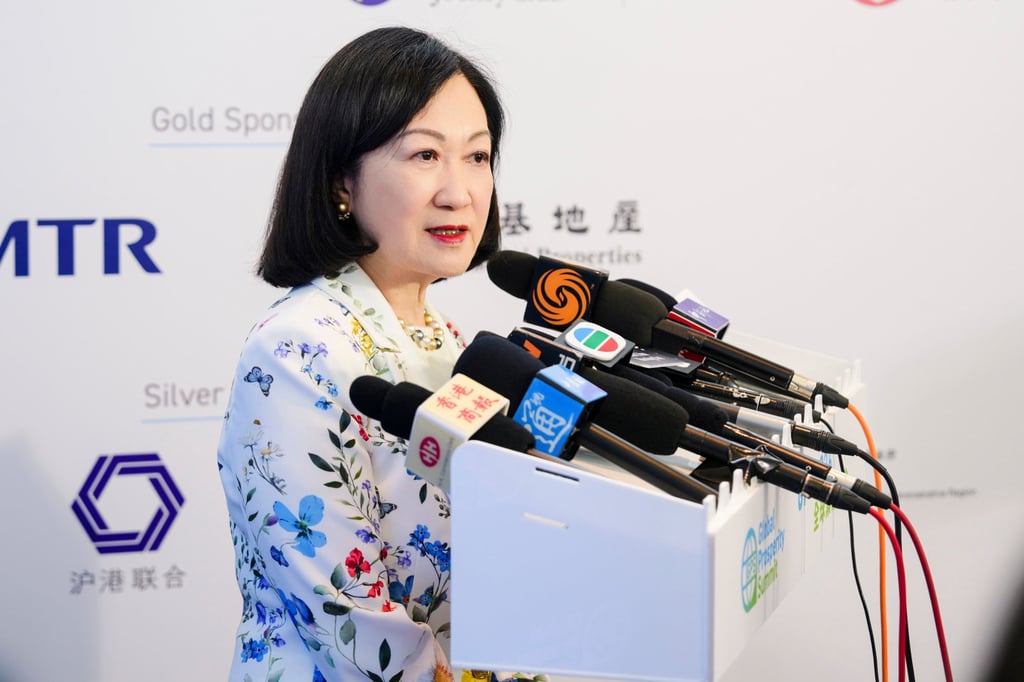
He urged for the setting up of an agency to lead the project – an idea that was also shared by other speakers of the panel and Regina Ip, the founder of GPS and chair of the board of governors of the Savantas Policy Institute.
In her concluding remarks of the summit, Ip said: “One of my takeaways from the summit is the urgency of Hong Kong to establish a space office, so that Hong Kong can play a key role in the space economy.”
Ip said the city could provide services on multiple fronts, including financial, legal and arbitration services, as well as satellite data analysis for emerging aerospace companies.
“This is something Hong Kong can do, because we have strong foundations and a well-established services system to support development of the new aerospace economy,” she said.
Gao also said she strongly supported the Hong Kong government in considering aerospace as an important component of the city’s first five-year plan, with public consultations due to begin in early June.
“Hong Kong is well positioned to contribute to aerospace development in many aspects,” she said.
Gao, who is also director of the Hong Kong University of Science and Technology’s Centre for AI Robotics in Space Sustainability, explained that the aerospace industry was currently undergoing a transformation from a more traditional concept to a “new space paradigm”.
“This presents a favourable opportunity for regions that are new to developing aerospace. Hong Kong can seize the moment to fully leverage its strengths in scientific research and innovation – especially in areas such as AI and aerospace,” she said.
“In addition, Hong Kong can also capitalise on its long-established advantages in the rule of law and finance services, which would be highly beneficial to its development in this sector.”
Tong pointed to the urgent need for the government to set up a space office, noting the city was far behind in the space industry but was now catching up.
“I think it’s absolutely important [that] the government should have a space office to align university research, talent development, international participation and also dealing with geopolitics,” he said, adding that these were things that the government should be doing.
During GPS 2026, attendees heard that the space economy could contribute to Hong Kong’s GDP growth by between 2 to 3 per cent over the next two years, should the industry continue to develop.
The economic potential of the global space economy is huge, according to a 2024 World Economic Forum report which projected its size would surge from around US$630 billion in 2023 to about US$1.8 trillion by 2035, at an annual growth rate of 9 per cent.
With the fast-changing scene in aerospace development, the Chief Executive’s Policy Unit of the Hong Kong government has already hosted a high-level round table on the space economy, inviting academics, investors and experts from the mainland and overseas to discuss strategic positioning and opportunities in a global space economy.
The unit said the city had a landmark opportunity as Beijing tapped “explosive industrial expansion” through its 15th five-year plan, aiming to cement China’s status as a “major space power”. Chief Executive John Lee Ka-chiu highlighted the sector and Hong Kong’s advantages in his policy address last year.
The latest budget delivered by Financial Secretary Paul Chan Mo-po in February gave further momentum to the city’s aerospace industry. Among key initiatives announced were a request for Hong Kong Exchanges and Clearing to review listing requirements for aerospace enterprises, as well as a directive for the Office of Attracting Strategic Enterprises to identify aerospace companies to develop in the city.