Defining the Asean century: Singapore event explores region’s path to a sustainable future
Asean Conference 2024 examines the growth of Southeast Asian economies, green investment and the importance of cross-regional collaboration
The eighth edition of the Asean Conference, with the theme of “Reimagining Asean for a Sustainable Tomorrow”, took place August 29 at the Sands Expo and Convention Centre in Singapore. The annual event – organised by the Singapore Business Federation, with support from Singapore-based bank UOB as a founding partner – brought together more than 500 government leaders and C-suite executives from 13 countries to facilitate regional economic dialogues and provide insights into how businesses can use available resources to drive growth.
The conference kicked off with a ministerial dialogue featuring Gan Kim Yong, Singapore’s deputy prime minister and minister for trade and industry, who underscored the pivotal role that regional partnerships will play in transforming the Association of Southeast Asian Nations bloc into a global hub for innovation and sustainable growth. He also emphasised the region’s growing significance to the global economy amid a climate of rising tensions around the world.

Echoing this sentiment, Wee Ee Cheong, deputy chairman and CEO of UOB, noted in his opening address to the conference that despite global challenges, Asean economies have shown remarkable resilience, consistently outpacing global growth. He also reaffirmed UOB’s commitment to Southeast Asia by partnering with government investment agencies to aid companies looking to expand beyond their borders.
The Asean Conference also featured two panel discussions that offered insights into region-wide economic development. The first panel reviewed the progress and achievements made under the Asean Economic Community Blueprint 2025, examining the impact of economic integration on regional businesses and also looking towards the next steps.
The second panel addressed the circular economy, discussing emerging trends as well as how new resources and financial tools can be used by businesses to reassess and enhance their strategies within the region.
During the second half of the day, individual markets were explored in breakout sessions focused on Indonesia, Malaysia and Thailand. These market breakouts featured panel discussions on Indonesia’s digital landscape and sustainability investments, Malaysia’s business and investment prospects, and Thailand’s opportunities for green investment.

Opening the Malaysia Market Breakout, Ng Wei Wei, CEO of UOB Malaysia, remarked on the impact that the country’s economy has on the Asean region and the wider world.
She pointed to the Malaysian state of Penang and its critical role as a “Silicon Valley of the East”, contributing about 8 per cent of global semiconductor output. In addition, Ng noted that German semiconductor company Infineon Technologies AG is building the world’s largest front-end wafer fabrication plant in Malaysia, thereby increasing global reliance on the country’s technological manufacturing sector.
Ng also told attendees that infrastructure developments in Malaysia’s Sarawak state are poised to help transform the region into a “major renewable energy powerhouse” that is ready to meet the growing global demand for green energy.
The Malaysia breakout session also featured a keynote speech by Dato’ Dr Azfar Mohamad Mustafar, Malaysia’s high commissioner to Singapore, who highlighted the country’s recent strides towards building a circular economy while also leading the transition to green energy in Southeast Asia.
“In addition to sustainability, Malaysia is embracing green technology as a key driver of our investment in digital infrastructure. From testing and access to external literacy programmes, we are empowering a new generation of innovators,” he said.
Incorporating sustainable practices is also a core strategy for Thailand’s economic growth, according to Richard Maloney, CEO of UOB Thailand. Speaking at the opening of the Thailand Market Breakout, he noted that the country is positioning itself as a leader in renewable energy, green finance and sustainable tourism by leveraging its strategic location at the heart of Southeast Asia, as well as strong collaboration between government, financial institutions and the private sector.
“This is about more than meeting international standards,” he said. “It is about shaping a sustainable future that aligns with global priorities while fostering economic growth.”
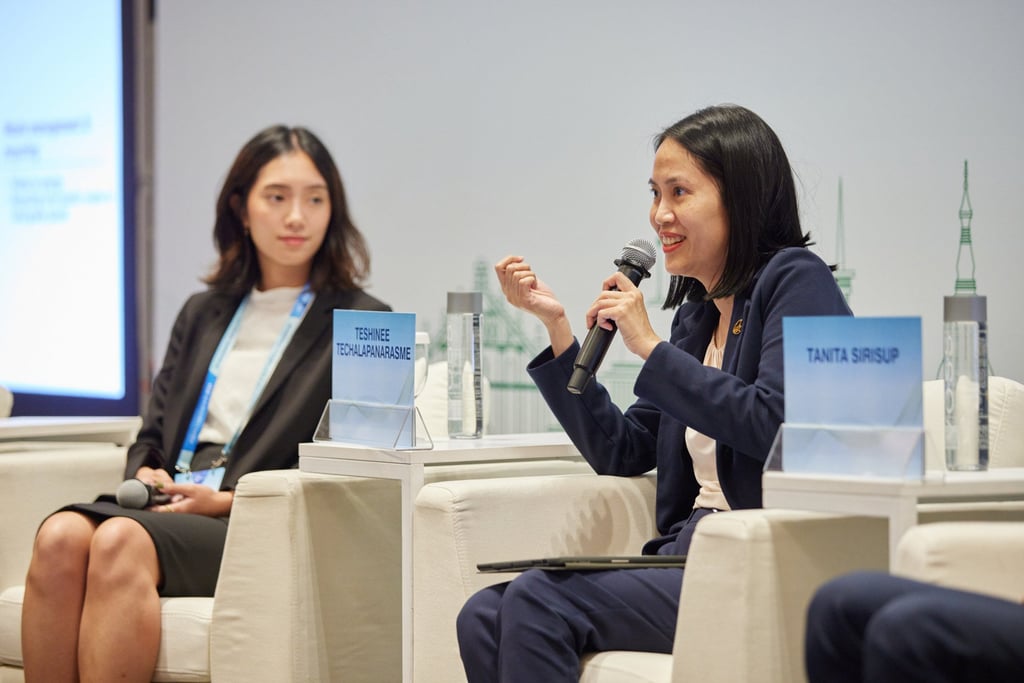
Later in the breakout session, Tanita Sirisup, executive director of the Thailand Board of Investment (BOI), expounded on the various ways in which the country has enhanced its capacity for a greener economy. They include maximising natural resources, providing renewable energy, promoting reuse over waste, reducing pollution, creating future-ready food sources and promoting eco-friendly biocomplexes.
She highlighted the BOI’s far-reaching green incentives that are being offered to investors and businesses that adopt sustainable practices or venture into more environmentally conscious businesses.
“If they make an additional investment to turn themselves into a smart and sustainable industry, we also provide additional incentives,” she told breakout attendees. Sirisup added that cross-regional partnerships like the one between Thailand and Singapore can prove to be mutually beneficial in driving prosperity and a sustainable future.
Watch the video to see how the 2024 Asean Conference unfolded, including discussions about the region’s emerging economic trends, key growth drivers and new business opportunities. Also hear from UOB’s leaders in Indonesia, Malaysia and Thailand as they share insights into their respective markets.