New Shaw Prize computer science category honours more innovators who benefit society
Expansion of prestigious annual award recognises field of study’s growing role in changing the way the world communicates

Since its inception, the Shaw Prize has honoured individuals who have made recent groundbreaking contributions to modern civilisation through their academic and scientific work.
It has enabled these scientists working in the fields of astronomy, life science and medicine, and mathematical sciences and their discoveries benefiting humankind to also inspire a new generation of innovators to make contributions to the world with their skills and talent.
The prestigious annual international award was launched in 2002 by the late Hong Kong media mogul and philanthropist Sir Run Run Shaw, and first presented in 2004. Past recipients include the Japanese stem cell researcher Professor Shinya Yamanaka, who received the 2008 Shaw Prize in Life Science and Medicine for his work that opened up new frontiers in regenerative medicine and personalised therapies.
Another notable laureate, British theoretical astrophysicist Professor Roger D Blandford, won the 2020 Shaw Prize in Astronomy for numerous contributions, in particular helping us understand one of the universe’s most powerful and mysterious phenomena – the theory that energy extracted by black holes is the source of electromagnetic radiation emitted from the centre of a galaxy.
Last month, the Shaw Prize Foundation, which manages and administers the award, announced that computer science – the study of computation and information in all their forms – will be added as a fourth category. The nominations will begin this September, with the winner or winners of the inaugural Shaw Prize in Computer Science announced in May or June next year and presented at the award ceremony in October or November next year.
Dr Raymond Chan, chair and council member of the foundation, believes the addition of this award reflects the evolving nature of scientific inquiry and is a timely and necessary move. “Our mission has always been to honour contributions that benefit humanity, and computer science is the foundation of today’s world-changing technologies,” he says.
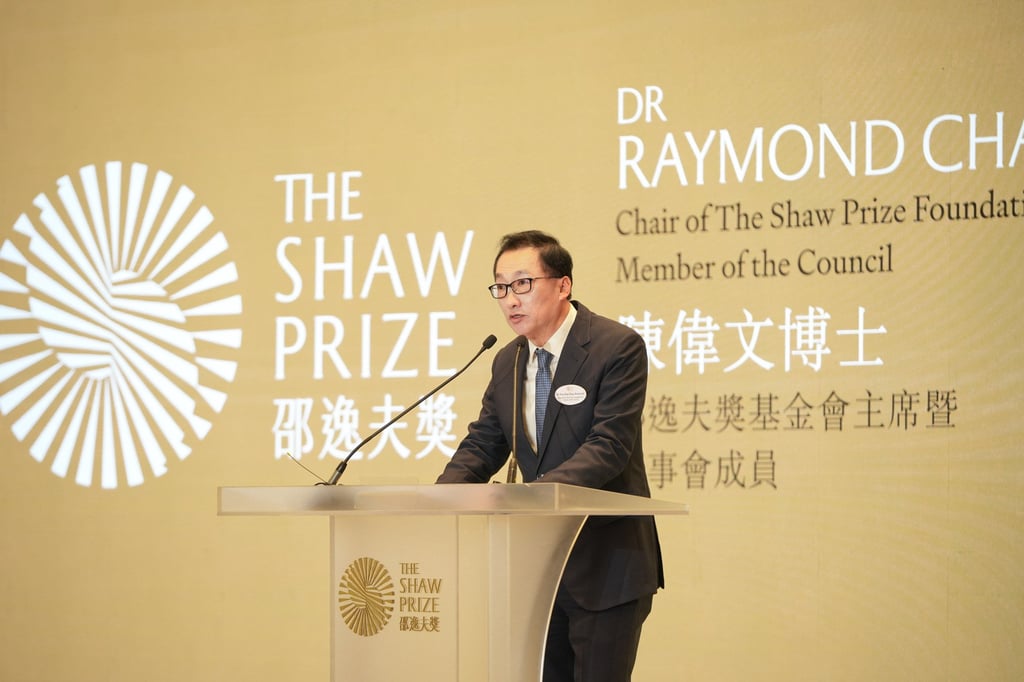
“It aligns with our core vision of recognising contributions to basic knowledge, while also being a key driver for breakthroughs in other fields – like [artificial intelligence (AI) computer system] AlphaFold’s impact on life sciences.” The program, developed by Google DeepMind, predicts a protein’s 3D structure from its amino acid sequence.
The breakthrough, which can be used in applications including the better understanding of antibiotic resistance, was one of two discoveries honoured jointly with the 2024 Nobel Prize for chemistry.
Although still a relatively young discipline, computer science has become essential to modern life. From healthcare and sustainability to communication and AI, it underpins countless technological transformations. However, the field remains under-represented in the global scientific awards landscape.
“There is a recognised gap in major international awards dedicated solely to computer science, both in Asia and globally,” Chan says. “This prize helps to address that.”
Leading the Shaw Prize in Computer Science selection committee is Professor Jennifer Tour Chayes, a mathematician turned computer scientist who is dean of the University of California, Berkeley’s College of Computing, Data Science, and Society, which Chayes helped to establish in 2023. It was the first new college at Berkeley in more than 50 years.
Chayes entered the field of computer science later than most, at the age of 40, after a chance encounter opened her eyes to how the mathematics she was using in physics and statistics also applied to computation.
That epiphany sparked a career shift that led her to American technology conglomerate Microsoft, where Chayes was its technical fellow and spent more than 20 years leading various research programmes and was founder and managing director of three interdisciplinary labs: Microsoft Research New England, New York City and Montreal.

Since joining Berkeley in 2020, Chayes has led interdisciplinary research initiatives that connect computing with things such as medicine and climate science. For example, one of her recent collaborations uses generative AI to speed up the development of materials that can capture carbon dioxide from the air – a key technology in the fight against climate change.
Working together with Berkeley chemist Professor Omar Yaghi, the winner of the 2025 Nobel Prize for chemistry, Chayes and her team use AI to design metal-organic frameworks and covalent organic frameworks – porous structures that act like super sponges, which are capable of trapping gases, such as carbon, or water directly from the air.
“Every time we think of a new material, it would take Omar two to three years to make it,” she says. “Now, with generative AI [computer systems that can copy intelligent human behaviour and produce new content, especially text or images], we have shortened the process to about two weeks.”
Early computer science focused on hardware and programming languages, but today it also encompasses disciplines such as machine learning, data science, systems design and ethics. “We’re entering an age of agents,” Chayes says, referring to autonomous AI systems. “It is very important to realise that human beings should be learning to interact in teams with AI agents – to co-evolve with them as a team.”
Chan believes that advances in computer science will see the field of study continue to play a vital role in addressing major global challenges in areas including healthcare, climate and sustainable development.
In medicine, for example, these emerging technologies will be used in diagnostics, with machine systems helping to detect early signs of diseases such as cancer and being used as tools to help screen and identify patients who need urgent care, especially when human resources are limited.
He also believes that the new Shaw Prize in Computer Science, together with the existing categories, will “better represent the interconnected landscape of modern science”.
“The Shaw Prize is dedicated to honouring those who push fundamental boundaries while keeping human benefit central to their work,” Chan says. “The prize itself opens doors to increased support from their institutions and collaborators. The foundation will also help amplify the visibility of their work and facilitate more meaningful connections for their research.”
Above all, Chayes sees the addition of the computer science category as an opportunity to highlight contributions that have reshaped the field and encourage young scientists from all walks of life to become interested in the subject.
“Computer science is an incredibly rewarding field where you can have a big impact and address some of the greatest questions in science,” she says, while offering advice to students considering the subject. “Believe in yourself and aspire to do great things, because even if you don’t quite meet those goals, the journey itself will be transformative.”