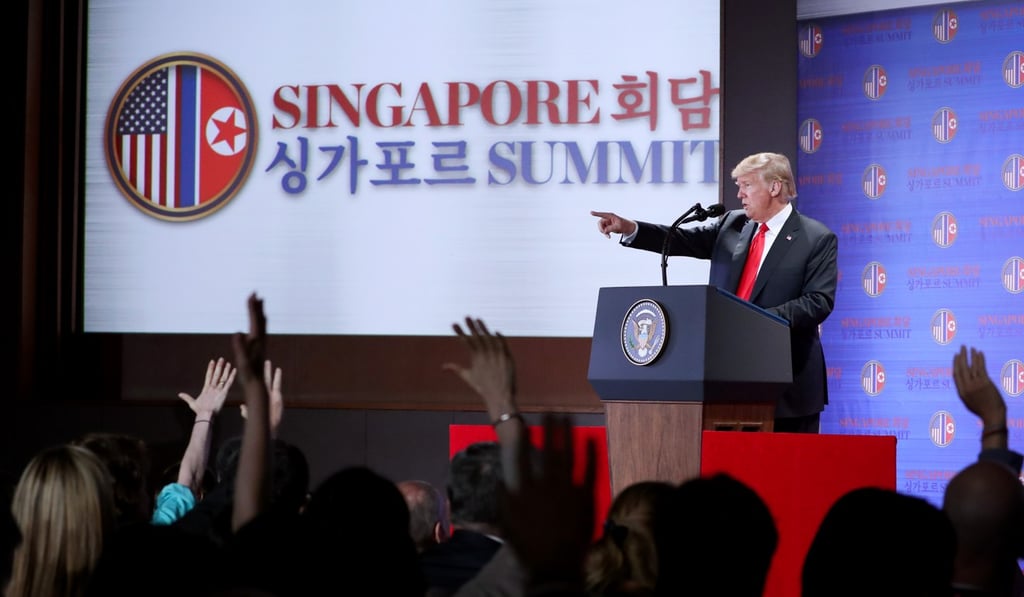
‘Those are literally the North Korean and Chinese talking points’: why Trump’s decision to halt military exercises with South Korea makes allies nervous
Previously, the US has insisted these kinds of drills are defensive measures to demonstrate US and South Korean preparedness to respond promptly to any aggression by the North

US President Donald Trump’s decision to suspend major US military exercises in South Korea could weaken allied defences, depending on the length and scope of the hiatus. But the potential for diplomatic damage seems even greater.
The US, South Korea and Japan were making a public display of solidarity on Thursday over the outcome of Trump’s summit with North Korea’s Kim Jong-un. But analysts and former officials with experience in US-Asia policy were shaken by Trump’s failure to inform the Asian allies – or even the Pentagon – before mothballing the military manoeuvres.
“Those exercises are critically important because they are deterrence,” said Chuck Hagel, a former defence secretary in the Obama administration. He welcomed Trump’s willingness to talk to Kim but worried that the president has underestimated the complications he has introduced for the Pentagon by suspending the military drills. “You don’t just shut them on and off like a water faucet.”
The exercises in question go well beyond routine training, which apparently is unaffected by Trump’s decision. Large-scale exercises are done to ensure that evolving tactics, procedures and plans can be carried out smoothly and that US and South Korean forces are in sync. They also are a means of showing allied solidarity, which is part of the psychology of deterring enemy attack.
The US has stationed combat troops in South Korea since the Korean war ended in 1953 with an armistice and no peace treaty. The more than 28,000 US forces serve as a military trip-wire against North Korean aggression. The next major exercise with South Korea is known as Ulchi Freedom Guardian; last year’s version was held for 11 days in August and involved about 17,500 US troops.
The US has insisted these kinds of drills are defensive measures to demonstrate US and South Korean preparedness to respond promptly to any aggression by the North. But when Trump announced his decision to halt them, he characterised them as “provocative” and as “war games”.