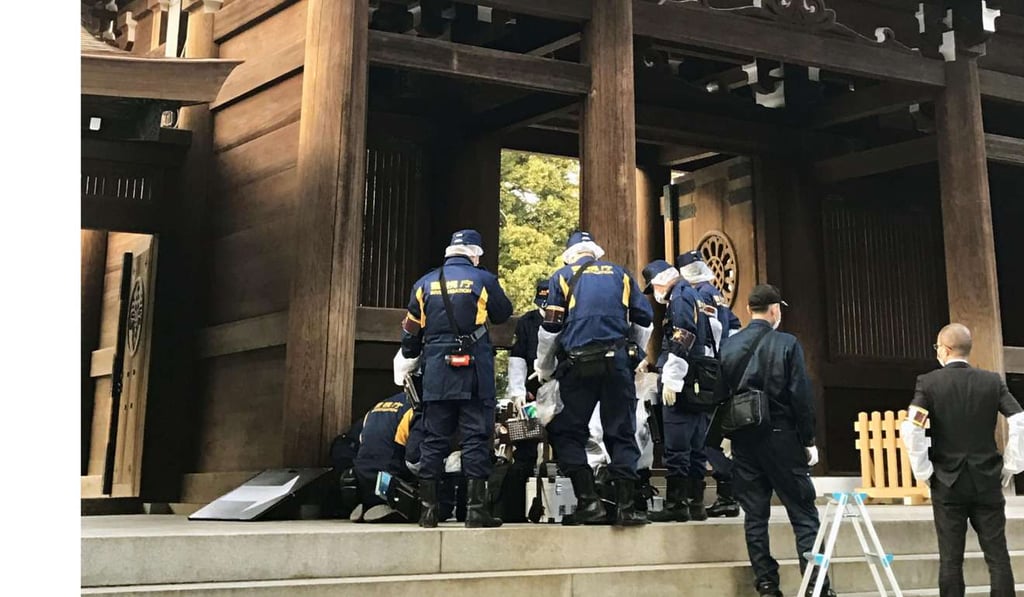
Japanese police are investigating another outbreak of vandalism in which small amounts of an oily liquid have been used to deface some of the most famous shrines and temples in the country.
Oil stains were found this week in at least a dozen locations within the precincts of Tokyo’s Zojoji Temple, parts of which are designated as national important cultural properties and date back to 1622.
The viscous liquid was identified on the temple bell, the main gate and a stone statue.
The same day, similar oily stains were found on the gate of Meiji Shrine, one of the most important Shinto venues in Tokyo and with a long and close association with the Imperial family.
Over the preceding weekend, someone had deliberately squirted an oily substance at places within Shimogamo Shrine, a Unesco World Heritage site in Kyoto, while the main hall of Kimpusenji, a Buddhist temple in Nara Prefecture, was similarly defaced.
The episodes have immediately drawn comparisons with a series of almost identical incidents that commenced in 2015 and continued until November of last year. In total, police in 16 prefectures across the country looked into cases in which oil was sprayed or splashed on 48 temples or shrines, as well as Nijo Castle in Kyoto.