Shipwreck recovered off South Korea reveals hidden secrets about Chinese porcelain, trade and culture
- In 1323, the large trade ship left Ningbo, Zhejiang Province, eastbound for Japan’s Hakata port in Fukuoka
- It drifted north, possibly in a summer storm, and foundered in the strait between Imja island and Jeung island in Sinan County

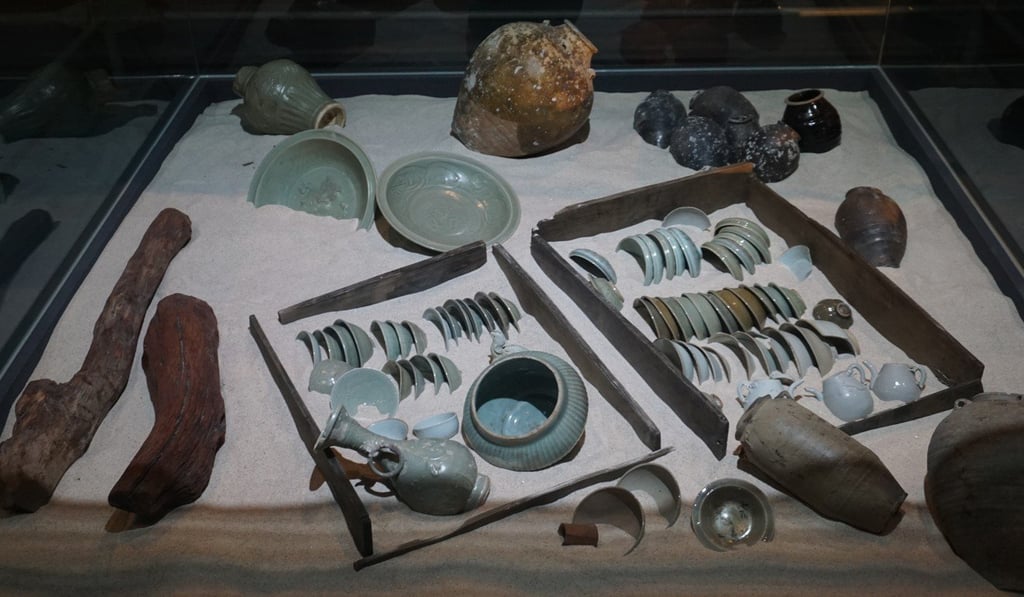
A 14th-century Chinese trading ship, which was wrecked carrying priceless cargoes before being discovered in 1976 off the southern coast of South Korea, provides an endless source of information about China’s porcelain manufacturing, maritime trade and high culture in East Asia.
The National Museum of Korea in Seoul marked the 40th anniversary of the discovery of the treasure boat in Sinan County with a special exhibition in 2016 and published in three volumes the results of decades of examinations of 24,000 recovered relics. Most recently, the museum opened a special display of 180 of 800 black-glazed porcelains from the wreck. The museum also has a permanent display corner dedicated to Sinan shipwreck treasures.
“This is a rare chance of seeing the highly prized black glazed porcelains manufactured at various kilns in 14th-century China that have been brought together in the same place,” curator Kim Young-mi said .
These porcelains turned out to be closely associated with China’s tea consumption, which was also enthusiastically embraced by Japanese nobles. The porcelains, now on display at a special exhibition at the museum, were made in Jiangxi province, Hebei province and more importantly Fujian province, where the famous Jian kilns produced the most prized pieces, especially in Japan.
The exhibition includes about 60 tea bowls from Jian kilns during the Southern song period (1127-1279) which were already being traded as antiques at that time. During this period, people placed powdered tea leaves in deep bowls, added warm water and stirred it to create foam before drinking. This method was later replaced by brewing tea with warm water and tea leaves.
In 1323, a large trade ship left Ningbo, Zhejiang Province, eastbound for Japan’s Hakata port in Fukuoka. The 260-ton vessel, 34 metres long and 11 metres wide, was carrying Chinese ceramics, wooden lacquer ware and metal crafts. At the lower part of the hull were a large tank for portable water, 8 million bronze coins weighing 28 tons and pieces of red sandalwood used for making furniture. these items also served as ballast.