Advertisement
Advertisement
Coronavirus pandemic: All stories
Get more with myNEWS
A personalised news feed of stories that matter to you
Learn more
A handful of people walk on the usually busy Takeshita street in Tokyo's Harajuku district on Wednesday. Photo: AFP

Coronavirus: Japan’s major cities go quiet after state of emergency declared

  • The declaration, covering roughly 56 million people, enables local governors to impose stay-home orders and restrict the operation of certain facilities
  • Grocery shopping, visits to hospitals and commuting are still allowed under the month-long state of emergency
Tokyo and some major cities in Japan appeared unusually quiet on Wednesday with many stores shut and fewer people in the streets, a day after a state of emergency was declared because of the new coronavirus pandemic.

Aside from supermarkets, chemists and others providing critical services, many businesses in Tokyo, Osaka and the five other prefectures for which the emergency was declared have decided to stay closed through May 6 in line with the government’s request for people to stay at home and limit social contact.

Japan PM declares state of emergency, unveils stimulus package

The closed businesses include major department stores, cinemas, bowling alleys and shops inside station buildings. Department store sections selling food, however, continued to operate.

Trains and buses were running, although the number of people taking them was significantly lower than usual.
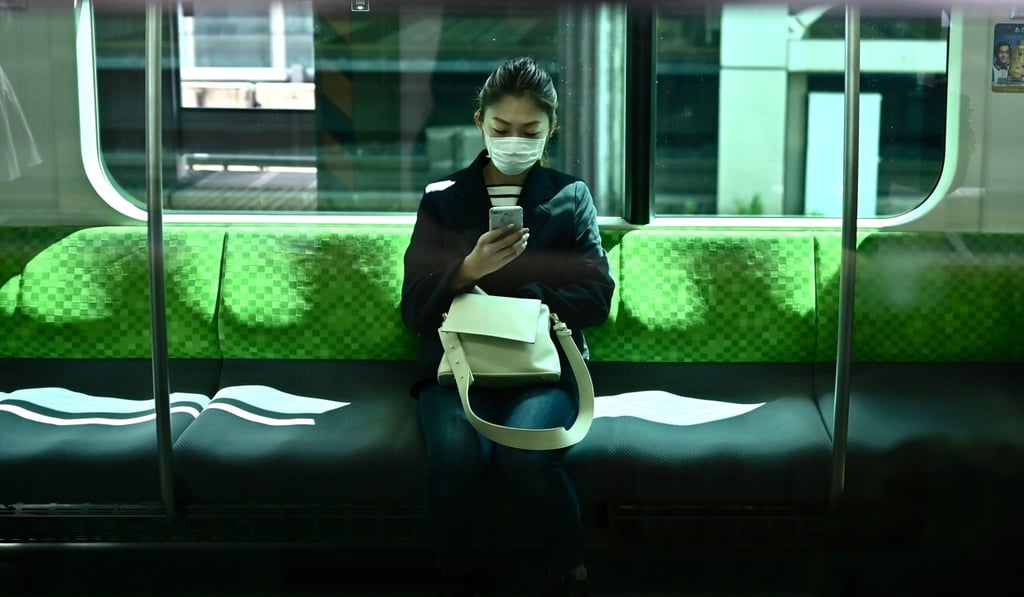
A woman uses her phone on a train in Tokyo on Wednesday, the first day of the state of emergency. Photo: AFP

“On a usual morning, traffic is very busy here, but I feel there are significantly fewer commuters [today],” said a 59-year-old company executive in front of JR Yurakucho Station in central Tokyo.

“We have employees working from home, but there are tasks that force me to come to office, such as dealing with some documents that need to be signed with a seal.”

Many stores in a major shopping arcade at Tokyo’s Sugamo area, which is popular among elderly people, posted closure notices on their doors.

“A popular shop for which people usually line up is also closed. I know it can’t be helped, but it is sad,” said Yoshiko Takahashi, 79, who lives nearby. “I hope this comes to an end quickly so we can go out happily.”

A man wearing a face mask walks inside the grounds of the almost empty Zozoji Buddhist temple near the landmark Tokyo Tower on Wednesday. Photo: AFP

Nobuo Toku, 74, who has decided to open his bar in Osaka, commuted to the western Japan city from nearby Amagasaki, Hyogo Prefecture. “The number of commuters was limited for the past week, but it is even fewer today,” he said.

Toku said there is a part of him that wants to stay at home for fear of infection but he “cannot make a living” unless he goes to the bar.

Abe declared on Tuesday a month-long state of emergency for Tokyo, Chiba, Kanagawa and Saitama as well as Osaka, Hyogo and Fukuoka to curb the spread of the new coronavirus - after an alarming growth in cases in urban areas.

The declaration, covering roughly 56 million people, or about 45 per cent of the country’s total population, enables prefectural governors to take measures such as instructing citizens to stay at home and restricting the operation of schools and other facilities, although there are no legal penalties for noncompliance.

Grocery shopping, visits to hospitals and commuting are still allowed under the declaration.

Post