Japan weather experts baffled by tsunami caused by Tonga volcano eruption
- The weather agency had initially not expected huge changes to tide levels, as volcanic eruptions are said to rarely cause a rise in tide levels
- Tsunami caused by volcanic eruptions are less frequent than those caused by earthquakes, meaning much remains unknown scientifically

The eruption of an underwater volcano off Tonga on Saturday that caused tsunami waves of up to around 1 metre to hit parts of Japan’s coast stumped weather experts, as volcanic eruptions are said to rarely cause a rise in tide levels.
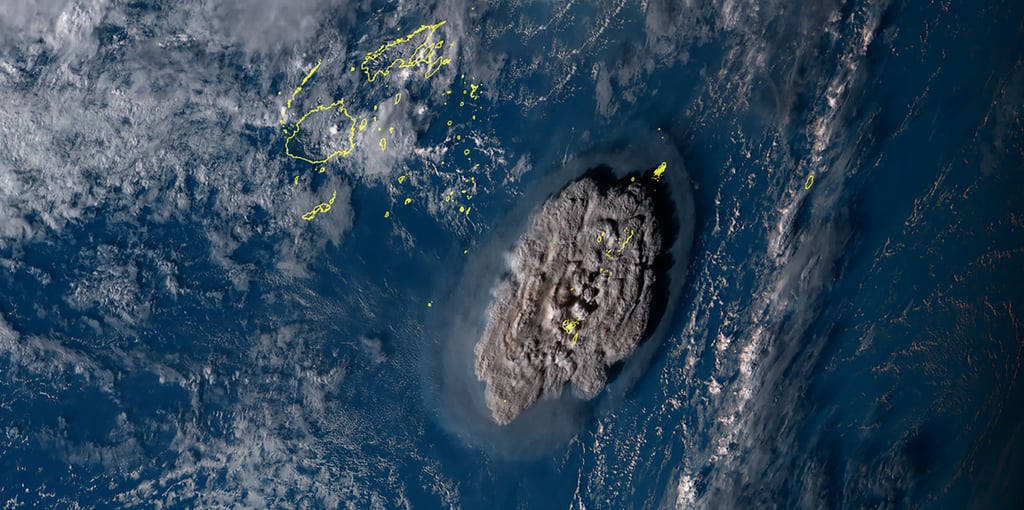
Hunga Tonga-Hunga Ha’apai, an underwater volcano located about 8km (5 miles) from Japan, erupted at around 1.10pm on Saturday Japan time, resulting in a plume of smoke reaching a height of 16km and blanketing the area in a thick film of volcanic dust, according to satellite imagery.
Japan’s weather agency released information at 7.03pm saying slight changes in sea levels were expected but initially denied there was cause for alarm. It later changed its tune and decided to issue a tsunami warning and advisory after tide levels continued to rise along Japan’s Pacific coast from around 8pm.
The tidal changes, which came two-and-a-half hours earlier than expected, did not match the characteristics of a tsunami, the agency said, adding at a press conference later that it “did not know the mechanism”.
Tsunami caused by earthquakes occur when the violent movement of tectonic plates that contain the sea floor creates massive displacement in a body of water. When a tsunami is generated in distant waters, it passes through several observation points before reaching Japan, enabling its size and arrival time to be estimated.
But the phenomenon on Saturday confused weather agency officials as tide level changes were only a few dozen centimetres at Saipan and other observation points between Tonga and Japan, and they changed too quickly for a tsunami.
Experts have theorised that the tidal wave was caused by a shock wave known as an “air tremor” that pushed the sea level down and raised the tide level in coastal areas when it hit Japan.