Advertisement
India
AsiaSouth Asia

India, dependent on fossil fuels, is experiencing an EV boom driven by incentives and cost-conscious customers

  • A US$1.3 billion federal plan to encourage EV manufacturing and offer discounts for customers, along with rising fuel costs are driving up sales, analysts said
  • But the long-term viability for EVs depends on securing supplies of critical minerals needed for batteries, as well as other parts, one analyst said

3-MIN READ3-MIN
Photo: Bloomberg
Associated Press
Groceries stashed in the back of an electric delivery scooter are an increasingly familiar sight in the Indian city of Bangalore. In crowded markets, electric rickshaws drop off and pick up passengers. And the number of tech start-ups focused on electric transport has shot up as the city – and country – embrace electric vehicles (EV).
India is one of the fastest-growing electric vehicle markets in the world and now has millions of EV owners. More than 90 per cent of its 2.3 million electric vehicles are the cheaper and more popular two- or three-wheelers – that’s motorbikes, scooters and rickshaws – and over half of India’s three-wheeler registrations in 2022 were electric, according to an IEA report released in April.

A US$1.3 billion federal plan to encourage EV manufacturing and provide discounts for customers, along with the past decade’s rising fuel costs and consumer awareness of the long-term cost benefits are combining to drive up sales, analysts say.
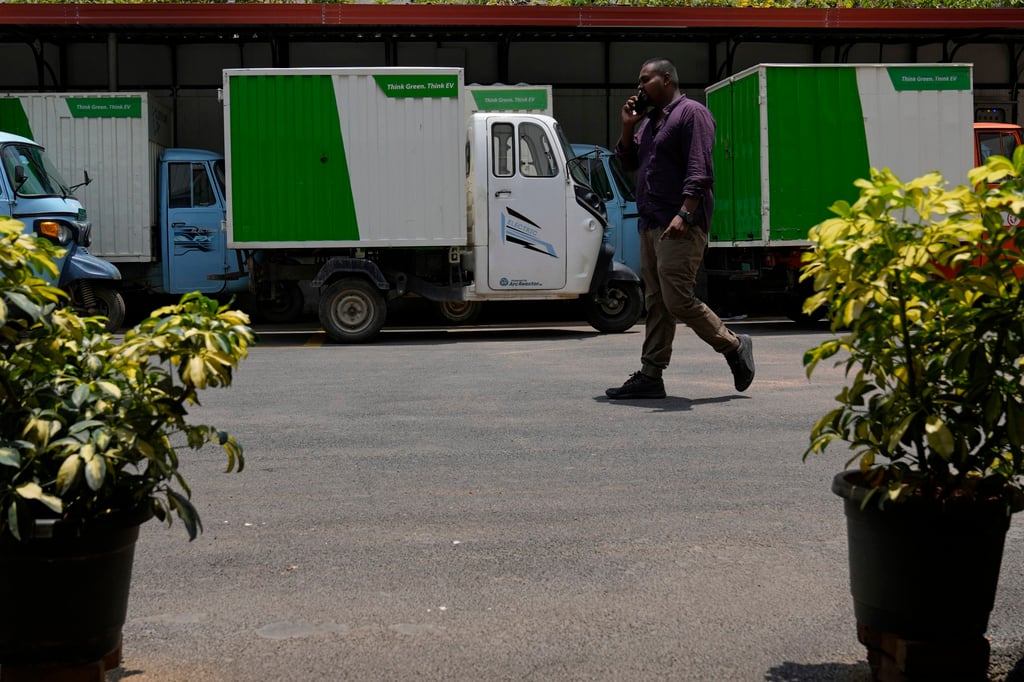
A man walks past electric rickshaws at a logistics company in Bangalore, India. The country is of the fastest growing electric vehicle markets in the world. Photo: AP
Electric vehicles are one solution to bring down planet-warming emissions and improve air quality – with road transport contributing significantly to global emissions. For the electric vehicles market to successfully slash carbon, experts say moving electricity generation away from fossil fuels, managing critical mineral supply chains and boosting EV sales across different socioeconomic backgrounds in the country will be key.
Advertisement

Balaji Premkumar, a 25-year-old rickshaw delivery driver, switched to an EV earlier this year. At most traffic stops he’s surrounded by gas-powered three-wheelers that rumble and rattle, spewing thick smoke into the air – something that his used to do, too, before he went electric.

Premkumar said the new vehicle is easier and more comfortable to drive and he can already see a cost difference.

“If I spend 60 rupees to charge the vehicle for three hours, I get 80 kilometres (50 miles). In a diesel vehicle I’ll be spending at least 300 rupees (US$3.60) to get the same mileage,” he said.

Advertisement
Advertisement
Select Voice
Select Speed
1.00x