Advertisement
To counter China, India will add US$5 billion aircraft carrier to its navy fleet
- The new carrier, which can hold at least 28 fighter jets, will be flying the French Rafale jets, according to people familiar with the matter
- The 3-carrier battle group will be a show of strength for India’s navy in the Indian Ocean at a time when China is increasingly marking its presence
2-MIN READ2-MIN
54

India is set to add another aircraft carrier to its fleet worth almost 400 billion rupees (US$4.8 billion) as it seeks to counter China’s naval presence in the Indian Ocean region, according to people familiar with the matter.
The Defense Acquisition Council – the country’s top defence decision-making body headed by defence minister, Rajnath Singh – is expected to clear the acquisition of its second indigenous carrier on Friday, people with direct knowledge of the development said, asking not to be named because the discussions are private.
The new carrier, which can hold at least 28 fighter jets and helicopters and displaces 45,000 tons of water – a measure of size for ships, will be flying the French Rafale jets, the people said. India’s first home-made carrier, INS Vikrant, joined the fleet last year and was built by Cochin Shipyard Ltd. The country also has a Russia-made aircraft carrier.
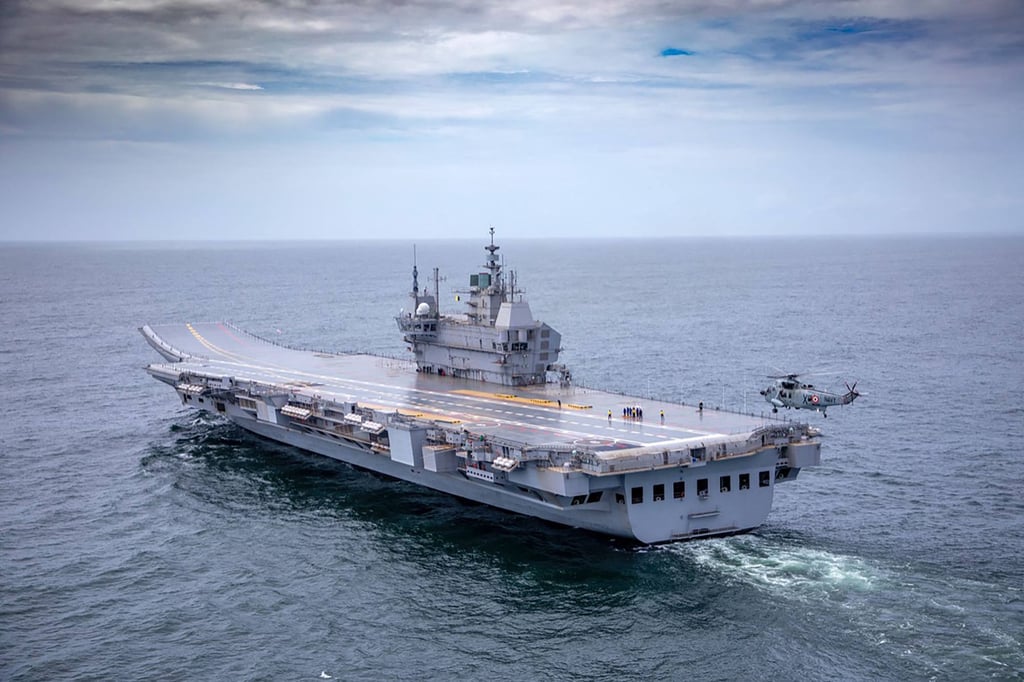
A three-carrier battle group will be a show of strength for the Indian navy in the Indian Ocean at a time when the naval wing of the China’s People’s Liberation Army – the largest navy in the world, with 370 ships and submarines – is increasingly marking its presence in the region.
Advertisement
An enlarged fleet also gives India the ability to exert influence in the seas by being present at many faraway places continuously, the people said.
Representatives for the ministry of defence and Indian Navy declined to comment.
The Indian Ocean is already heavily militarised with as many as 125 naval vessels, including those from the US, France and Japan, roaming its waters any given time, roughly three times the number of vessels deployed in the wake of the September 11 terrorist attacks when the Washington invaded Kabul.
Advertisement
Select Voice
Select Speed
1.00x