Advertisement
India
AsiaSouth Asia

Explainer | Why do India’s general elections take so long to complete?

  • This year’s vote will take 44 days, with results due on June 4, but the duration has varied over the years from just four days to nearly four months
  • Officials from the election commission, which oversees the vote, have to make sure there is a voting booth available within 2km of every voter

Reading Time:3 minutes
Why you can trust SCMP
4
A woman in Hyderabad shows the indelible ink mark on her finger after casting her vote in November’s Telangana state assembly elections. Photo: AP
Associated Press

From April 19 to June 1, nearly 970 million Indians – or over 10 per cent of the global population – are eligible to vote in general elections. The mammoth exercise is the biggest anywhere in the world and will take 44 days before results are announced on June 4.

Prime Minister Narendra Modi is seeking a third successive term. He will face off against a broad but flailing alliance of opposition parties that are struggling to challenge his appeal.

Most surveys predict Modi’s Hindu nationalist Bharatiya Janata Party will win comfortably, cementing him as one of the country’s most popular and consequential leaders.
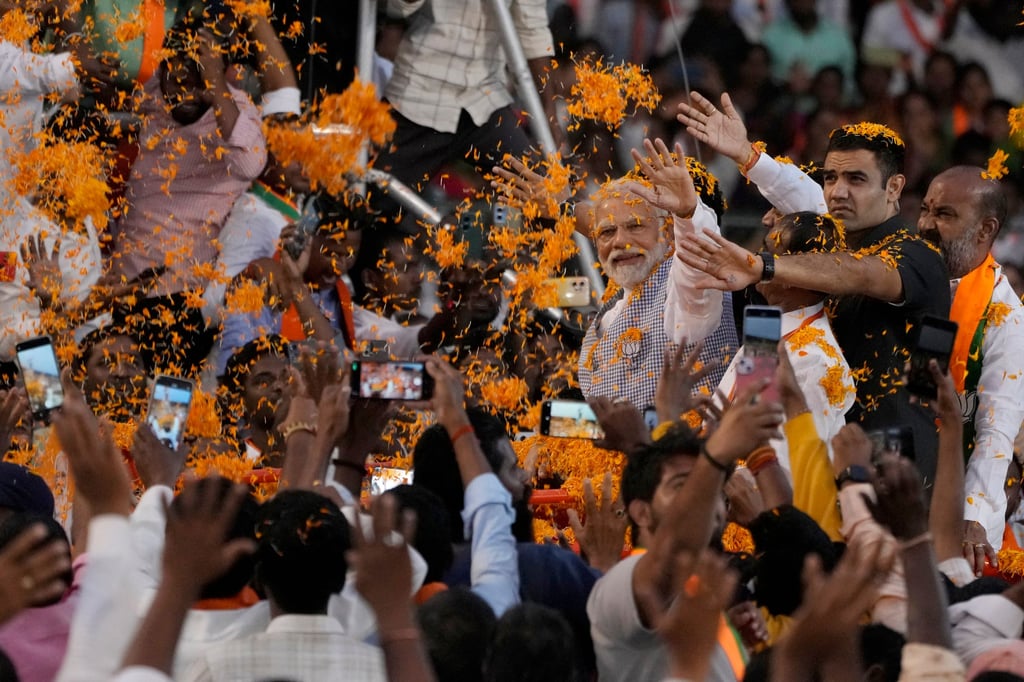
Indian Prime Minister Narendra Modi greets supporters as he arrives for a campaign rally in Hyderabad last year. Most surveys predict he will comfortably win a third successive term. Photo: AP

Why does it take so long?

It boils down to two key reasons: the sheer size of India, the world’s most populous country, and the astonishing level of logistics needed to ensure that every registered voter is able to cast their ballot.
Advertisement

Over the years, the duration of voting has wavered. It took nearly four months to complete the vote in India’s first elections in 1951-1952, after it gained independence from British rule, and just four days in 1980. In 2019, voting took 39 days, and this year’s election is the second longest.

With 969 million registered voters, the size of India’s electorate is bigger than the combined population of the European Union.
Advertisement

The vote to choose 543 lawmakers to the lower house of parliament takes place over seven phases. India’s 28 states and eight federal territories will vote at different times. Each phase is one day, with the first kicking off April 19 and ending on June 1.

While some states will cast their ballots in a day, voting elsewhere may take longer. Uttar Pradesh, the largest state the size of Brazil with 200 million people, will vote on all seven days, for example.
Advertisement
Select Voice
Choose your listening speed
Get through articles 2x faster
1.25x
250 WPM
Slow
Average
Fast
1.25x