Advertisement
Indonesia’s Joko Widodo pledges to create jobs and cut bureaucracy as he’s sworn in for 2nd term
- Jokowi’s inauguration was attended by several foreign dignitaries including Chinese Vice-President Wang Qishan and Singapore PM Lee Hsien Loong
- He vowed to develop the country’s human resources, overhaul the inefficient bureaucracy and move out of the middle-income trap by 2045
4-MIN READ4-MIN

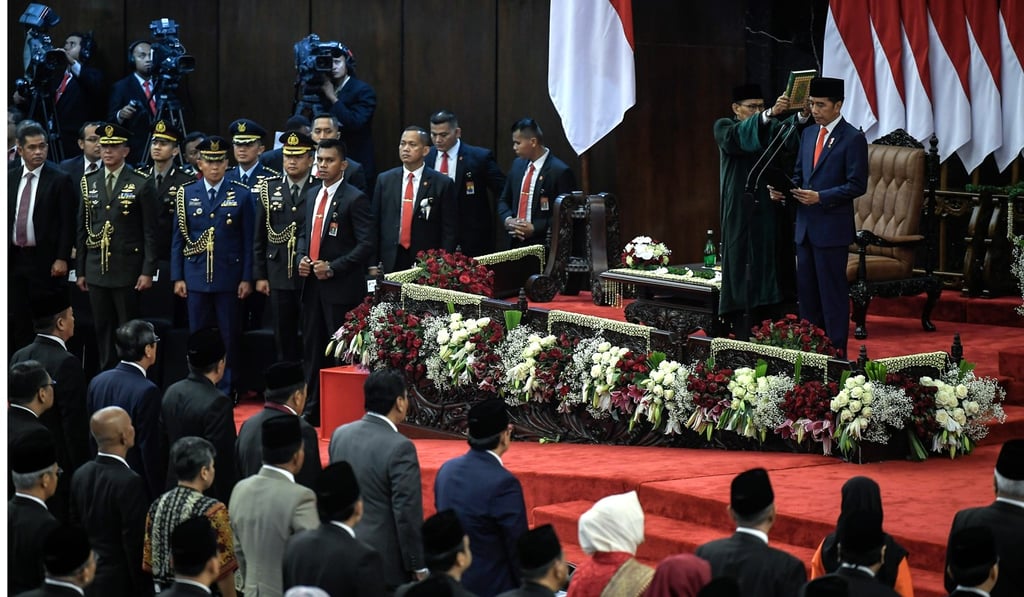
Indonesia’s President Joko Widodo was on Sunday sworn in for his second and final term as the leader of the world’s most populous Muslim country, amid tight security in the capital.
Jakarta was on high alert with over 30,000 police and military personnel deployed to secure the city after the stabbing of the country’s top security minister Wiranto on October 10 by an Islamic State-linked militant. Wiranto was seriously wounded.
Several foreign dignitaries were present at the ceremony, including Australian Prime Minister Scott Morrison, Chinese Vice-President Wang Qishan, Singapore Prime Minister Lee Hsien Loong, Cambodian Prime Minister Hun Sen and Malaysian Prime Minister Mahathir Mohamad. Japan and the United States sent special envoys.
Advertisement
“In the name of Allah, I swear to fulfil my duties as the president of the Republic of Indonesia to the best of my abilities and as just as possible,” Widodo, 58, said as he took the oath with a copy of the Koran held above his head during the brief ceremony before the 711-member People’s Consultative Assembly, the upper house.
Advertisement
Widodo, commonly known as Jokowi, pledged to develop the country’s human resources, move Indonesia out of the middle-class trap to be one of the world’s top five economies by 2045, overhaul an inefficient, corruption-riddled bureaucracy, and reform outdated laws which are a hindrance to development.
“However, none of that will come automatically, and will not come easily,” he said in his speech.
Advertisement
Select Voice
Select Speed
1.00x