
China will be kept out of Comprehensive and Progressive Trans-Pacific Partnership, US senator predicts
- Beijing ‘will not meet the standards’ and behaves ‘in a predatory fashion’, according to Senator Bill Hagerty, who is involved in trade issues
- A former top Chinese trade negotiator says the central role of state-owned companies should disqualify China as a CPTPP candidate
Members of a Pacific Rim-focused trading bloc that China is trying to join will likely not allow Beijing in based on the country’s track record on market access, said a Republican US senator involved in trade issues.
“I am not surprised that the CCP’s rhetoric is that they would like to enter the CPTPP,” Hagerty said on the sidelines of the annual Washington Council of the Americas, referring to the Chinese Communist Party. “They will not meet the standards.”
“I cannot imagine a set of circumstances that the other members that have already acceded to that treaty would accommodate a country that behaves … in a predatory fashion,” he added.
The comments by Hagerty – a member of Senate committees on appropriations, foreign relations and banking – put him on the side of lawmakers opposed to the CPTPP, a later version of the Trans-Pacific Partnership, which former president Donald Trump pulled out of soon after he took office in 2017.
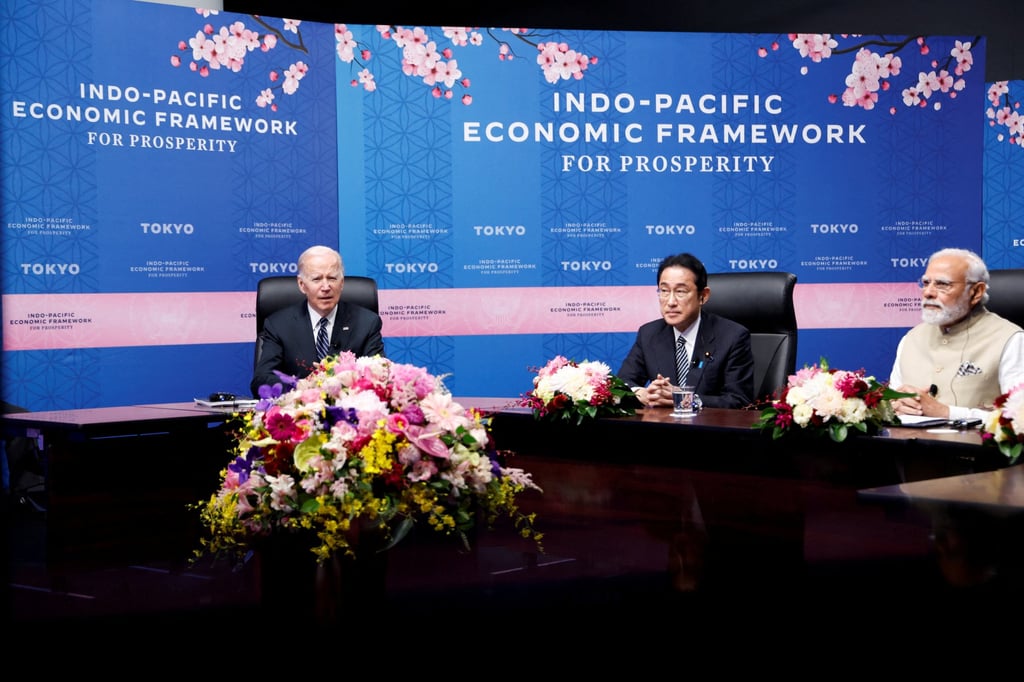
US President Joe Biden’s administration has also been cool to the idea of countering China by re-engaging with CPTPP members, and has offered his Indo-Pacific Economic Framework instead.
Britain reaches agreement to join trans-Pacific trade pact
China’s commerce ministry said in October that it was “reaching out to, communicating and talking with” CPTPP members in accordance with the trade deal’s accession procedure, the country’s Ministry of Commerce said.
Beijing’s former top trade negotiator Long Yongtu has fought back against claims that the central role of state-owned companies should disqualify China as a CPTPP candidate by noting that Singapore and Vietnam also have many such enterprises.
Biden and Kishida pledge to strengthen US-Japan ties as a counter to China
Hagerty said the US needed more agreements with reciprocal market access, and promoted the US-Japan Free Trade Agreement as an example of what the US government should be focused on.
Under the terms of that accord, the US reduced or eliminated 241 tariffs on mostly industrial goods, including machine tools and steam turbines, as well as some niche agricultural products, such as green tea. Japan did the same for about 600 agricultural products including beef, pork and cheese.
“The underlying theme has to be reciprocity,” Hagerty said. “It can’t be just about opening up for the US market and making our companies more vulnerable.”
“We have to have … a two-way opportunity, and I think that’s the lens that we need to look at any trade, whether it’s the CPTPP or any other sort of multilateral [trade deal],” he added. “They’re hard to do.”

