Advertisement
US-Japan summit preview: Joe Biden and Fumio Kishida expected to raise defence, diplomacy as China looms
- Joined by the Philippine president, leaders will showcase ‘support and solidarity’ for common vision of South China Sea, White House official says
- US ambassador to Japan describes Tokyo as pivotal in ‘latticework’ strategy, but analysts say much remains politically vulnerable
5-MIN READ5-MIN
37

Defence and diplomacy will top the agenda when US President Joe Biden and Japanese Prime Minister Fumio Kishida meet on Wednesday in the first such bilateral summit in Washington since 2015, focusing on deterrence amid China’s rapidly expanding military footprint.
The two leaders will then join a trilateral summit on Thursday with Philippine President Ferdinand Marcos Jnr as the Biden administration works to bolster its network of Indo-Pacific economic and security agreements amid growing tension in the waters around the Philippines.
“What you will see is a strong string of support and solidarity among our three leaders for a common vision of a South China Sea that is governed by international law,” Mira Rapp-Hooper, White House senior director for East Asia and Oceania, said on Tuesday.
Advertisement
“We are continuing to innovate the groupings with whom we’re working closely, adding to the fit-for-purpose latticework that we are using throughout the Indo-Pacific,” she added.
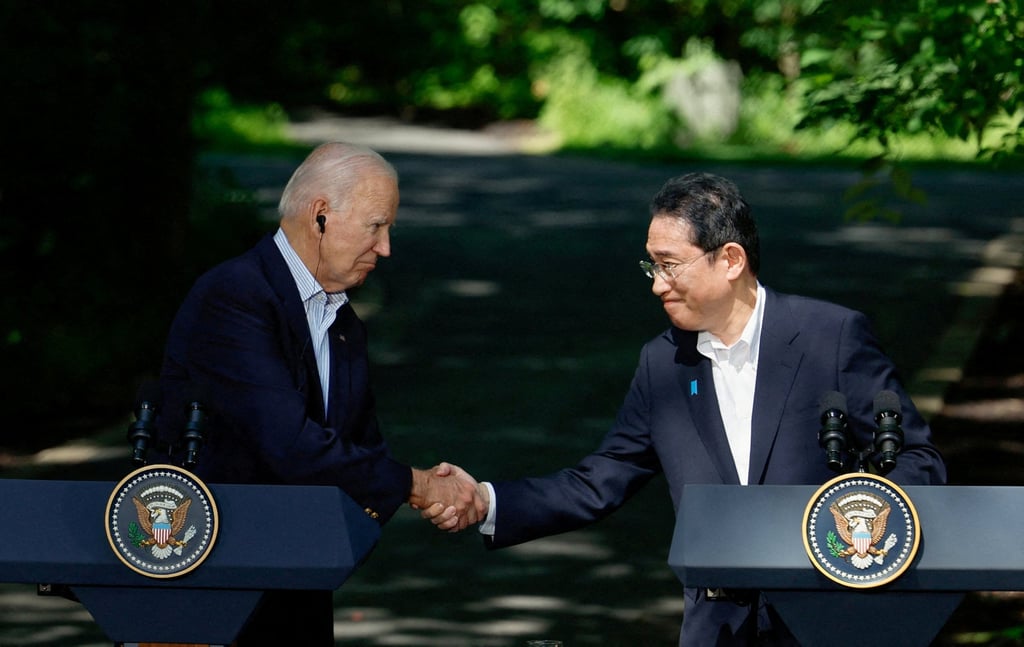
A significant part of Wednesday’s US-Japan summit is likely to centre on streamlining the two respective military bureaucracies so that the Pentagon and Japan’s Self-Defence Forces can react quickly and efficaciously in the event of a conflict with China or North Korea.
Advertisement
“Our two countries are working together with a clearer understanding of the importance of closer coordination … as we establish that joint operational command,” said Shigeo Yamada, Japan’s ambassador to the US, at the Centre for Strategic and International Studies, a Washington think tank.
Advertisement
Select Voice
Select Speed
1.00x