Don’t read too much into Tillerson’s choice of words in Beijing
US Secretary of State used Chinese diplomatic phrases in a statement, but that may not signal anything about the Trump administration’s intent

While in China during his inaugural visit to the Asia-Pacific region as US secretary of state, Rex Tillerson, the former chief executive officer of oil behemoth ExxonMobil, used a certain set of Chinese diplomatic phrases in a statement before his meeting with his Chinese counterpart, Wang Yi.
In the United States, a subset of Asia-Pacific analysts read this as a distressing sign that Tillerson – a novice in the world of foreign policy – was underbriefed and underprepared for the world of carefully telegraphed Chinese diplomatic signalling.
Tillerson said that the US-China relationship had been “a very positive relationship built on non-confrontation, no conflict, mutual respect, and always searching for win-win solutions”. His language nearly echoed verbatim the language that Chinese President Xi Jinping had delivered to former US President Barack Obama in 2014, at the White House.
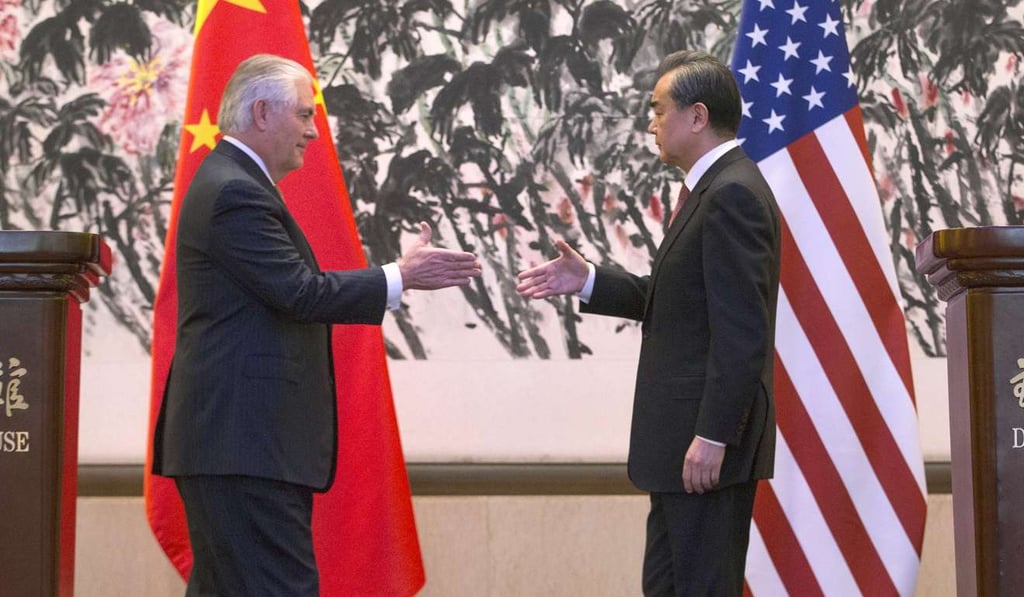
In a sense, Tillerson’s language could be read as an endorsement of Xi’s central project in managing Washington-Beijing ties since he took over the leadership of the Chinese Communist Party – namely, that the United States should respect China’s sensitivities in the South China Sea, East China Sea and over other questions related to China’s so-called “core interests”, which additionally cover Taiwan, Tibet and Xinjiang and have broadened under Xi’s leadership.
Depending on which US analysts of the relationship with China one speaks to, impressions of Tillerson’s use of these terms are different. First, the Shanghai Communique of 1972 – one of the foundational bilateral documents that sets the baseline for contemporary bilateral US-China relations – mentions the phrase “mutual respect”, suggesting that Tillerson may have been intending to evoke this older formulation of US-China ties.