Advertisement
US-China trade war
ChinaDiplomacy

From Huawei charges to new tariff threats from Donald Trump: jolts keep buffeting US-China trade talks

  • Mixed messages and the appearance of US disconnect have been the norm during the months of up-and-down negotiations
  • ‘When Trump pays attention, it tends to throw a monkey wrench in the works,’ a US analyst says

6-MIN READ6-MIN
US President Donald Trump threatened to increase tariffs on US$200 billion worth of Chinese goods just as a Chinese delegation was scheduled to resume trade talks in Washington. Photo: AFP
Mark Magnierin New York
Months after Huawei Technologies chief financial officer Sabrina Meng Wanzhou landed in Vancouver for what was supposed to be a routine layover, she remains a bit player in a US-China stand-off over trade tariffs, next-generation 5G telecommunications and alleged espionage. The extradition process could take months, even years, on US charges that she and the company violated Iran sanctions and stole trade secrets.

This month marks two benchmarks of sorts, five months since Meng was detained and a year since a breakdown in talks that were meant to avert a trade war that has seen over US$360 billion in tariffs imposed on goods moving between the world’s two largest economies.

Vice-Premier Liu He and a large delegation of Chinese officials are scheduled to arrive in Washington this week to begin what could be a final round of talks, although a tweet by US President Donald Trump on Sunday threatening to raise tariffs on another US$200 billion worth of Chinese goods has added to the uncertainty.
Advertisement

Trump’s latest salvo is not likely to scare Beijing into bowing to US demands and could be counterproductive, some said.
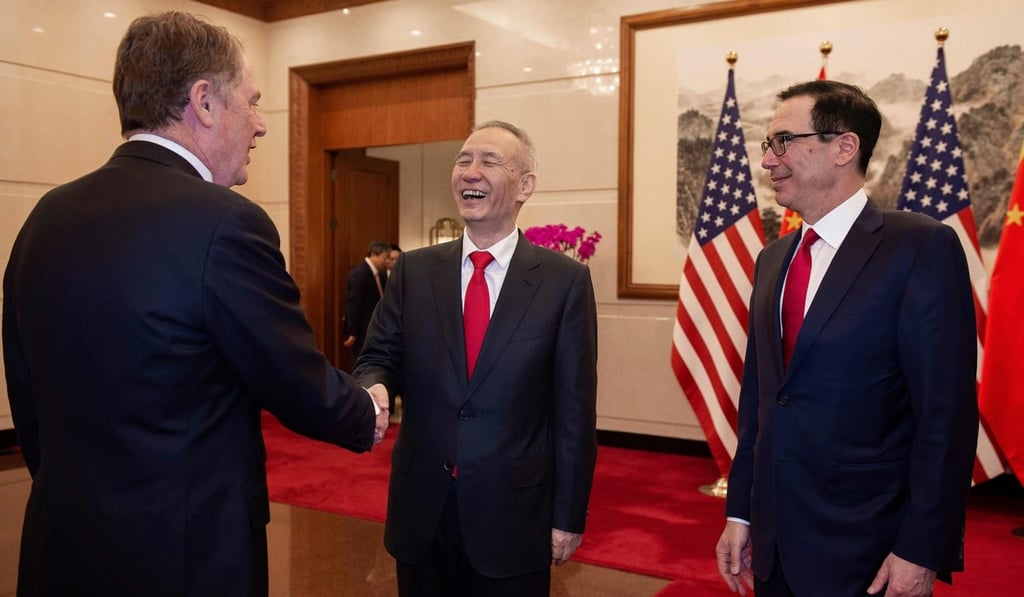
Chinese Vice-Premier Liu He shake hands with US Trade Representative Robert Lighthizer (left) as US Treasury Secretary Steven Mnuchin looks on in Beijing on March 29. Photo: AFP
Advertisement

“I doubt Trump’s negotiating technique will do any good for him,” said Weihuan Zhou, a senior lecturer at Australia’s University of New South Wales. “Trump may think that threatening higher tariffs will force China to move. I think China will respond, but it won’t compromise on its fundamental interests.”

The high-profile trade battle is only one of many irritants roiling markets and spurring tension between the US and China. As Washington struggles to develop a cohesive response to China’s economic and military rise, the Huawei case underscores some of the difficulties it faces, including those of its own making.

Advertisement
Select Voice
Select Speed
1.00x