Advertisement
Advertisement
Belt and Road Initiative
Get more with myNEWS
A personalised news feed of stories that matter to you
Learn more
Construction workers at the Sonangol refinery in Luanda, Angola. China’s two policy banks have not made any new general-purpose commitments to Sonangol and other firms in the extraction and pipelines sector since 2017, according to the study. Photo: AFP

China’s overseas development loans at lowest level in recent years as it shifts to ‘small is beautiful’ projects, study finds

  • Lending from China Development Bank and China EximBank has been on downward trend for several years after a long boom, researchers say
  • It is emblematic of the recent Chinese approach to economic engagement that prioritises smaller and more targeted projects, according to author
China’s two policy banks extended 28 new loans worth US$10.5 billion in 2020 and 2021, a new study shows – the lowest in recent years as Beijing makes a strategic shift to what it calls “ small is beautiful” projects.

The lending from China Development Bank (CDB) and the Export-Import Bank of China (China EximBank) represents a continued decline in Chinese overseas development finance since it peaked in 2016, according to data compiled by the Boston University Global Development Policy Centre.
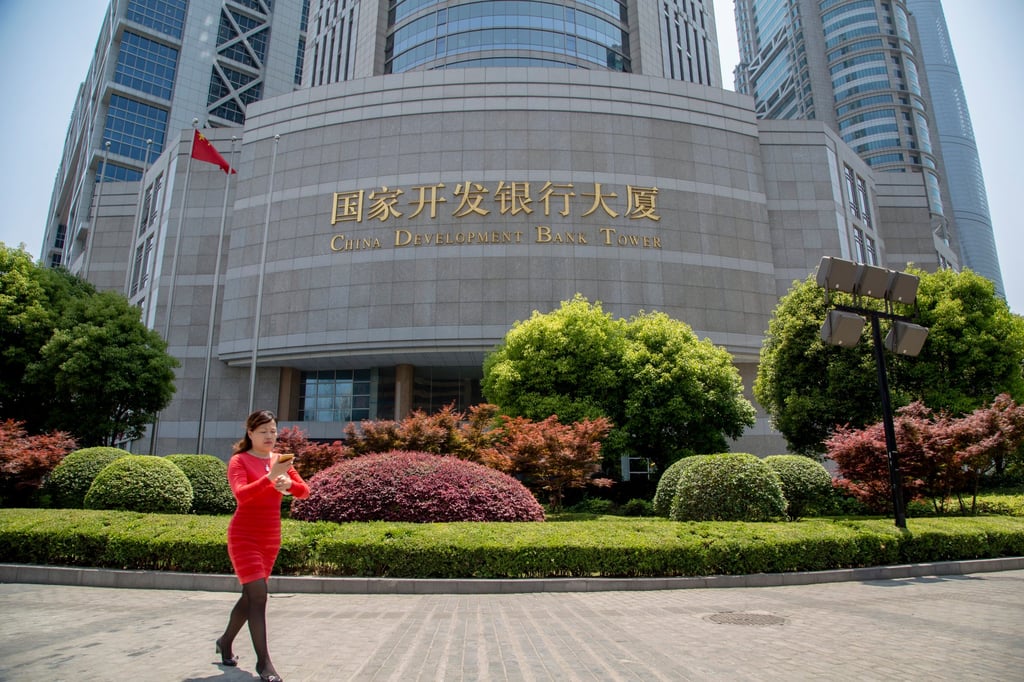
Its study found that overseas development finance from CDB and China EximBank has been on a downward trend for several years after a long financing boom for projects under the multibillion-dollar Belt and Road Initiative.
Researchers say CDB and China EximBank extended 28 new loans worth US$10.5 billion in 2020 and 2021 – the lowest level in recent years. Photo: LightRocket via Getty Images

Some 1,099 Chinese overseas development finance commitments – totalling US$498 billion – were made to 100 countries between 2008 and 2021, according to China’s Overseas Development Finance Database, which is managed by the Boston University centre.

Rebecca Ray, a senior academic researcher at the centre and the author of the study, said China’s overseas development finance had fallen in total value but also in terms of the average loan commitment size.

“This trend is emblematic of the ‘small is beautiful’ approach to Chinese economic engagement in recent years, which prioritises smaller and more targeted projects,” Ray said, adding that it “emphasises projects with smaller geographic footprints and lower risks to sensitive ecosystems and Indigenous communities”.

China’s infrastructure loans are putting overseas coasts at risk: study

Addressing the third belt and road symposium in November 2021, President Xi Jinping said high-quality “small and beautiful” projects, which are sustainable and improve people’s livelihoods, should be a priority in overseas cooperation. China’s central bank has since issued new regulations capping external lending by the country’s banks.

Ray said that while China has shifted away from its most ambitious years of development finance, it has continued to lend in more measured ways, increasingly going for “smart and small” – prioritising high-quality, targeted support over large-scale general support.

According to the study, loan commitments in 2021 were limited to just two sectors: transport and public administration. Transport lending was limited to one project where planning began well before the Covid-19 pandemic but the loan was signed in the last year – the 24km (15-mile) Dhaka-Ashulia Elevated Expressway in Bangladesh.

Public administration and discretionary finance included loans for trade finance and general budgetary support for Angola, Pakistan, Sri Lanka, Trinidad and Tobago, and Turkey. Rather than starting new projects, this lending represents support for countries as they emerge from the pandemic and return to previous growth and infrastructure development trajectories.

The study said transport remained the only specific sector with loan commitments in 2021, representing a larger trend over the last several years. As overall lending has fallen dramatically, support for transport has fallen by less than for other sectors.

This was “unsurprising” given that transport is a core theme of belt and road lending, according to Ray.

01:25

China-funded infrastructure across Africa force difficult decisions for its leaders

China-funded infrastructure across Africa force difficult decisions for its leaders

She said the shift away from general-purpose support for oil and gas state owned enterprises (SOEs) and public-private partnerships (PPPs) was another example of China’s move towards “small is beautiful” overseas lending.

Further, general-purpose lending to SOEs and PPPs in the extraction and pipelines sector like Angola (Sonangol), Brazil (Petrobras), Ecuador (Petroecuador), Russia (Rosneft) and Venezuela (PDVSA) accounted for US$60 billion from 2009 to 2017. If these five firms were a country, they would have been the top national recipi­ent of Chinese overseas development finance for that period. But the study said CDB and China EximBank had not made new general-purpose commitments to them since 2017.

It said China’s development finance had been concentrated among its top 10 borrowers – Angola, Argentina, Bangladesh, Brazil, Ecuador, Iran, Kazakhstan, Pakistan, Russia and Venezuela – which account for US$296.3 billion, or 59 per cent, of total loan commitments.

Most of China’s bor­rowers also borrow significant amounts from the World Bank, though for different sectors, according to the study. While Chinese loans are mainly for infrastructure and extraction, World Bank loans have supported health, education and other key public administration sectors.

The researchers also noted that from 2018 to 2021, projects supported by Chinese development finance with geographic footprints have become much less likely to overlap with sensitive territories.

“In this period, 66 per cent of finance for specific projects with geographic footprints had no overlaps with critical habitats, Indigenous peoples’ lands or national protected areas,” Ray said. “This shift is a positive trend for conservation and Indigenous peoples’ rights.”

China tells US to fix own problems before weighing in on African debt

CDB and China EximBank may be unlikely to return to their earlier lending levels, according to Ray. She said that while China’s current account surplus had rebounded, its policy priorities had turned inward in response to the pandemic and its economic impact.

At the same time, the study said, “big borrowers like Argentina and Pakistan have begun to propose ambitious finance projects, but have limited space for new borrowing amid a burgeoning global debt crisis”.

02:35

Belt and Road Initiative explained

Belt and Road Initiative explained

Kevin P. Gallagher, director of the Boston University Global Development Policy Centre, said conditions in China and in host countries were less conducive to large amounts of development finance than they were a decade ago.

“This is concerning, as the need for development finance is at an all-time high due to the polycrisis of financial instability, climate change and pandemic,” Gallagher said.

“Let’s hope this respite is temporary, and that both China and host countries are taking this time to reset development finance to ensure it enables low carbon and socially inclusive growth paths in a manner that is fiscally sound and financially stable.”

The study noted that interest for development finance from developing countries seems to be picking up. It said frequent recipients of Chinese lending, including Argentina and Pakistan, had approached China for financing this year.

“Nonetheless, borrowers’ capacity to take on additional debt is still at reduced levels, as the economic impacts of the Covid-19 pandemic have triggered a global debt crisis,” the study said. “While renegotiations for debt service payments are ongoing, it is unlikely that new issuances of debt will rebound to previous levels.”

3