Advertisement
In a contest of ‘unequals’, China pitches to build a multipolar world
- As G7 leaders met in Japan, China’s president used the timing to court like-minded Central Asian countries
- It was part of Beijing’s drive to offer developing economies practical support instead of ‘acrimony’ and ‘ideological confrontations’, analysts say
5-MIN READ5-MIN
48

Jane Caiin Beijing
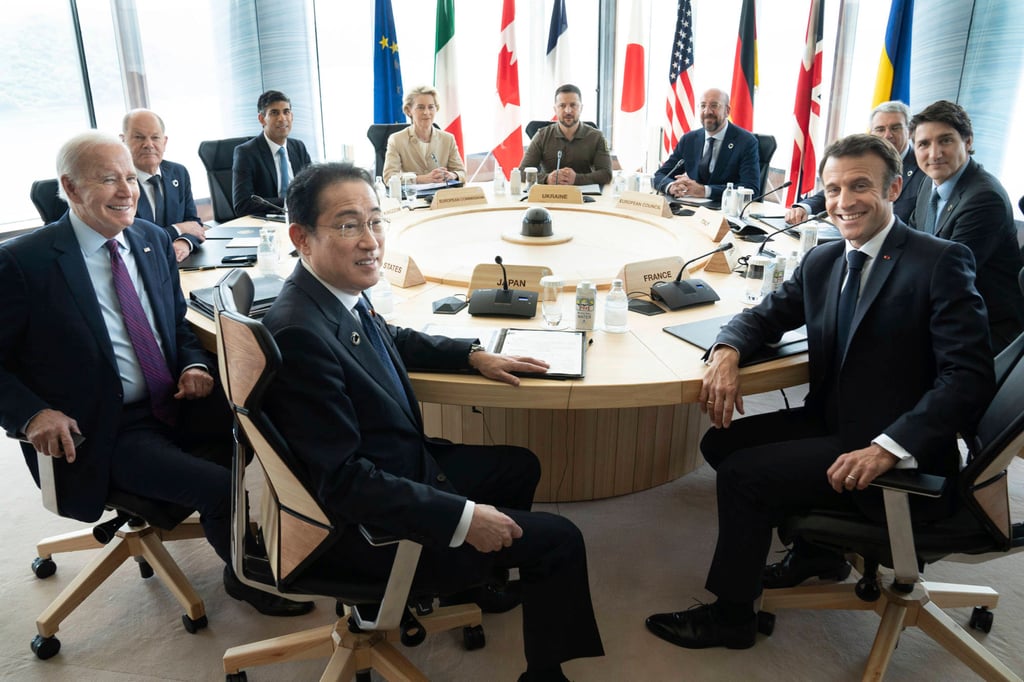
While the leaders of the world’s richest countries met in the Japanese city of Hiroshima and singled out China as a source of their concerns on issues from maritime claims and economic intimidation to human rights, China rolled out the red carpet for leaders from five Central Asian countries in Xian, a city that witnessed the peak of prosperity in China’s imperial dynasties.
The timing of the two-day China-Central Asia Summit in mid-May, which partially overlapped with the Group of Seven summit, underscored China’s efforts to catch up with the United States as a global statesman in a battle for influence amid rising tensions between Beijing and Washington-led Western countries, analysts say.
“The China-Central Asia Summit was a first. The G7 hosts, schedules and summits are mapped well in advance. It would be an extraordinary coincidence if the Central Asia summit wasn’t planned as competition,” said George Magnus, a research associate at Oxford University’s China Centre.
Advertisement
In a communique released at its closing, the G7 industrial powers criticised China for its use of “economic coercion”, militarisation of the South China Sea and “interference activities” aimed at undermining the safety of diplomats, the integrity of democratic institutions and economic prosperity.
The group – consisting of the US, the United Kingdom, Canada, France, Germany, Italy, and Japan, as well as the European Union – also urged Beijing to press Russia to stop its military aggression and withdraw its troops from Ukraine.
At about the same time in Xian, Chinese President Xi Jinping called for the “brethren in Central Asia” to unite against attempts to divide them, and claimed “ethnic conflicts, religious strife and cultural divisions” were not the main theme of the region. He pledged to expand trade and economic cooperation, deepen connectivity and improve energy cooperation.
Advertisement
Advertisement
Select Voice
Select Speed
1.00x